
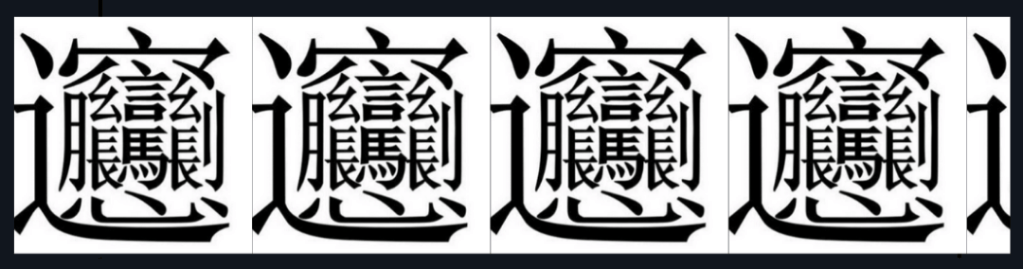
Editor’s note: In “Noodle Insurrection or a Gathering of Radicals”, Jennifer Eagleton intertwines Chinese character radicals with politics, crafting a witty poem around Shaanxi’s biangbiang noodles. She blends linguistic play, cultural history, and insurrectionary imagery, demonstrating radicals’ layered meanings.

A few years ago, during Hong Kong Poetry Writing Month, we were given a prompt to compose a poem using the elements that constitute Chinese characters, known as “radicals”. It proved an intriguing challenge.
These radicals—of which there are 214—are visually prominent components of Chinese characters, under which the character is traditionally listed in a Chinese dictionary. Frequently, one can glean a sense of a character’s meaning from the radicals it contains. For instance, the water radical 水 is most commonly represented in characters as 氵, known as “three drops of water”. The following are some “watery” characters: 泡, 液, 清 (respectively: bubble, liquid, clear/transparent). This method could serve as an excellent means of learning Chinese radicals.
As I often write about language and politics, I wished to find a character that would allow me to draw upon another sense of the noun “radical”: “a person who advocates thorough or complete political or social change, or a member of a political party or section of a party pursuing such aims”, and apply it to the radicals contained within a single character in order to create a story. The character biang (below)—used for a certain type of noodle and composed of many different radicals—seemed to be ideal.
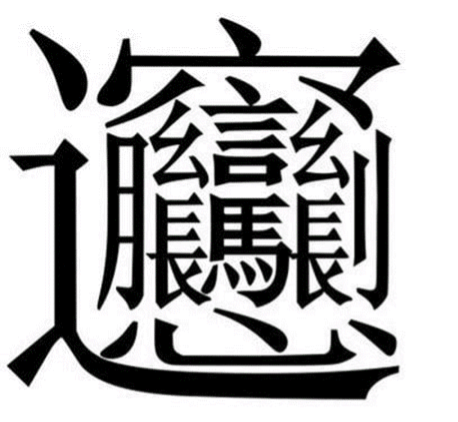
The character biang
Biangbiang noodles, also known as youpo chemian (油潑扯), originate from Shaanxi province. These noodles are likened to a belt, owing to their considerable thickness and length. The standard variant of the traditional character contains 58 strokes. I incorporated the various Chinese radicals embedded within this intricate character into the corresponding sections of the poem. The radical for “thread” (幺), for instance, was placed near the noodle reference, as the noodles are “thread-like” and flat.

Noodle Insurrection or A Gathering of Radicals
by Jennifer Anne Eagleton
This month (月) we supped on Shaanxi noodles,
thick & broad (幺), we scoff them down.
The chilies are red, flavourful, & hot,
but our fervent hearts (心) are even hotter
as we eagerly discuss (言)new schemes
that grew loftier as the night wore on (長).
In the distance, a horse (馬) neighs loudly,
the signal of an approaching stranger.
Tucking our knives (刀) into our belts,
we hurriedly leave the warmth of the cavern (穴),
striding (辶) home with thoughts of insurrection.
How to cite: Eagleton, Jennifer. “Noodle Insurrection or a Gathering of Radicals.” Cha: An Asian Literary Journal, 17 Aug. 2025, chajournal.blog/2025/08/17/biang.


Jennifer Eagleton, a Hong Kong resident since October 1997, is a close observer of Hong Kong society and politics. Jennifer has written for Hong Kong Free Press, Mekong Review, and Education about Asia. She has published two books on Hong Kong political discourse: Discursive Change in Hong Kong (Rowman & Littlefield, 2022) and Hong Kong’s Second Return to China, A Critical Discourse Study of the National Security Law and its Aftermath (Palgrave Macmillan, 2025). Her poetry has appeared in Voice & Verse Poetry Magazine, People, Pandemic & ####### (Verve Poetry Press, 2020), and Making Space: A Collection of Writing and Art (Cart Noodles Press, 2023). [All contributions by Jennifer Eagleton.]
 Cha
Cha 