

📁 RETURN TO FIRST IMPRESSIONS
📁 RETURN TO CHA REVIEW OF BOOKS AND FILMS
Rajan Kurai Krishnan, Ravindran Sriramachandran, and V.M.S Subagunarajan, Rule of the Commoner: DMK and the Formations of the Political in Tamil Nadu, 1949–1967, Cambridge University Press, 2022. 280 pgs.
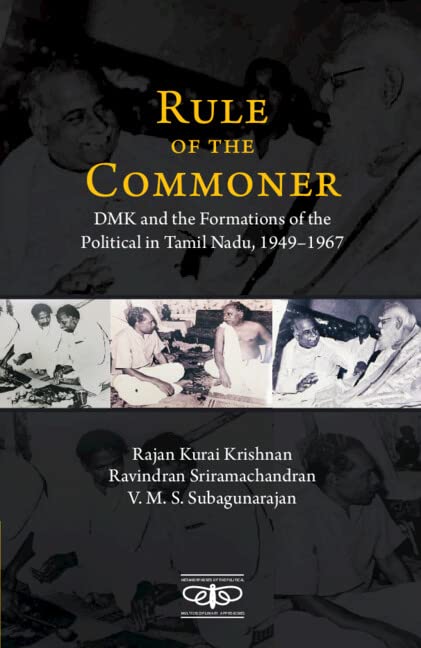
A riveting work of meticulous research and scholarly examination, Rule of the Commoner theorises the genesis and evolution of the Dravida Munnetra Kazhagam (DMK), the political organisation in Tamil Nadu founded by C. N. Annadurai in 1949. Co-authored by Rajan Kurai Krishnan, Ravindran Sriramachandran, and V. M. S. Subagunarajan, the book represents an ambitious fusion of historical narrative, political theory, and literary analysis, foregrounding the DMK’s instrumental role in shaping Tamil populist politics. Organised into three principal sections—“Ideation”, “Imagination”, and “Mobilisation”—it examines the party’s skilful articulation of Dravidian-Tamil identity through cultural politics, public rhetoric, theatrical productions, literary writings, and more, as well as its prolific institution-building across village networks by mobilising mass appeal. Setting the DMK’s rise against the newly emergent national identity, the authors offer incisive readings of shifting hierarchies of caste, class, language, and political power through an interdisciplinary lens, drawing on the theories of Ernesto Laclau, Chantal Mouffe, Charles Ryerson, and Partha Chatterjee, among others.
By probing an array of interlinked questions—spanning nationalism, linguistically driven Tamil ethno-nationalism, caste-class consciousness, grassroots democratic institution-building, and the cultural politics of literature, theatre, oratory, and religio-mythic rewritings—Rule of the Commoner traverses an expansive intellectual terrain. Yet its clarity of structure and research-driven analysis ensure that no single perspective overwhelms the whole. The book applies equal analytical rigour to propaganda pamphlets, leaders’ speeches, grassroots organising, and the processes of identity construction, treating each as an essential strand in the web of political formation. The chapter on “Imagination” is particularly compelling, revealing how literature became the DMK’s political weapon in capturing mass appeal. The authors show how theatrical productions, films, and periodical literature were systematically deployed to disseminate a Dravidian-Tamil identity among the populace. This strategic harnessing of the arts to propel social change distinguishes the DMK from many other socio-political movements of its time.
What is striking about the DMK is how its cultural interventions operated in concert with its political objectives. These varied analyses never appear disjointed—each perspective contributes to understanding the broader phenomenon of how a distinctive Tamil populist identity was constructed and articulated within the Tamil region against the backdrop of dominant nationalist narratives. The book makes clear that such cultural assertion was not merely symbolic but instrumental in forging a new political subjectivity that would transform Tamil Nadu’s political landscape. Rule of the Commoner offers an exceptionally rich account for readers seeking to trace the ideational formation and extraordinary ascent of Tamil Nadu’s still-dominant DMK. Neither reducing the Dravidian awakening to a passing fad nor romanticising it as a utopian project, it maintains a nuanced balance underpinned by substantial evidence. Filling a significant gap in English-language scholarship on Tamil Nadu’s political history, this is a lucid, insightful, and engaging chronicle.
How to cite: Annamalai, Kathiravan. “Politics of the Plebs—Rule of the Commoner: DMK and the Formations of the Political in Tamil Nadu.” Cha: An Asian Literary Journal, 12 Aug. 2025, chajournal.blog/2025/08/12/the-commoner.


Kathiravan Annamalai is a Research Scholar in the Department of English at Pondicherry University. His doctoral research explores comparative perspectives in the dramatic literature of the Harlem Renaissance and the Dravidian Movement. His broader research interests encompass Indian Literature in English, Subaltern Studies, Drama, and Translation Studies. He has presented papers at various national conferences and has published research articles in peer-reviewed academic journals. [All contributions by Kathiravan Annamalai.]
 Cha
Cha 