

📁 RETURN TO FIRST IMPRESSIONS
📁 RETURN TO CHA REVIEW OF BOOKS AND FILMS
Click HERE to read all entries in Cha on Vigil.
Jeffrey Wasserstrom, Vigil: The Struggle for Hong Kong, Brixton Ink, 2025. 176 pgs.
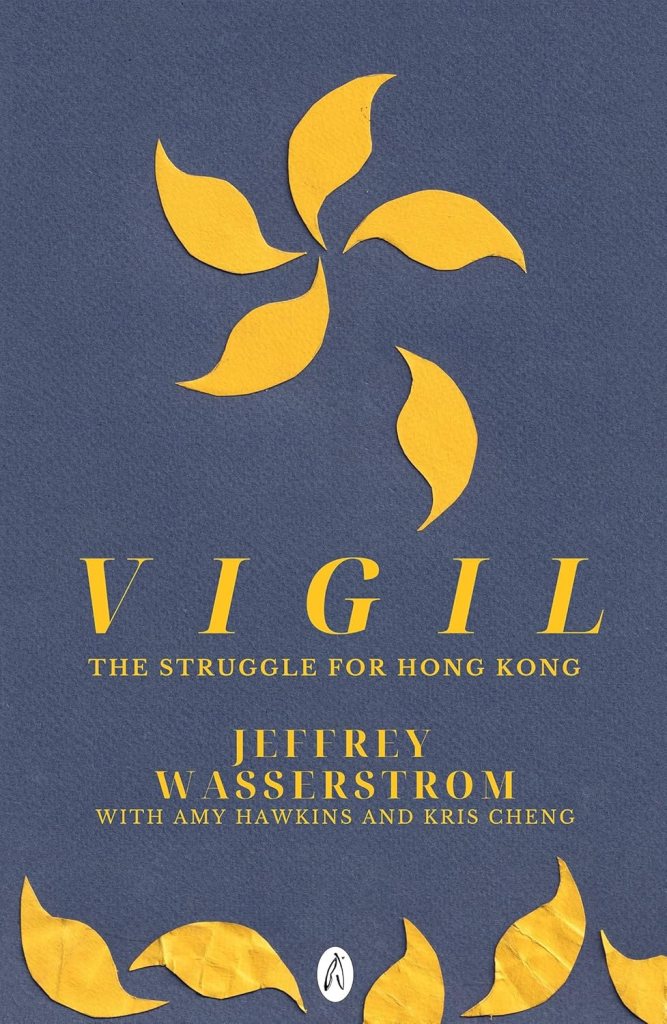
Jeffrey Wasserstrom’s Vigil: Hong Kong on the Brink was first published in early 2020, capturing the urgency and global visibility of the 2019 Hong Kong protests. A slim yet potent primer, it offered international readers a lucid, compassionate account of a city in revolt. In her 2020 review for Times Higher Education, Tammy Lai-Ming Ho described it as an “engaging work from a writer with an unwavering passion for Hong Kong,” commending its ability to blend historical depth with literary texture. Five years on, Vigil returns in a new edition—not merely reissued, but reframed—enriched by a Preface from Wasserstrom himself, a Foreword by journalist Amy Hawkins, and an Afterword by former Hong Kong Free Press editor Kris Cheng. This new paratextual scaffolding transforms the original chronicle into something weightier, more haunted—a postscript to a vigil that is now, quite literally, banned.
Published amid the ongoing trial of Jimmy Lai, renewed national security charges against Joshua Wong, and a wave of foreign judges resigning from Hong Kong’s Court of Final Appeal, the 2025 edition arrives at a moment when the past is not only being rewritten but actively erased. Meanwhile, the rise in cross-border consumption from Hong Kong into the Greater Bay Area symbolises an uneasy pivot from political resistance to economic assimilation. In this climate, the reappearance of Vigil invites not only remembrance, but reckoning. What began as a modest act of documentation now reads as diasporic memory work—a layered form of historical witnessing by, for, and beyond Hongkongers.
What’s New:
Preface, Foreword, Afterword
◯
The three new texts that frame this edition each adopt a distinct mode of address: elegiac remembrance, journalistic immediacy, and personal-political testimony. Together, they deepen the scope of the original book and shift its tone from anticipatory to mournful.
Wasserstrom’s Preface begins with a quiet revelation: the last time he attended the June 4th vigil in Victoria Park, in 2019, proved to be the final legal gathering of its kind. What was once a ritual of public mourning has become criminalised remembrance. His recollections of exchanging updates with Amy Hawkins, then a Beijing-based journalist, lend the book a cross-border intimacy that echoes Hong Kong’s own hybrid identity—a city suspended between visibility and vulnerability.
Hawkins’ Foreword is unflinching. She opens with a stark statistic: by January 2024, nearly 300 individuals had been arrested under the National Security Law or colonial-era sedition legislation. Yet beyond the numbers, it is the attrition of everyday freedoms that cuts deepest. Independent bookstores shutter under pressure; screenings of politically ambiguous films like Zhang Yuan’s Beijing Bastards (1993) are held with the title obscured in black marker. Quoting the founder of a Hong Kong publishing house, Hawkins observes that “people are quickly adjusting to the idea that the old days of public expression are no more.” The effect is chilling not because it is unprecedented, but because it has become routine.
Kris Cheng’s Afterword shifts from the collective to the personal. A former editor and eyewitness to countless protests, Cheng recounts the disillusionment following the Umbrella Movement, the sudden reawakening of 2019, and the slow attrition of hope that followed. His anecdotes—of masked protesters’ eyes “filled with anger and determination,” of journalists harassed, of Denise Ho’s surreal online concert performed in a shuttered bookstore under police surveillance—are devastating in their quiet accumulation. One can almost feel the city’s breath growing shallower.
Together, these three additions do more than extend the book’s temporal reach—they revise its tonal register. The cautious hope of 2019, embedded in Wasserstrom’s original narrative, now appears as a historical artefact—eclipsed by structural violence, mass emigration, and a silence so total it verges on the operatic.
Reassessing the Original Vigil
◯
When Vigil first appeared, its strength lay in Wasserstrom’s ability to situate Hong Kong’s immediate crisis within a longue durée of imperial handovers, civic awakenings, and contested sovereignties. Episodic yet coherent, the book moved through key events while threading in references to Tiananmen, the Umbrella Movement, and Cold War Berlin. Symbols carried weight: water became a metaphor for fluid defiance, masks for collective solidarity, and disappearance—a recurring trope—for the state’s tightening grip on dissent.
Wasserstrom wrote not as a distant scholar but as a Western observer aligned with local voices, attentive to the affective textures of protest. Yet he maintained a studied humility, frequently deferring to local journalists and cultural producers. That posture—admirable in 2020—feels newly significant in 2025: the act of citation becomes a strategy of preservation.
Some analogies now read as painfully prescient. His comparison of Hong Kong to West Berlin—a city symbolic, surveilled, yet globally seen—resonates in a time when visibility itself is contested. Likewise, the framing of the 2019 marches as “among the largest in the history of the world” now stands in bitter contrast to the dismembering of civil society that followed. The frame remains—the picture has changed.
The 2025 reader thus encounters Vigil not as a living document, but as a lament. The book’s original ending, which suggested that “many things may become clearer” in 2020, now reads like a line from a tragedy whose final act is already known.
From City to Diaspora:
Vigil in Exile
◯
If the original Vigil was born of street-level encounters and candlelit gatherings in Victoria Park, the 2025 edition is a product of exile—curated between Irvine and London, and issued not by a New York press (Columbia Global Reports), but by Brixton Ink, a small diasporic imprint. The book itself, in its new form, has become a transnational artefact: no longer merely documenting the Hong Kong protests, but embodying the memory infrastructure of a city in retreat.
The Tiananmen vigil in Trafalgar Square—recounted in the Preface—serves as a subtle inversion of the Victoria Park gatherings that once marked Hong Kong as the last outpost of Chinese civil remembrance. That square in central London, now one of the few public spaces where such vigils remain legal, becomes a surrogate stage—a floating platform for displaced rituals. In this configuration, Vigil reads not only as a record of protest, but as a piece of portable memory: part pamphlet, part eulogy, part reliquary.
This diasporic repurposing is echoed in the Afterword’s haunting reference to Denise Ho’s 2024 “performance”—staged online at a shuttered bookstore under surveillance by a dozen police officers. Just as Victoria Park has been emptied of its symbolic power, Hong Kong’s once-vibrant protest culture now re-emerges only in fragments—scattered across time zones, mediated through encrypted channels, or whispered in borrowed languages. Meanwhile, in the digital realm, the state’s successful effort to suppress the protest anthem Glory to Hong Kong even beyond its legal jurisdiction mirrors the silencing of memory within the city’s borders.
In this light, Vigil performs a dual function. It stands as a form of civic commemoration—preserving the language, rhythms, and metaphors of a movement that dared to “be water.” But it also affirms the resilience of diasporic Hongkongers who, in the face of erasure, continue to rewrite their history in exile. The candle may no longer burn in Victoria Park, but it flickers still—across books, kitchens, protests, and vigils scattered across the globe.
The Broader Struggle:
Milk Tea and Memory
◯
If Vigil is a quiet testament to the specificity of Hong Kong’s crisis, Wasserstrom’s The Milk Tea Alliance: Inside Asia’s Struggle Against Autocracy and Beijing (2025) opens the aperture, positioning Hong Kong within a broader regional cartography of resistance. Wasserstrom traces the emergence of an informal coalition of digital activists across Thailand, Taiwan, Myanmar, and beyond—united not by political doctrine but by aesthetics, meme culture, and a shared antipathy towards authoritarianism. The symbolic beverage itself—sweet, caffeinated, customisable—becomes an avatar of flexible solidarity and digitally mediated dissent.
Together, Vigil and Milk Tea Alliance form a diptych. Where Vigil is local, elegiac, and tethered to place, Milk Tea Alliance is comparative, mobile, and future-oriented. The former documents the final moments of a city’s autonomy; the latter traces emergent patterns of post-national protest. Vigil laments a dismantled polity; Milk Tea Alliance imagines a transnational community still in formation.
Yet their convergence lies not in genre, but in function. Both books resist the logic of erasure. Both insist on memory as action. As Hongkongers abroad increasingly identify with the fate of Tibetans, Uyghurs, or Burmese dissidents—rather than with the abstract “Chinese” identity promulgated by Beijing—the psychic map of Asia is redrawn along lines of dispossession and diaspora. As Hawkins observes in the Vigil Foreword, the affinity with mainland reformers has faded; imagined solidarity now lies with other stateless or semi-stateless peoples who “feel the threat of the Chinese Communist Party far more acutely than people who left several years earlier.”
In this light, Milk Tea Alliance is not a sequel to Vigil, but its spectral double. If Vigil records the extinguishing of Hong Kong’s civic flame, Milk Tea Alliance carries that flame—fluctuating, migratory, digital—across borders and bodies. Between them, the two works offer not closure, but continuity: a testament to how memory moves when cities are seized and voices are forced to scatter.
Vigil for the Future
◯
A vigil, in its oldest sense, is a liminal act: a watchful waiting between night and day, mourning and hope. In its 2020 form, Vigil captured the world’s attention at the edge of such a threshold—when Hongkongers stood defiantly on the brink, still able to chant, assemble, and remember. The 2025 edition, reframed by exile, suppression, and silence, renders that threshold into something else entirely: not a space of waiting, but one of witnessing.
With its new Preface, Foreword, and Afterword, Vigil is no longer simply a book about protest—it is itself an act of remembrance. What it records is not only the political momentum of 2019, but the ways in which memory has since been fragmented, relocated, and reshaped. In a city where candles are now confiscated, songs erased, and vigils criminalised, this slender volume performs the function of a diasporic palimpsest—layering testimony upon testimony, and shadowing the official history with a counter-history that survives through print, conversation, and digital transmission.
The poignancy of Vigil in 2025 lies not only in what it says, but in the very fact that it continues to exist. It circulates now as contraband memory—as a record of a freedom that has been legislated out of public space, yet still flickers in private. That the book can still be read, reviewed, and republished—across courts, across continents—is itself an act of defiance. The vigil has ended in Hong Kong, but Vigil endures, its pages carrying what the city no longer dares to say aloud.
How to cite: Wong, Wayne. “Hong Kong Remembered and Rewritten: Jeffrey Wasserstrom’s Vigil.” Cha: An Asian Literary Journal, 6 Aug. 2025, chajournal.blog/2025/08/06/wasserstrom-hong-kong.


Wayne Wong is a Lecturer in East Asian Studies at the School of East Asian Studies, University of Sheffield. He holds a joint PhD in Film Studies and Comparative Literature from King’s College London and the University of Hong Kong. His work has appeared in peer-reviewed journals including Asian Cinema, Global Media and China, Journal of Contemporary Chinese Art, and Martial Arts Studies. He is currently collaborating with artists, curators, filmmakers, and charitable organisations in the United Kingdom on the Hong Kong–UK diaspora—exploring new modes of expressing Hong Kong diasporic identity through cinema, exhibition, and the performing arts.
 Cha
Cha 