
茶 FIRST IMPRESSIONS
茶 REVIEW OF BOOKS & FILMS
[REVIEW] “The Worst Kind of Dystopia: Hon Lai Chu’s Mending Bodies” by Luca Griseri
Click HERE to read all entries in Cha
on Mending Bodies.
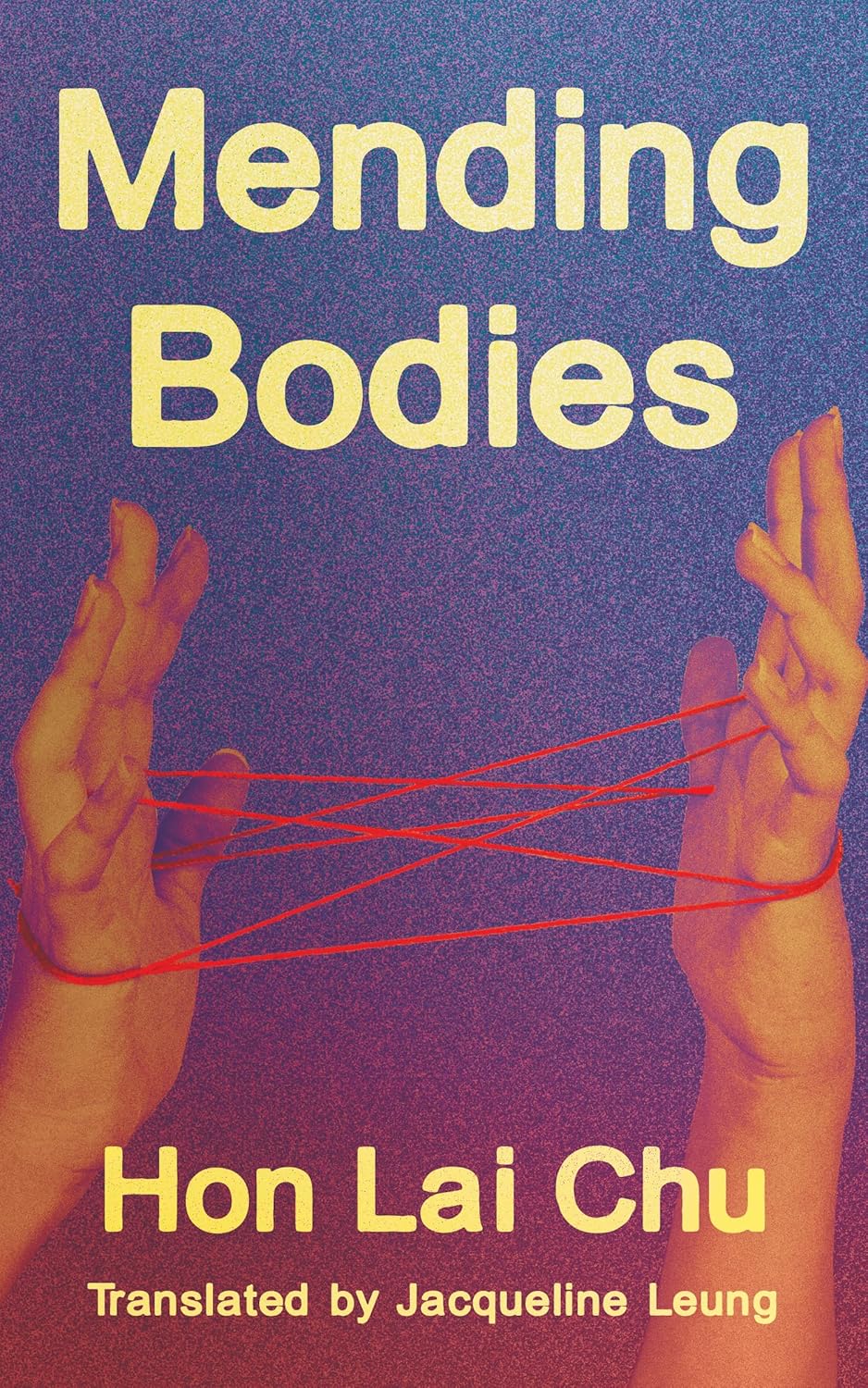
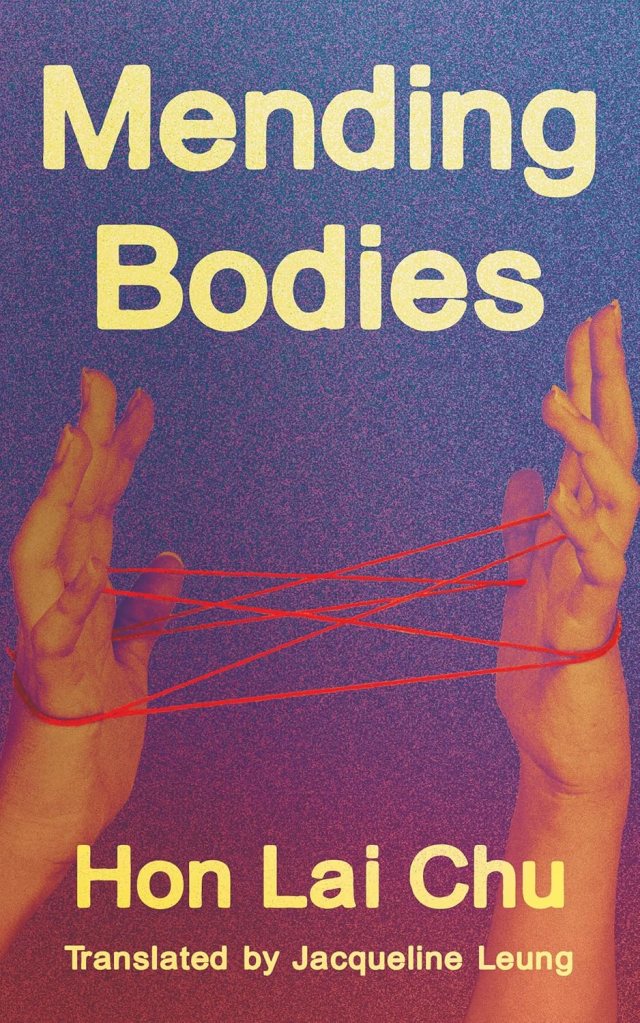
Hon Lai Chu (author), Jacqueline Leung (translator), Mending Bodies, Two Lines Press, 2025. 240 pgs.
For those who haven’t read the original Chinese version of Mending Bodies, this review contains some spoilers.

The climactic scene of Mending Bodies, Hon Lai Chu’s novel recently translated into English by Jacqueline Leung, calls to mind the story in Amos Tutuola’s The Palm-Wine Drinkard, when the “perfect gentleman” reveals himself to be no more than a collection of borrowed body parts—returned, one by one, as he departs the village: first his left foot, then the right, followed by his stomach, and so on, until only his skull remains. Hon Lai Chu is not concerned with linguistic experimentation or narrative audacity but, much like the Nigerian writer, she poses urgent questions about identity and co-dependency in the dramatic finale of Mending Bodies.
Crucially, such a harrowing conclusion is central to how the unnamed protagonist—a restless university student—responds to the absurd fictional premise around which the plot revolves: the Conjoinment policy that encourages citizens to surgically attach themselves to another person. Both the protagonist’s final act and the macabre legislation invite multiple interpretations, not only as allegories of social realities (as suggested in other reviews published in this magazine—a perhaps unsurprising parallel, given that the story unfolds in an unnamed city modelled on Hong Kong), but more broadly as meditations on social imposition, agency, and the complexities of human relations.
INESCAPABLE ALIENATION,
OVERWHELMING PRECARITY
◯
Mending Bodies, originally published in 2010, is animated by preoccupations that are central to the author’s broader body of work. Not only does it employ a surreal plot to explore bodily transformation and social control—themes that feature prominently in Empty Faces and indeed in much of Hon Lai Chu’s fiction—but more specifically, it examines solitude and interpersonal intimacy, a leitmotif also present in the six stories that comprise The Kite Family.
As Mary, the protagonist’s roommate and closest confidante, observes, “everyone lives in their own world, but to avoid conflict, we fake companionship as if we’re all kindred spirits.” People drift apart—the protagonist from Mary, and from her family—and interpersonal bonds prove brittle and fleeting at best: “maybe I was the one to disappear first, and in that time, this man had seized his chance to take up the space I’d left.” Conjoinment intensifies this alienation: those who undergo the procedure escape “one kind of solitude, only to fall into another”, defined by stifling conversations and unrelenting boredom. In this sense, the original title (縫身, “Sewn Bodies”), with its emphasis on forcibly conjoined individuals, more precisely conveys the novel’s pervasive sense of fragmentation.
As much as it is a tale of alienation, this is also a story of precarity. At its core, instability is the very reason for conjoining: the realisation that “modelling was a short career” renders the procedure a seemingly rational option for Aunt Myrtle. More broadly, a sense of insecurity pervades the narrative—because, aside from the perverse logic embedded in the Conjoinment Act, very little true mending takes place. Nothing and no one ever truly comes together, let alone is repaired.
Upon reflection, Mending Bodies might be read as a Bildungsroman sui generis. It charts the transition from the promise and idealism of youth to a new life stage marked by the end of studenthood. Yet the only discernible trace of personal or intellectual development is the sobering realisation that what once appeared permanent is, in fact, temporary and fragile. As ever, Mary articulates it best: “our selves tend to grow and shed like hair when we least expect it.”
SPACES OF CONFORMITY &
SPACES OF DEVIANCE
◯
But the thread that most vividly connects Mending Bodies to the broader body of Hon Lai Chu’s work is the exploration of how internalised and unquestioned social norms construct limitations and boundaries. In a novel that is, at its core, an investigation of how individuals navigate divergent social spaces, this theme is most powerfully realised in the ultimate space: society itself.
This is a realm of pressure and conformity, where identities are shaped and expectations imposed. Governed by various figures of authority—doctors, teachers, and family members alike—it is regulated by a formidable bureaucracy, exemplified by the lawyers who meticulously outline the ramifications of conjoinment, ensuring the widespread adoption of societal norms.
In Hon Lai Chu’s vision, society discourages originality. It renders the interrogation of one’s identity difficult—let alone the pursuit of alternatives to the norms it upholds and, for better or worse, imposes upon its members. At its foundation lies the curtailment of agency, made evident in the way the protagonist seems almost to stumble upon her decision to undergo the conjoinment procedure. Her motivation is not rooted in conviction; she shows little concern for her conjoinment partner and openly admits, “it was not my decision, nor was it any individual’s decision… maybe things were already irrevocably changed, and we were inevitably doomed.”
If conjoining is something foisted upon her—quietly, by stealth—and endured under the weight of social pressure; if it is essentially a codified set of “rules laid down by other people” (and, crucially, internalised as such), then those who submit to it need not reckon too deeply with its consequences. This is the other side of the erosion of agency, and Mary articulates it with striking clarity when she reassures the protagonist: she need not worry “that it’s a bad decision, because it’s not a decision, but an obligation.”
Alongside this vast terrain of conformity, there remain liminal spaces where one might briefly reclaim a sense of self and temporarily forget society’s expectations and “the habits that one has normalised and that bound us”: the hotel to which the professor takes the protagonist; the room she shares with her fellow student; Aunt Myrtle’s separation consultancy, housed in a derelict building seldom visited; and the clandestine surgeries where unlicensed doctors perform separations—uncannily reminiscent of illicit abortion clinics. Within these spaces, a modicum of agency may be recovered—and, indeed, must be exercised—for they permit decisions to be made, rather than obligations to be merely endured.
THE NATURAL STATE OF THINGS
◯
In truth, the Conjoinment policy has become so thoroughly internalised, so widely accepted, that these liminal zones can never fully counterbalance the overwhelming pressure to acquiesce—pressure whose apparent naturalness is reinforced in various ways.
First, the author elides any discussion of the policy’s historical or sociopolitical origins. The narrative unfolds at least thirty-five years after the implementation of the Conjoinment Act (as evidenced by Aunt Myrtle’s backstory—fifteen years spent conjoined, followed by the establishment of her consultancy two decades prior to the present action). This chronological distance allows Hon Lai Chu to bypass a detailed exposition of the policy’s genesis, which is mentioned only in passing as speculative rumour. At the same time, Mending Bodies devotes more attention to the banal and bodily inconveniences of conjoinment—adjusting to walking, sleeping—than to its broader social implications. This emphasis on the ordinary subtly underscores how naturalised the policy has become.
The narrative’s narrow focus further intensifies this impression. Centred on a melancholic protagonist who exhibits little in the way of civic consciousness (aside from the occasional, half-formed desire to protest), the novel unfolds in a tone of quiet reverie rather than social critique. This is most evident in the protagonist’s internal reflections—often among the novel’s most lyrical passages—which highlight her introspective nature and her reluctance, or inability, to connect her personal malaise to larger structural forces.
Confronted with such conditions, and further reinforcing the sense that the Conjoinment procedure has been fully absorbed into the fabric of everyday life, the general public responds with a kind of weary resignation. They may not be wholly indifferent, as the narrator suggests, but they scarcely register the increasingly surreal prognostications about their city’s future. After all, as May remarks, to live a successful life one must be “more compliant and good at developing firm beliefs”—provided, of course, that those beliefs align with those sanctioned by others.
A WORSE KIND OF DYSTOPIA
◯
In truth, this tone of alienation and resignation is not the only lens through which a dystopian story might be told—and the novel’s premise could easily have lent itself to a very different kind of narrative. One, for instance, in which the protagonist possessed a more developed social consciousness and a firmer resolve; or one that led readers back to the origins of the policy itself, examining how citizens initially responded to its implementation. Perhaps even a version that, in elaborating the social implications of such absurd legislation, explored its repercussions across a spectrum of social actors. For example, a novel in which Aunt Myrtle took centre stage—opening the way for a richer analysis of the societal fractures caused by the Conjoinment Act.
But Hon Lai Chu has written no such novel. Instead, she has offered a claustrophobic account of a hopeless individual who commits a tragic and unforgivable act. The protagonist’s final instructions allow her to reclaim a measure of agency and carry profound resonance through their Tutuola-like symbolism: they stand as a physical reminder of the plurality that constitutes the self, in defiance of a system bent on suppressing difference. More fundamentally, they reaffirm the idea that identity can—and should—be multifaceted. By ending the novel in this way, the author suggests that the pressure to conform can be evaded only through a disaggregation of the singular identity that society insists upon.
Crucially, the protagonist harbours no illusion that her final gesture might acquire broader social meaning, or even that it might resonate with others on a personal level. On the contrary—she anticipates it will be trivialised, quickly forgotten. It is, in her view, a purely private act: an individual’s escape from the suffocating strictures of collective life. This is a pivotal point, for society can only be a space for difference if non-conforming actions retain significance—and if there are still those willing to recognise, understand, and value them. But this is not the case in Mending Bodies, where acquiescence has long since taken root.
Thus, in choosing to write the story she has, Hon Lai Chu reveals a more insidious kind of dystopia—one more disturbing than the Conjoinment policy itself, and more tragic than the desperate act to which an individual might be driven. The society she depicts is dystopian because it has relinquished the hope that genuine mending remains possible; that interpersonal connection might endure beyond the fleeting; that a discordant act might still carry meaning beyond the self; and that someone, somewhere, might be willing to remember a solitary gesture.
How to cite: Griseri, Luca. “The Worst Kind of Dystopia: Hon Lai Chu’s Mending Bodies.” Cha: An Asian Literary Journal, 21 Jul. 2025, chajournal.con/2025/07/21/bodies.


Luca Griseri (he/him) studied history and postmodern philosophy in his native Italy. After obtaining an MBA from the University of Warwick (UK), he embarked on a career in marketing and over 18 years lived in London, Kuala Lumpur and Singapore. He is currently based in Penang, where he indulges in his passions: running, hiking in the forests and eating street food. [All contributions by Luca Griseri.]
 Cha
Cha 