
📁 RETURN TO FIRST IMPRESSIONS
📁 RETURN TO CHA REVIEW OF BOOKS AND FILMS
Kim Won‑seok (director), When Life Gives You Tangerines, 2025. 16‑episode Netflix original series, split into four volumes.

Falling under the category of K-drama, When Life Gives You Tangerines is Netflix’s latest slice-of-life series, released globally on 7 March 2025. Directed by acclaimed South Korean filmmaker Kim Won-seok, it features Moon So-ri, Park Hae-joon, IU, and Park Bo-gum in the principal roles. Spanning sixteen episodes, the series unfolds in the form of a non-linear scrapbook, delicately stitching together the scattered fragments of its characters’ lives. Set between the coastal village of Dodong-ri on Jeju Island and the urban sprawl of Seoul, the narrative oscillates from 1951 to the 21st century, centring on Oh Ae-sun (portrayed by both IU and Moon So-ri), her lifelong love Yang Gwan-sik (played by Park Bo-gum and Park Hae-joon), their families, and their children—Yang Geum-myeong (IU, in a dual role) and Yang Eun-myeong (Kang You-seok).
The series’ title not only subverts the familiar proverb “when life gives you lemons,” but also invites viewers to confront the raw, elemental emotions of love, anger, loss, compassion, and guilt. It unravels the bittersweetness of life through its slow-burning, immersive narrative. At its core is the intergenerational saga of Ae-sun and Gwan-sik. Frequently described as “heart-wrenching” or an “emotional journey,” the series charts the enduring struggle to meet adversity with fortitude—that is, the pursuit of resilience. While it may follow the arc of a rags-to-riches tale, the quest for prosperity is portrayed as a generational endeavour.
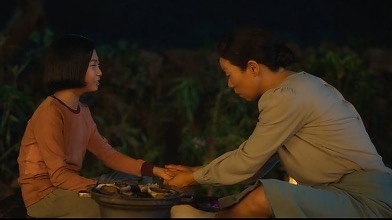
Oh Ae-sun shares an emotional moment with her mother, Gwang-rye, as she gently applies balsam flower paste to her daughter’s fingers—a quiet gesture of hope for better days to come.
This narrative of resilience begins with the hardships faced by the haenyeo community of Jeju Island, as embodied in the life of Jeon Gwang-rye (Yeom Hye-ran), Ae-sun’s mother. Following the death of her husband, she toils relentlessly to sustain her family, braving unceasing adversity. Ae-sun is sent to live with her paternal grandparents so that she might escape hunger and survive—a quiet testament to the silent sacrifices that shape generations.
However, the mother–daughter duo struggles to coexist under the same roof. Ae-sun dreams of becoming a poet and shines as a gifted student. The tanginess of life strikes with an emotionally devastating tragedy, forging Ae-sun into a fierce woman, hardened by the perils of poverty. She marries Gwan-sik, who had stood by her side like a shadow throughout her childhood and adolescence. After marriage, Ae-sun assumes the role of homemaker—largely due to the traditional expectations of Gwan-sik’s shaman grandmother, Park Mak-cheon (Kim Yong-rim).
With limited resources and a large family to sustain, Ae-sun aspires to offer her daughter the education and opportunities that she herself was denied. As Mak-cheon’s worldview clashes with Ae-sun’s aspirations, Gwan-sik makes a decisive choice—he leaves the family home with Ae-sun and their daughter, moving into a rented dwelling. Though the couple continues to struggle to make ends meet, they ensure their beloved daughter never goes to bed hungry.
After confronting the abuse of the fishing boat captain, Bu Sang-gil, they face the severe consequence of unemployment. Yet, in a gesture that feels both like a gift and a blessing from Gwang-rye—delivered through Kim Chun-ok (Na Moon-hee), Ae-sun’s paternal grandmother—the couple receives financial support sufficient to purchase a fishing boat. The boat arrives as both symbol and salvation, coinciding with the birth of their second child, Yang Eun-myeong. With a tangible improvement in their circumstances, they are finally able to secure a permanent residence.
Just as spring begins to offer comfort, life delivers a cyclonic blow—the couple is confronted with the most devastating loss a parent can endure.

Gwan-sik in a moment of disorientation, grappling with the profound loss he faces as a parent.
The couple poured their hearts into rebuilding their lives, quietly soothing their emotional fissures for the sake of their children. Geum-myeong grew into a bright student and was admitted to Seoul National University. The narrative then shifts to her struggles in Seoul, where she grapples with limited financial means. There, she meets her first love, Park Yeong-bum (Lee Jun-young), whose life is rigidly controlled by his mother. Geum-myeong takes up illegal private tutoring and later secures a job at a cinema ticket counter to supplement her income.
The conflict intensifies when she is offered an opportunity to participate in a student exchange programme in Japan—an opportunity she must decline due to financial constraints. Her frustration and sense of deprivation are projected onto her parents, who, in a gesture of self-sacrifice, sell their ancestral home in Jeju and move into a modest apartment to fund their daughter’s travel. As time passes, the couple also struggles to raise Yang Eun-myeong, who yearns for the same validation his sister receives as the family’s ‘golden child’. They are ultimately forced to sell their fishing boat to support him.
This sibling duo, burdened by guilt and responsibility, attempts to repay the mounting debt and carry the emotional weight of having lost both their family home and their parents’ only source of livelihood. Upon her return from Japan, Geum-myeong faces heartbreak and the daunting task of securing employment amidst the Korean Financial Crisis of 1997. It is during this turbulent period that she finds both love and a life partner in an old friend—yet her struggle for stability continues.
In their old age, the couple chooses to open a modest squid noodle soup shop in a suburban area far from the bustle of the city. After an initial period of hardship, fortune begins to favour them—their kindness and resilience are returned in abundance. With the support of old friends from Jeju and their children, they sustain the business. Geum-myeong’s entrepreneurial spirit eventually secures her a stable position in a company where she even appears on television. Just as life seems to settle into grace, Gwan-sik’s health begins to deteriorate under the weight of years of hardship.
In the midst of this, Ae-sun finally fulfils her lifelong dream—her poems are published under her name, Oh Ae-sun. Though the story closes with a poignant loss, it ends with Ae-sun as a teacher in Jeju, residing once more in her maternal home. There, beneath the ancestral tangerine tree, she sips tea with Geum-myeong, her book of poetry beside her—a quiet culmination of resilience and remembrance.

Ae-sun and Geum-myeong at the end of the series, celebrating Ae-sun’s poetry book and freshly harvested tangerines.
Through its neutral-toned visual palette, the series exquisitely captures the quiet strength embedded in each character. Beginning with South Korea’s iconic ‘women of the sea’—the haenyeos, embodied by Jeon Gwang-rye—the narrative honours the endurance of women who sustained their families through the harshest of conditions. Gwang-rye’s fortitude enabled Ae-sun to survive a youth marked by hunger and poverty. This legacy of resilience continues through her granddaughter, Geum-myeong, who endures and overcomes the trials of the 1997 financial crisis.
The series masterfully traces this inherited strength as a thread connecting past and present. With understated elegance, the creators have illuminated the silver linings woven into adversity. It also portrays with great sensitivity the emotional elasticity required by families and relationships to endure crises—those moments that test one’s most deeply held beliefs and shake the very core of one’s dignity.
Through the lives of Ae-sun and Gwan-sik, the creators have distilled the essence of love and compassion within the frame of a lifelong relationship. Their journey establishes an intimate connection with viewers, who come to share in their hardships, failures, compromises, losses, and perseverance—from childhood to old age. This quiet rags-to-riches arc stands as a testament to the human will to endure, even when life takes from you your parents, your child, your home, and even your love. It is a portrait of steadfast resistance—a gentle yet resolute refusal to give up.
Echoing the hopeful tonality of BTS’s song Life Goes On, the series argues that life is unpredictable and uncontrollable, and that what remains within the human grasp is the ability to struggle, to rise, and to continue—for the sake of living. Gwang-rye poignantly captures the spirit of the series, and of life itself, when she says: “One day, life might get so tough that you feel like you can’t go on. Don’t just lie still—struggle with all your might. Tell yourself you won’t die and must survive, no matter what. You’ll be able to breathe again.”
Though emotionally powerful, the series is also suffused with moments of quiet joy—Ae-sun becoming the first female village chief; Geum-myeong’s admission to Seoul National University; and, in her later years, Ae-sun’s fulfilment as a published poet. These modest victories and fleeting joys glimmer through the long shadow of hardship.
While the lives of Ae-sun and Gwan-sik may feel remote to contemporary urban audiences, the character of Geum-myeong acts as a vital bridge—a young woman from Jeju, without financial privilege, striving to build a better future for herself and her family. Her character resonates deeply with younger viewers, serving as a thread that connects them to their parents’ resilience, struggles, and often-unspoken traumas. As the third generation, the couple’s children recognise the value of family, yet their attempts to repay their parents and break the cycle of generational hardship often leave them emotionally exposed. Their story reflects a yearning to overcome inherited sorrow—a determination to transform the pain of poverty into something purposeful.
Geum-myeong’s narrative speaks especially to those “big fish from a small pond” who carry forward their parents’ unwavering love and self-sacrifice as a driving force. Though each episode runs close to an hour and unfolds at a meditative pace, this is more than compensated for by the emotionally resonant performances and the depiction of tender, innocent, and mature expressions of love—between parents and children, grandparents and grandchildren, friends, and lovers.
At its heart, the series is a meditation on resilience—an invisible thread that binds generations and lends life its quiet, enduring meaning.
How to cite: Nayak, Dinisha. “The Sweetness of Resilience: Unraveling Netflix’s When Life Gives You Tangerines.” Cha: An Asian Literary Journal, 15 Jul. 2025, chajournal.blog/2025/07/15/tangerines.



Dinisha Nayak is a research scholar in English from India. Her areas of interest include comics and graphic narratives, as well as Asian American literature. When not immersed in critical reading, she can often be found capturing fleeting thoughts and emotions in her illustrated journal.
 Cha
Cha 