
📁 RETURN TO FIRST IMPRESSIONS
📁RETURN TO CHA REVIEW OF BOOKS AND FILMS
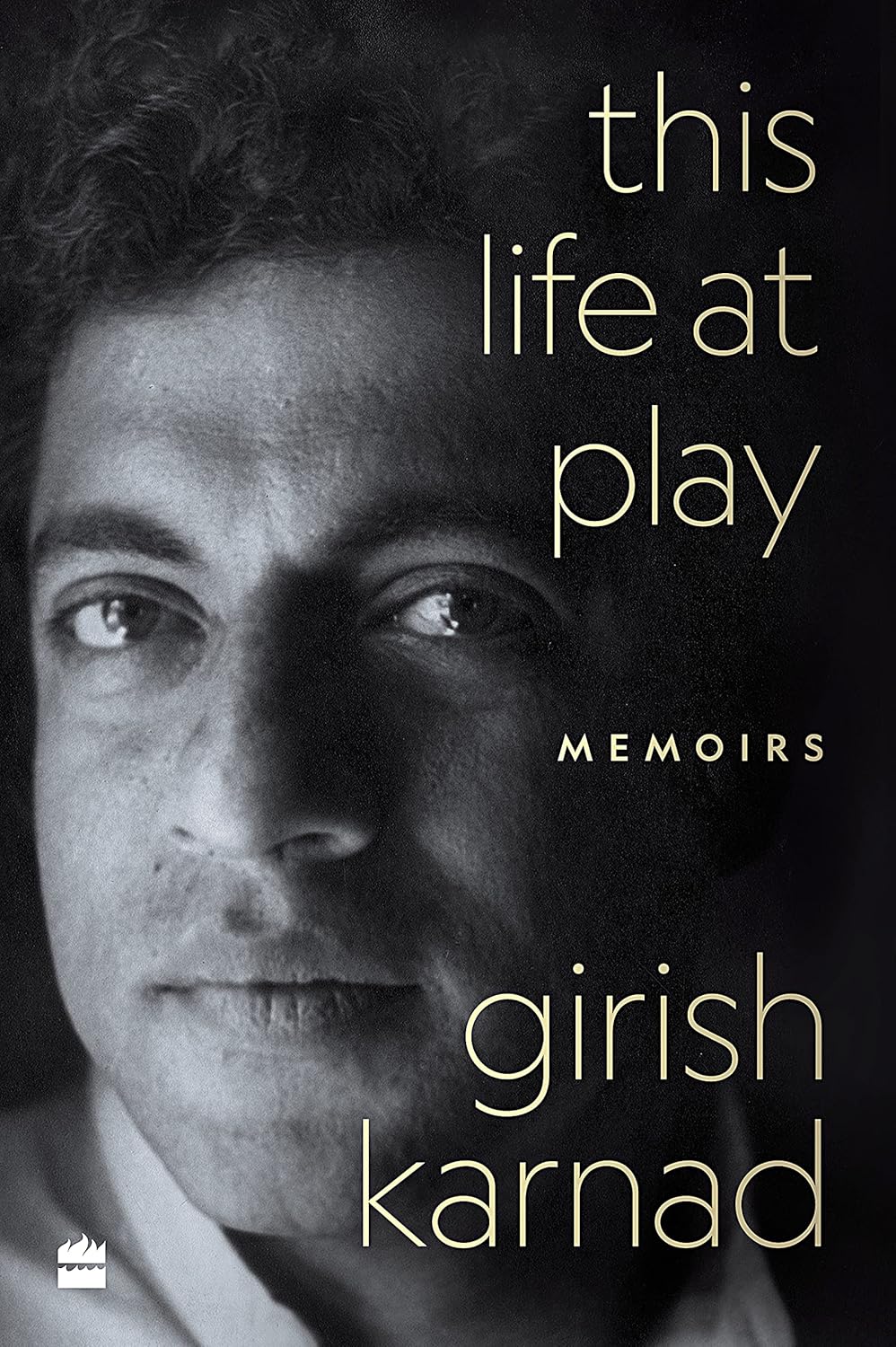
Girish Karnad, This Life at Play: Memoirs, Fourth Estate, 2021. 320 pgs.
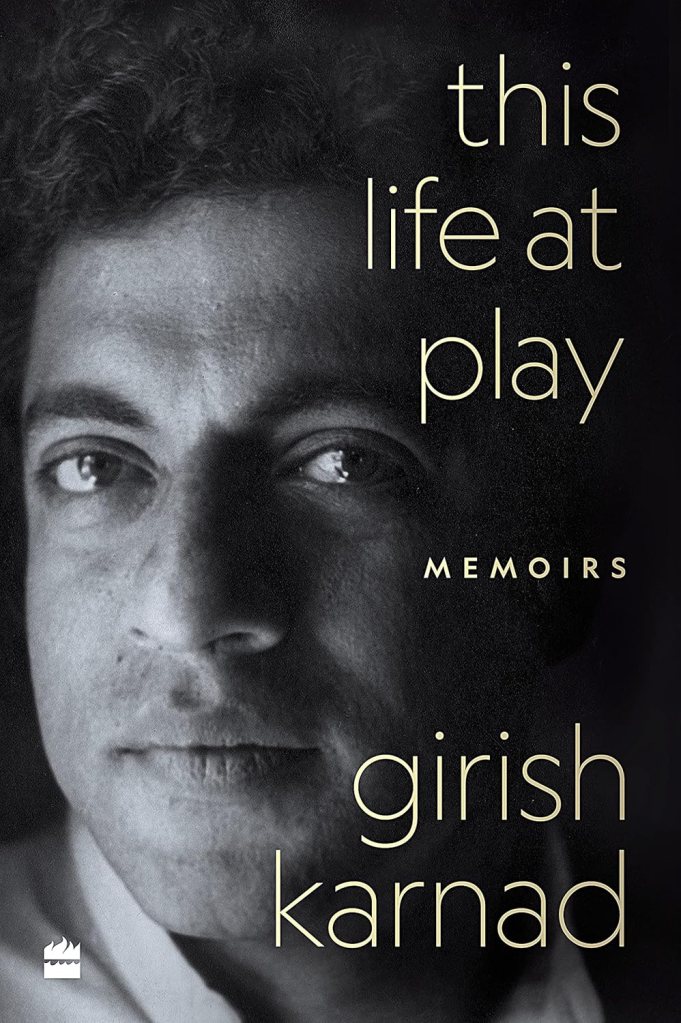
Memoirs strip writers of their literary pedestals. They become characters in their own narratives—curious onlookers of their own lives—mediating past experiences through the lens of present understanding. Rather than demanding critical analysis, memoirists invite readers to settle in comfortably, as though sharing a cup of coffee between intimate friends. What follows is a kind of profound communication reserved for one’s closest confidants. Girish Karnad’s This Life at Play: A Memoir extends such a hand of friendship. It offers a vivid glimpse into his formative years with remarkable candour, revealing the experiences that shaped him into a socially conscious artist. Readers are invited to sit in quiet admiration as Karnad exercises what theatre historian Shanta Gokhale once described as “the pleasure in choosing certain words over others.” He writes with the honest flow of a river unafraid of its memories.
The personal and the public coalesce throughout the memoir. Karnad moves seamlessly from the Yakshagana performances of his childhood to the Catholic influences of his adolescence; from his first kiss at Oxford at the age of twenty-three to his emergence as a renowned playwright and socially committed intellectual. His life unfolds in acts—as if it were a carefully orchestrated play. Landscapes play a crucial role in nurturing his artistic sensibility. Memories of Sirsi, Dharwad, Bombay, Oxford, Madras, old Mysore, and Poona emerge with vitality. The recurring influence of artists and writers such as G.B. Joshi, D.R. Bendre, Kirtinath Kurtakoti, A.K. Ramanujan, and B.V. Karanth underscores the idea that identity is shaped as much by inner reflection as by external encounters.
Even within the memoir, Karnad cannot resist theorising on the nature of good playwriting. Mathematics, he writes, taught him the fundamentals of dramatic structure: “While proving a theorem, it is important at the outset to identify its constituent parts, the relationships between those parts, and how they are held in balance… This is essential technical training for a playwright” (76). His regrets, friendships, guilt, family tensions, and sexual frustrations receive the same weight as his devotion to dramatic craft and his sense of social responsibility.
He writes, “But when it comes to understanding what a playwright is attempting with his craft, the ambitious failure is often more useful than a flawless play” (109). He extends this critique to himself, and the memoir draws much of its power from this unflinching subjectivity. In other words, Karnad examines himself as one might peer into a mirror—with unwavering candour. “My characters and I were reflecting one another like the infinite chain of reflections one sees in a barbershop when two mirrors face each other” (200). This image encapsulates the memoir’s central achievement: the writer becomes both observer and observed, creator and creation.
Karnad recalls A.K. Ramanujan’s observation that “Translation is a way to take an excellent work written by someone else and make it one’s own.” This piece, in its own modest way, aspires to something similar—placing my name alongside a writer whose work I have long admired, while hoping to capture an echo of his voice and, in doing so, make it my own.

Girish Karnad
How to cite: Annamalai, Kathiravan. “A Playwright’s Memoir: Girish Karnad’s This Life at Play.” Cha: An Asian Literary Journal, 14 Jul. 2025, chajournal.blog/2025/07/14/this-life.


Kathiravan Annamalai is a Research Scholar in the Department of English at Pondicherry University. His doctoral research explores comparative perspectives in the dramatic literature of the Harlem Renaissance and the Dravidian Movement. His broader research interests encompass Indian Literature in English, Subaltern Studies, Drama, and Translation Studies. He has presented papers at various national conferences and has published research articles in peer-reviewed academic journals. [All contributions by Kathiravan Annamalai.]
 Cha
Cha 