

📁 RETURN TO FIRST IMPRESSIONS
📁 RETURN TO CHA REVIEW OF BOOKS AND FILMS
Dương Hướng (author), Quan Manh Ha and Charles Waugh (translators), No Man River, Penguin Random House SEA, 2025. 248 pgs.
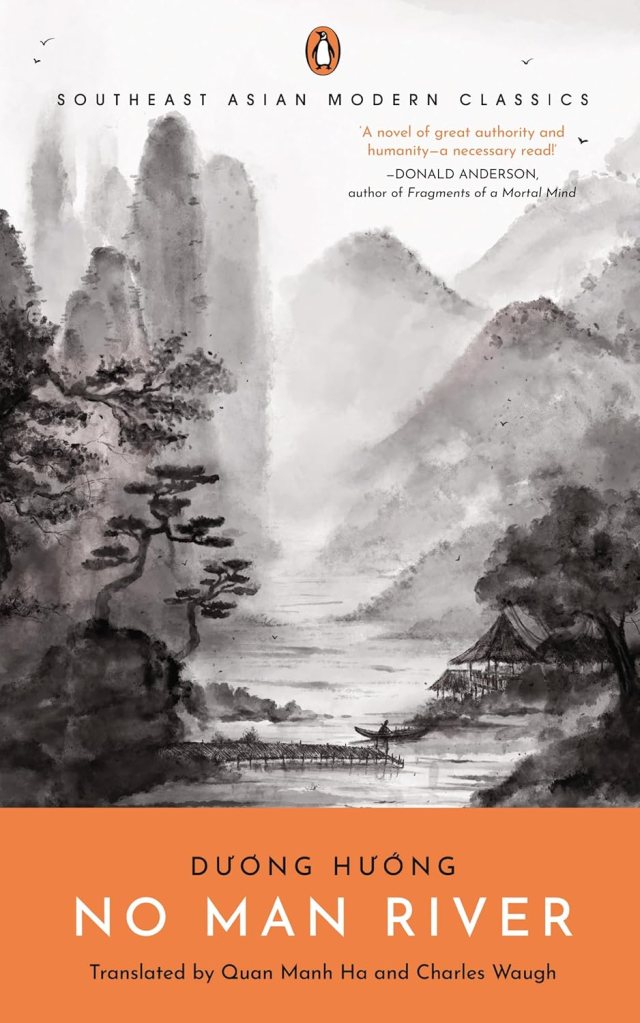
The recent publication of the English edition of Dương Hướng’s No Man River marks a significant and timely contribution to the literature on the American War in Vietnam—particularly given the paucity of Vietnamese-authored novels on this subject available in English since the normalisation of diplomatic relations between the United States and Vietnam in 1995. Although fifty years have passed since the war’s controversial end in 1975, Dương’s novel retains striking contemporary relevance. It underscores the potential for younger generations to instil values such as love, empathy, and reconciliation in their elders, while simultaneously challenging entrenched social norms in pursuit of a more progressive society. Through evocative depictions of Đông Village—its ancient mango trees, meandering river, and communal house—the novel transports readers into a richly imagined northern Vietnamese landscape during and after the war.
The narrative opens with the return of Vạn, a celebrated veteran of the war against the French, who aspires to rebuild his community in accordance with idealistic socialist principles. His efforts, however, are thwarted by enduring political and familial tensions within the village. Accordingly, the narrative shifts its focus from an individual protagonist to a collective one, critically examining human prejudices, archaic cultural practices, and the societal expectations surrounding personal sacrifice. On one level, No Man River explores interpersonal relationships and romantic entanglements; on another, it offers a broader critique of the communist propaganda and political atmosphere that shaped northern Vietnam’s resistance to American invasion. The emotional, psychological, and physical scars left by the war continue to haunt Vietnam—decades after its conclusion.
The novel presents an intriguing departure from traditional war fiction through its emphasis on female characters, who are typically relegated to peripheral roles. It interrogates the historical burdens imposed upon women—such as the expectation to preserve chastity, fulfil motherhood, and remain loyal to deceased spouses. As noted in the Foreword, Vietnamese culture often regards womanhood as complete only through motherhood—a belief internalised by several young female characters, ultimately leading to tragedy or social disgrace. By foregrounding these experiences, No Man River subverts conventional war narratives, juxtaposing the domestic “war” endured by women at home with the armed conflict fought by men on the battlefield.
No Man River offers international readers a nuanced, multidimensional understanding of the American War in Vietnam—not merely through historical events, but through the lived experiences, emotions, and perspectives of the Vietnamese people, so often overlooked in Western accounts. The novel addresses enduring themes such as moral ambiguity, female identity, human suffering, the tension between collective and individual experiences, and trauma—issues that remain strikingly relevant in a world where war continues to dominate global discourse. Its humanistic power lies in its capacity to evoke empathy, challenge preconceived notions, and remind us of the personal cost of war: that no human being is spared from its crimson claws.
How to cite: Maine, Rebecca. “No Human Being is Spared from its Crimson Claws: Duong Huong’s No Man River.” Cha: An Asian Literary Journal, 12 Jul. 2025, chajournal.blog/2025/07/12/no-man-river.


Rebecca Maine is an undergraduate at the University of Montana, where she studies creative writing, psychology, and public history. Her work has appeared on the Montana History Portal and in The Oval Literary Magazine. She lives in Missoula, Montana with her husband and two cats. [All contributions by Rebecca Maine.]
 Cha
Cha 