

📁 RETURN TO FIRST IMPRESSIONS
📁 RETURN TO CHA REVIEW OF BOOKS AND FILMS
Click HERE to read all entries in Cha on Vigil.
Jeffrey Wasserstrom, Vigil: The Struggle for Hong Kong, Brixton Ink, 2025. 176 pgs.
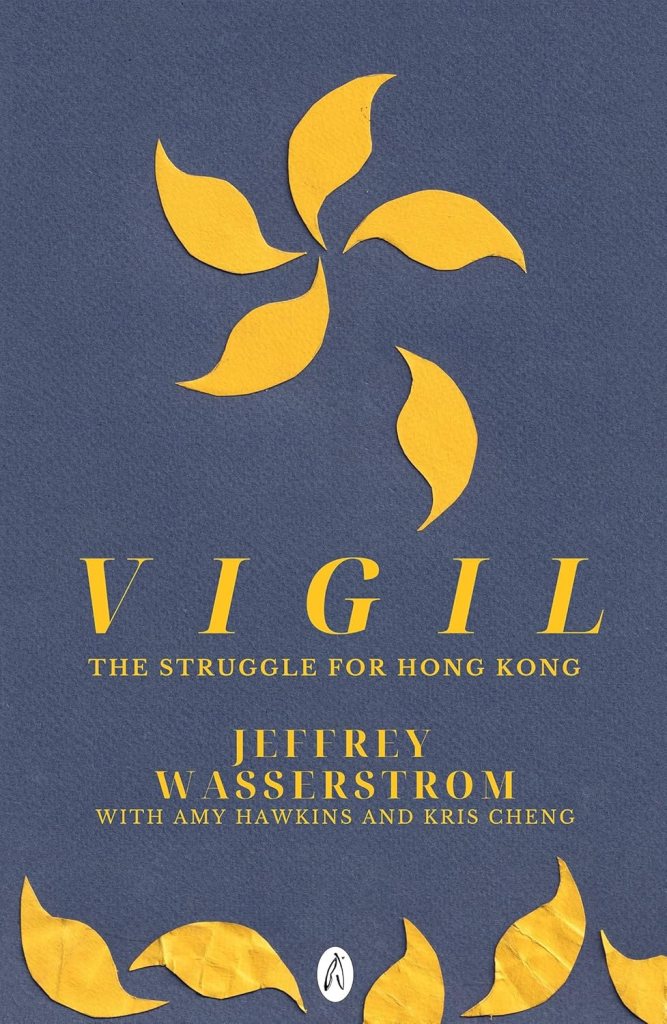
The ability to document pivotal historical events with scholarly rigour as they unfold is a formidable skill for any scholar to master. Frequently, volumes that attempt to capture rapidly developing moments—such as the 2019 Anti-ELAB protests mounted by Hong Kong’s democracy movement—are, in hindsight, hindered by the blind spots and limitations of a presentist perspective. Jeffrey Wasserstrom’s Vigil: The Struggle for Hong Kong stands as a rare counterexample: a work centred on contemporary events that continues to serve as a vital resource even after the moment it chronicles has passed. Now in its second edition, five years after its initial publication in 2020, Vigil remains an essential lens through which to view the 2019 democracy protests in Hong Kong and the movements that preceded them. Written in October 2019, at the height of the protests, Wasserstrom’s account retains the urgency that marked its inception.
One of the principal reasons for the book’s enduring relevance is its framing of the 2019 protests as a moment embedded within Hong Kong’s broader historical trajectory. Throughout the volume, Wasserstrom recounts the city’s recent past in lucid and engaging prose. The history of Hong Kong’s struggle for self-governance—and the gradual erosion of its autonomy following the 1997 handover from Britain to the People’s Republic of China—is one of complex negotiations, a succession of unfulfilled promises (including the pledge of universal suffrage), and a pattern of tightening restrictions on autonomy that has repeatedly provoked public mobilisation. Wasserstrom offers a concise yet thorough and accessible account of these developments, tracing the city’s political awakening through a series of defining moments that culminate in the events of 2019. By elucidating the roots of the 2019 protests and demonstrating how they evolved from earlier movements in 2003, 2011, 2014, and 2016, Wasserstrom situates his vivid report of the 2019 protests within a larger historical context.
Wasserstrom combines this concise historical account with his own reflections on visiting Hong Kong over many years—particularly between 2014 and 2019. Indeed, the title of the book—Vigil—partly reflects Wasserstrom’s own experience of attending the annual commemoration of the Tiananmen Massacre in Victoria Park. Additionally, he draws on interviews (conducted with assistance from Amy Hawkins) to tell the city’s story in an intimate and granular fashion. As he traces the roots of the campaign back to the unfulfilled promises of autonomy and democratic governance made to Hong Kongers by joint agreement of the UK and China, Wasserstrom enlists the perspectives of many key figures in the city’s recent political history. Remarks from the likes of Chris Patten, Joshua Wong, Ma Jian, Wong Yeung-tat and Kong Tsung-gan contribute to his narrative, rendering it a significant record for future accounts of the movement.
Recalling the anxiety surrounding the 1997 handover of Hong Kong, the optimism that inspired the 2011 Occupy Central demonstrations and the 2014 Umbrella Movement, and the outrage that mobilised participants in the 2019 Anti-ELAB protests, Vigil bears witness to the tectonic shifts in the city’s socio-cultural and political landscapes over the past forty years. Wasserstrom is careful not to portray the activists involved in the democracy movement—or Hong Kongers writ large—as a monolith. Rather, Vigil’s assessment of the evolving movement foregrounds the animating debates and divergences that emerged across successive waves of activism, highlighting the differing tactical, ideological and generational approaches that gave the movement its vitality. From the experience of Benny Tai, the idealism of Joshua Wong and Anges Chow, and the radicalism of Sixtus Leung and Yau Wai-Ching, the democracy movement is viewed as a diverse and multifaceted collection of voices who called for change in the city.
By examining the democracy movement through multiple lenses—historical, institutional and personal—Wasserstrom’s concise account captures the spirit of the movement and those who took part in it. He also documents the rapidly diminishing space for autonomy that had been guaranteed to Hong Kongers at the time of the handover. In particular, the book’s fourth and fifth chapters (tellingly entitled Punishments and Battles, respectively) document the official response to the movement.
Wasserstrom’s descriptions of the measures undertaken by the authorities in Beijing and Hong Kong to suppress dissent—from disqualifying elected pro-democracy candidates from taking office, to mobilising thugs to assault protestors, and deploying riot police armed with tear gas and water cannons—grimly foreshadow the legal crackdown that would follow the events of 2019. Though, at the time of writing, he could not have foreseen the further escalation in violence that would unfold mere weeks after publication, nor the imposition of the National Security Law less than a year later in June 2020, Wasserstrom’s portrayal of the authorities’ responses nevertheless conveys the brutality and force that compelled protestors to scrawl “It was you who taught us that peaceful marches did not work” across the city’s walls and overpasses.
Read from the retrospective vantage of mid-2025, Wasserstrom’s account—almost entirely unchanged since the book’s first edition in 2020—now appears prescient. His closing prediction that “2019 will clearly go down in history as a year that, like 1919, marks a turning point in the history of protest, repression and imperial projects in East Asia,” resonates with particular force five years on, in the wake of the enactment of the National Security Law (p. 76).
It is on this point that the updated edition of Vigil offers essential reflection. The superb additions of a foreword by Amy Hawkins and an afterword by Kris Cheng draw attention to the transformations Hong Kong has undergone since the book’s initial publication. Hawkins opens the volume with a meditation on what she terms “the hollowing out of the city” in the wake of the events chronicled in Vigil. Recounting the arrests made under the new National Security Law and the imposition of Article 23 in March 2024, she reflects on the disorienting changes visited upon the city in a mere five years. Her poignant observation that Hong Kong in 2025 is “a city where, although the bright lights still glitter and the tropical waves of the South China Sea still sparkle, much of the local life has dulled” underscores the profound sense of loss felt by many who have left the city behind (p. xvi).
In his brief “Afterword,” Kris Cheng examines the city’s transformations in more granular and focused detail. He describes the prevailing atmosphere of intimidation and fear that has imprisoned activists, silenced journalists and stifled dissent. For many Hong Kongers, Cheng notes, the long arm of Chinese state repression reaches even beyond the city’s borders. Some of those who have sought refuge in the diaspora have faced bounties calling for their extradition and arrest. Even those spared such overt threats have encountered other forms of hardship abroad—barriers to accessing pensions, difficulties securing employment, and non-recognition of citizenship status. Though the protests of 2019 have been largely suppressed, their ripple effects remain palpable—even among those who left Hong Kong long ago.
Despite these setbacks, Hawkins discerns a kernel of hope in the emergence of a diasporic Hong Konger community—with as many as 200,000 resettling in the UK alone. By recreating Hong Kong outside its original borders, she notes, the city’s “food, culture, and sense of community can survive in an authentic and exciting way, thousands of miles away from where it came from” (p. xxi). Cheng, too, finds resilience in the activism of those in exile, who refuse to regard their cause as lost. He observes their pursuit of solidarity with other communities striving for self-determination—Catalonians, Tibetans and others—as a means of carrying forward the spirit of the democracy movement, and of Hong Kong itself, into future generations. “Perhaps we may meet in Hong Kong again,” Cheng concludes, “one day soon” (p. 83).
With its highly readable prose and concise length, Vigil offers a valuable introduction to Hong Kong’s recent sociopolitical history. For those encountering the city and its politics for the first time, Wasserstrom’s ability to weave a large-scale historical narrative about the evolution of the democracy movement with vivid and compelling vignettes from the ground makes the text an invaluable resource. The new contributions to this updated edition—from Hawkins and Cheng—reinforce the vitality of Wasserstrom’s urgent account, written at the height of the 2019 protests, and survey the constriction that followed in their wake.
As authoritarian retrenchment deepens in Hong Kong, and the Chinese Communist Party continues to erode the guarantees of “One Country, Two Systems” well ahead of its 2047 deadline, Vigil remains a vital record—a reminder of the forces that shaped the movement and the paths that led to the present. While history may not repeat itself, as Wasserstrom observes in his epilogue, accounts such as Vigil nonetheless compel us to revisit pivotal moments—like the protests of 2019—so that we might better comprehend our present.
How to cite: Stroup, David R. “Memory, Resistance, and Repression: The Enduring Relevance of Jeffrey Wasserstrom’s Vigil.” Cha: An Asian Literary Journal, 11 Jul. 2025, chajournal.blog/2025/07/11/vigil-hong-kong.



David R. Stroup is a Senior Lecturer in Chinese Politics at the University of Manchester. He is the author of Pure and True: The Everyday Politics of Ethnicity for China’s Hui Muslims (University of Washington Press, 2022). His research centres on everyday ethnicity and authoritarian governance in China—particularly within Islamic minority communities. His current projects include a study of online Islamophobia and nationalism in China, as well as an ethnography exploring community, identity, and football within the UK’s Hong Konger diaspora.
 Cha
Cha 