

📁 RETURN TO FIRST IMPRESSIONS
📁 RETURN TO CHA REVIEW OF BOOKS AND FILMS
Quan Manh Ha and Paul Christiansen (translators). Light Out and Modern Vietnamese Stories, 1930–1954. Northern Illinois University Press, an imprint of Cornell University Press, 2024. 228 pgs.
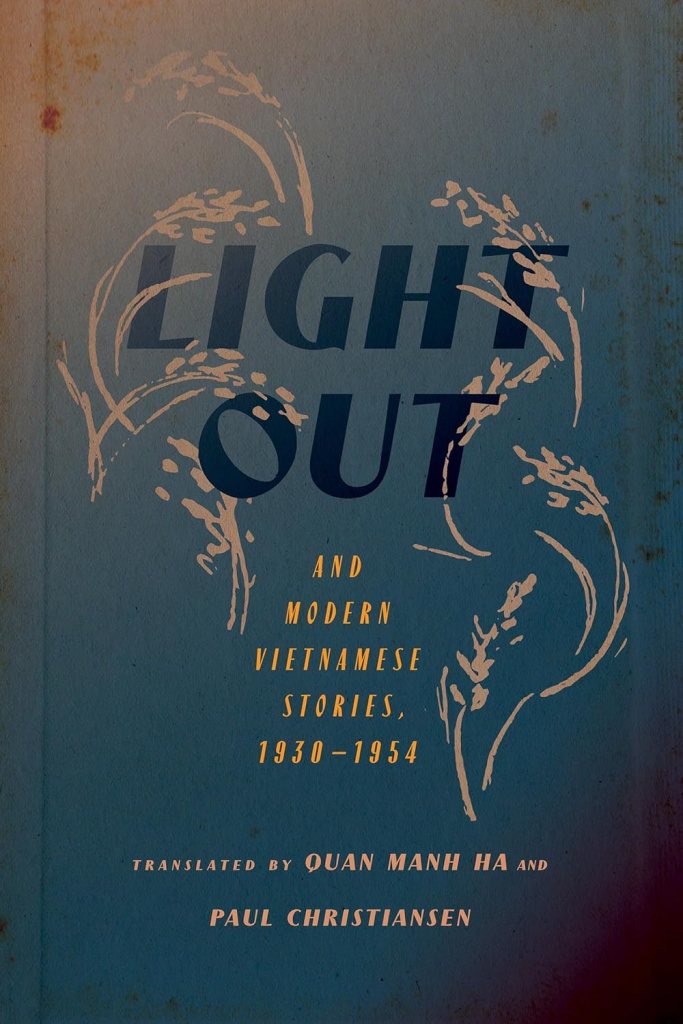
Light Out and Modern Vietnamese Stories is the first anthology of colonial Vietnamese literature written during the French occupation to appear in English translation. Translated by Quan Manh Ha and Paul Christiansen, the collection centres primarily on Ngô Tất Tố’s novella Light Out and includes eighteen short stories by his contemporaries that illuminate French colonial exploitation, class-based violence, and the struggle of Vietnamese women to survive amidst unrelenting poverty and patriarchal oppression.
Light Out offers an unflinching portrayal of village life in northern Vietnam at the height of French colonial rule. While its characters may appear somewhat one-dimensional to a Western reader, Ngô’s chief concern lies in critiquing the systemic injustices endured by Vietnamese peasants under French domination. From oppressive taxation to brutal agricultural cycles, Light Out resists any temptation to romanticise rural life or the colonial presence. The novella follows Mrs Dậu’s efforts to repay her family’s debts, incurred under the French-imposed head tax system, which compelled every male aged between eighteen and forty-nine either to contribute financially through village coordination or to perform thirty days (or more) of forced labour. In Mrs Dậu’s case, this includes her husband and deceased brother-in-law. Like many in the 1930s, her village was plagued by sudden floods that frequently destroyed the crops on which their livelihoods depended. The hypocrisy of the tax collectors is laid bare in excruciating detail, as village officials smoke opium in front of their starving neighbours.
Yet, throughout Light Out, Ngô resists reducing northern Vietnam and its people to a monolith of suffering and despair under colonial rule. He describes the region’s mud-brick houses, scorched roads, and village gates with a journalist’s eye for detail. The communal solidarity of the villagers is rendered with equal care: neighbour women assist Mrs Dậu in nursing her ailing husband with traditional Vietnamese remedies. This village culture—characterised by compassion, sympathy, and mutual aid—stands in quiet defiance of the unforgiving realities imposed by a colonial hierarchy and its zealous tax regime. Mrs Dậu, in her quiet resilience and fierce protection of her family, embodies a revolutionary spirit. She confronts injustice without compromising her convictions. Though the reader is never given direct access to her interior thoughts, the unwavering strength of her resolve speaks volumes about the moral and emotional centre of the text.
The eighteen short stories included in the anthology intimately depict Vietnamese women’s struggles for self-determination under French colonial rule. In Hunger by Thạch Lam, hunger is portrayed on multiple levels—not only for food but also for dignity and a better life. The protagonist, Sinh, becomes dependent on his wife after losing his job, and the narrative explores the starkly limited options available to impoverished women: charity or prostitution. Yet in colonial Vietnam, the wealthy are depicted as greedy and indifferent, rendering charity all but impossible. Sinh’s wife’s choice to feed her husband at the cost of her own virtue underscores the harsh realities Vietnamese women faced in order to survive.
Stories such as The Teeth of an Upper-Class Family’s Dog by Nguyễn Công Hoan continue the theme of survival at all costs, exposing the upper class’s flagrant disregard for the lives of the poor. In this story, a starving man attempts to steal food meant for a wealthy man’s dog, resulting in a scuffle in which the dog loses two teeth—an injury the owner vows the beggar will repay with his life. In Carrion Eaters, also by Nguyễn, a man’s body is left to decompose in his family’s pond until they manage to bribe the coroner with everything they own. Similarly, in Two Eyes by Khái Hưng, the protagonist confesses to hoarding rice during a famine for personal profit and only comes to recognise the cruelty of his actions on his deathbed. Throughout the collection, peasants and villagers are consistently dehumanised—reduced to financial burdens or treated as utterly expendable.
This unflinching portrayal of poverty directly mirrors the systemic violence the colonised population endured. While the French claimed to bring “civilisation” to the so-called Third World, they simultaneously exploited the land and its people to the point of devastation. French priorities lay squarely with their own soldiers, often leaving little or nothing for the Vietnamese. Compounding this exploitation were the recurring flash floods that swept across Vietnam during this period, severely crippling agricultural output just as colonial demands escalated. Many of the authors featured in this volume drew on these historical realities—both in their lived experiences and in their fiction—to offer a stark, realist account of Vietnamese life under colonialism and to nourish a growing sense of revolutionary urgency.
Many characters in the anthology live in conditions of relative poverty. Those fortunate enough to have shelter often house entire families within single-room, mud-walled dwellings. Food is sparingly rationed—nursing mothers go hungry as they prioritise feeding their older children. The vast majority of impoverished Vietnamese are illiterate, a vulnerability the wealthy exploit through deceptive contracts and exploitative agreements. In response, many of the stories satirise the upper class to expose their deep hypocrisy. Though themselves subject to French colonial oppression, wealthy Vietnamese characters rarely hesitate to oppress those beneath them.
Traditional literary genres such as romance and domestic realism are subtly subverted throughout the volume to foreground women’s disproportionate suffering as they strive to assert autonomy within a rigidly patriarchal society. The anthology’s introduction deftly connects the various stories thematically and situates them within their historical context, though a more detailed discussion of the influence of French and Chinese literary traditions on Vietnamese authors—and the stories themselves—would have enriched the analysis. While translation inevitably presents challenges for Western readers in grasping the linguistic and literary intertextuality at work—especially in Light Out—the translators’ explanation of grammatical tendencies such as passive voice and adverbial usage is illuminating.
Ngô Văn Giá’s scholarly essay following Light Out serves as a valuable companion text, offering insight into the novella’s principal themes and sociopolitical backdrop. His discussion of Ngô Tất Tố’s autobiographical imprint on the work is particularly compelling, reinforcing the political urgency embedded within the narrative.
Light Out and Modern Vietnamese Stories, 1930–1954 is a vital collection for Western readers seeking to understand the historical complexities and everyday struggles of Vietnamese life under French colonial rule. Its unflinching candour is particularly striking in an era when literature is too often shaped by commercial imperatives rather than political force. The volume stands as a foundational work of early twentieth-century Vietnamese literature—an urgent, resonant record of colonial exploitation whose relevance endures as wealthier nations continue to plunder the global South under the guise of “civilising” the “uncivilised.”
How to cite: Miller, Josie. “Writing Against Empire: Light Out and Survival in Colonial Vietnam.” Cha: An Asian Literary Journal, 7 Jul. 2025, chajournal.blog/2025/07/07/light-out.


Josie Miller (she/her) is currently pursuing an MA in Literary Studies at the University of Montana, USA. Born and raised in the heart of the Rockies, she is passionate about writing as a means of navigating personal challenges related to mental health and queer identity. As a lesbian writer, Josie seeks to explore how identity shapes one’s experience of the world and to create space for reflection and resonance through her work. You can follow her on Instagram or visit her website.
 Cha
Cha 