
📁 RETURN TO FIRST IMPRESSIONS
📁RETURN TO CHA REVIEW OF BOOKS AND FILMS
Faiqa Mansab, The Sufi Storyteller, Neem Tree Press, 2025. 320 pgs.
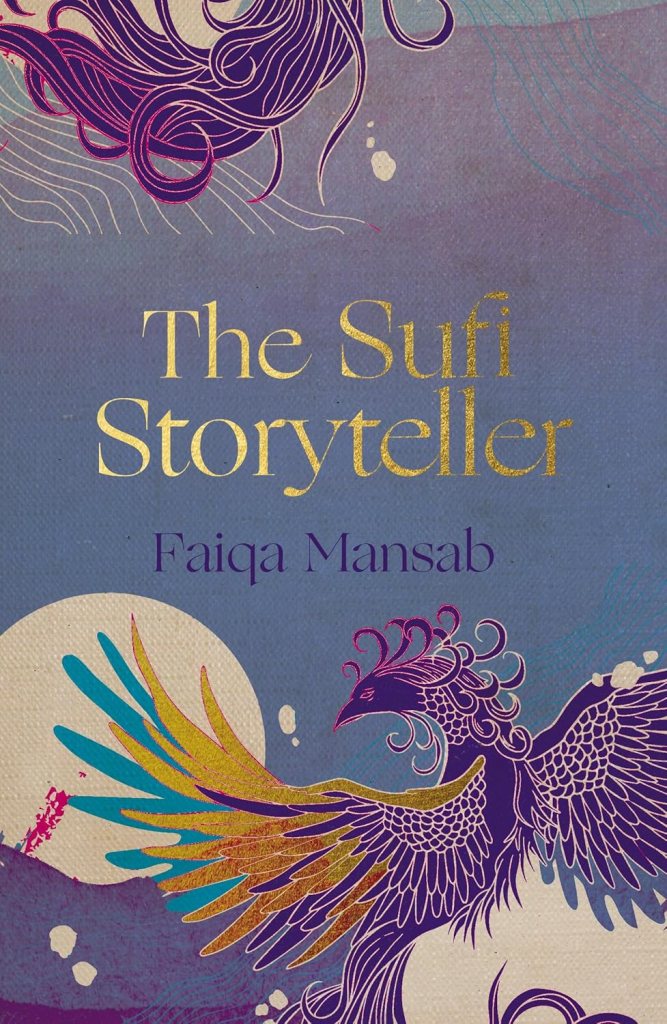
Faiqa Mansab’s The Sufi Storyteller emerges not merely as a compelling narrative in its own right, but as part of a burgeoning corpus of South Asian literature that seeks to bridge the metaphysical and the material, the sacred and the profane. It is a novel that leans consciously into the intangible—less a work of fantasy in the conventional sense than a liminal meditation, drawing from the same wellsprings that nourished the oral traditions of Sufi saints, itinerant qissekars, and Indo-Persian epics.
Set between a liberal arts college in small-town America and the war-scarred landscapes of Afghanistan, The Sufi Storyteller centres on Layla, a scholar of women’s histories, and Mira, a renowned Sufi storyteller burdened by a traumatic past. Their paths converge in the wake of a murder, when a note addressed to Mira from the killer initiates a journey that is as psychological as it is spiritual. What ensues is not a detective story in the conventional mould, but rather a layered pilgrimage through memory, grief, and myth.
The “realm of Story” that the two women must enter is no mere fictional construct devised for world-building. Rather, it is a space of cultural memory—a metaphysical landscape shaped by the Sufi imagination. In this, Mansab invokes the tradition of masnavis and dastaans, narrative forms that privilege cyclical structure, parable, and allegory over linear, plot-driven development. The result is a novel at once deeply rooted in South Asian literary tradition and vibrantly attuned to the contemporary diasporic experience.
Where Western fantasy often traffics in binaries—good and evil, hero and villain—Mansab’s storytelling dwells in the grey. This is the ethics of the Sufi tale, where transformation takes precedence over triumph, and where stories do not necessarily resolve but spiral inward. In Mira, we encounter a custodian of such narratives, an oral archivist of feminine suffering and resistance. Her role recalls that of the katha vachak—the teller of epics and spiritual allegories—frequently marginalised both in form and function within the modern literary canon.
Mansab’s prose echoes the cadence of these older traditions. Lush yet never indulgent, evocative yet tautly composed, her sentences move like breath—measured, attuned to rhythm. There is repetition, but it is deliberate, akin to the refrains of a Sufi qawwali or the metaphor-rich texture of a qissa. The book does not hurry the reader. Rather, it invites a contemplative pace, urging us to linger, to listen, to unlearn.
There is, too, something deeply feminist at work. While The Sufi Storyteller is not a manifesto, it remains insistently preoccupied with women’s voices—how they are inherited, silenced, buried, or reshaped. Layla’s academic training—textual, Western, institutional—is juxtaposed with Mira’s oral, intuitive knowledge. The narrative thus becomes a site of epistemological tension: who is allowed to know, who is permitted to tell, and at what cost.
This tension reverberates across much of contemporary South Asian fiction, particularly in the work of women writers reclaiming myth and folklore—from Arundhati Roy’s spiritual-political mythmaking, to Anita Nair’s Mistress, which draws upon Kathakali, to Musharraf Ali Farooqi’s translations of Hoshruba, which revel in the fantastical idioms of the Indo-Muslim imagination. Mansab’s novel belongs to this lineage, even as it remains singular in its quiet, understated register.
What renders The Sufi Storyteller particularly compelling is its refusal to exoticise the mystical. Sufism here is neither a plot device nor an aesthetic flourish—it is an ontological stance. Mira’s storytelling is not magical realism in the Latin American tradition, nor is it escapist fantasy. It is spiritual resistance—a means of enduring violence, of reclaiming a voice where silence once prevailed.
The novel’s pivot to Afghanistan—rendered with sensitivity but never veering into appropriation—also gestures towards broader questions of memory and displacement across the region. Violence in the narrative is both political and personal, yet always inextricably linked to gender. And still, Mansab eschews trauma porn. Her gaze is compassionate yet unsparing, offering not solutions, but space: for grief, for rage, for the possibility of healing through story.
Compared with her debut, This House of Clay and Water, which remained firmly rooted in the physical and psychological geographies of Lahore, The Sufi Storyteller is more expansive, more formally and thematically daring. And yet, both novels are bound by a thread of interiority—by Mansab’s profound investment in women’s emotional landscapes, and in language as both confinement and liberation.
Ultimately, The Sufi Storyteller is less concerned with unravelling a mystery than with confronting the mystery of storytelling itself. It speaks to the enduring power of narrative—not as entertainment or allegory, but as inheritance, as rebellion, as sanctuary. In a literary moment increasingly defined by genre-blending and transnational hybridity, Mansab’s novel reminds us that some of the most radical forms of storytelling have always existed beyond the page—in oral traditions, in sacred songs, in whispered acts of resistance.
And perhaps, in the hands of storytellers like Mira—and Mansab—they are returning.
How to cite: Namrata. “In the Realm of Story: Faiqa Mansab’s The Sufi Storyteller and the Reclaiming of South Asian Mythic Narrative.” Cha: An Asian Literary Journal, 6 Jul. 2025, chajournal.blog/2025/07/06/sufi.



Namrata is the editor of Kitaab, a South Asian literary magazine based in Singapore, and the founder of Keemiya Creatives, a literary consultancy where she works with authors and publishers in various capacities. Namrata also hosts the Bookbot Theory, a podcast on book-marketing which aims to help authors make their books sell. A published author, an independent editor and a book reviewer, she enjoys writing stories and think-pieces on travel, relationships, and gender. She is a UEA-India chapter alumnus and has studied travel writing at the University of Sydney. Her writings can be found on various sites and magazines, including Kitaab, the Asian Review of Books, Contemporary South Asia Journal of King’s College-London, Mad in Asia, The Friday Times, The Scroll, Feminism in India, The Brown Orient Journal, Inkspire Journal, Moonlight Journal, The Same, Chronic Pain India and Cafe Dissensus. Her short stories have been a part of various anthologies and she has also published two short story collections of her own. Namrata is currently working on her debut novel. [All contributions by Namrata.]
 Cha
Cha 