
📁RETURN TO FIRST IMPRESSIONS
📁RETURN TO CHA REVIEW OF BOOKS AND FILMS
Click HERE to read all entries in Cha on Mending Bodies.
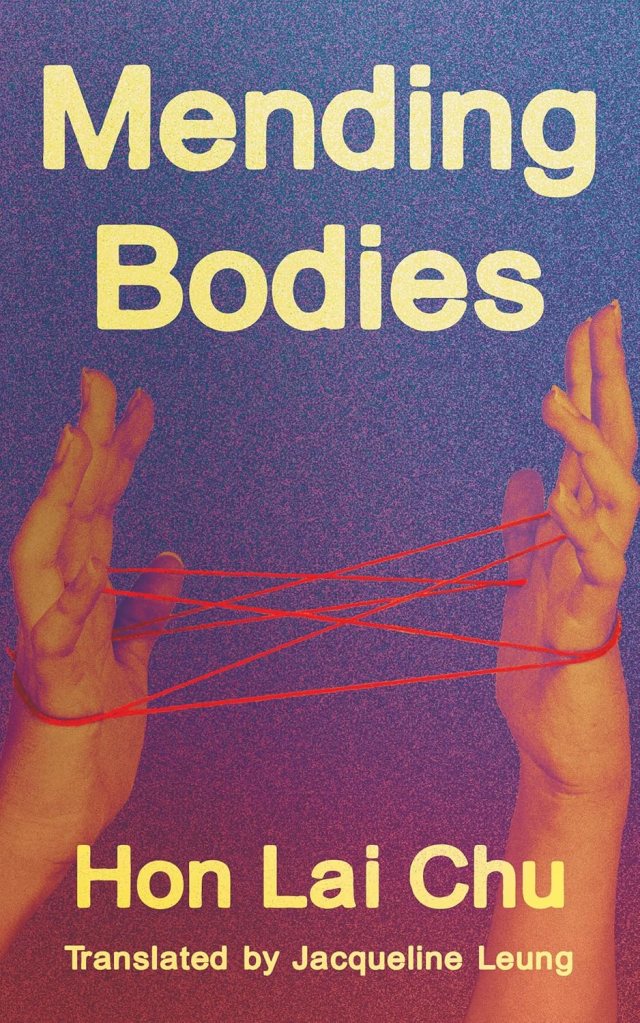
Hon Lai Chu (author), Jacqueline Leung (translator), Mending Bodies, Two Lines Press, 2025. 240 pgs.
For those who haven’t read the original Chinese version of Mending Bodies, this review contains some spoilers.
In an unnamed city, a government programme incentivises couples to “conjoin”—to surgically attach themselves to one another—promising a flourishing economy, ecological revitalisation, and personal fulfilment as a result. As a long-term resident of Hong Kong who has witnessed its many transformations, I immediately discerned political analogies with the city’s post-1997 trajectory as well as its ongoing debates over identity.
In my 2022 study on metaphors in Hong Kong politics following the 1997 handover—when sovereignty was transferred to the People’s Republic of China—the “One Country, Two Systems” framework was variously characterised as a “bridge”, a “wedge”, or even a “moat”, with a drawbridge that could be raised or lowered to ensure that “river water” and “well water” did not intermingle. Anyone familiar with Hong Kong’s political structure over the past twenty-six years will readily perceive the rhetorical and physical ambiguity of such a “conjoinment”—to use the term employed in Mending Bodies.
In the novel, a student writing her dissertation on the history of “Conjoinment” develops insomnia. As her world begins to unravel under the weight of societal expectations and the urgings of close friends, she begins to question whether they might be right—that it may indeed be better for her, and perhaps for the greater good of society and the nation, to sacrifice her individual autonomy and become conjoined with another.
The narrative intersperses excerpts from the student’s dissertation—its Abstract, Outline, and Case Studies—rendered in a distinct font, among her explorations, dialogues, and reflections on the merits and pitfalls of conjoinment, as well as the motivations and consequences of “separation”. This structure provides an engaging vehicle for the story of how conjoinment emerged, particularly through the enactment of “The Containment Act”, and addresses the appropriate timing for conjoinment, the procedures involved, and the criteria for identifying a compatible partner.
Conjoinment is presented as ecologically responsible: “A conjoined couple will shower, eat, and travel together, consuming less gas and water than if they were single. Also, fewer people will live alone, saving space and resources like furniture.”
But it seemed that people were largely “ambivalent” about it. This ambivalence towards policies over which we had no influence became, paradoxically, the last effective recourse for safeguarding our remaining freedoms. If we complied as though it scarcely mattered—or meticulously searched for loopholes—we could discreetly chart the boundaries of their control. Why does this narrative strike a chord with me? Acceptance of inevitability appears to be a characteristic of the Hong Kong people, who have long had forms of authority imposed upon them without their consultation.
In the book, a psychologist challenges the economic justification for conjoinment, asserting that “society was in a state of crisis graver than ever before. Somehow marriage, racial conflict, wealth discrepancy, the many contrived wars—they all came from our inability to fill the existential lack we were born with as individuals.”
“Only by being with another person can we experience the cycles of joy, heartbreak, harmony, and conflict necessary to arrive at true fulfilment.” The “opposition party” of the city contended that conjoinment “was an elaborate political ploy to make citizens forget about their long campaign for the city’s independence” (an appeal, perhaps, to the very ambivalence mentioned earlier).
In Hong Kong, under the framework of “One Country, Two Systems”, we were told by the “legal guardians” in Beijing that it was a “scientific” document, and that “the Basic Law and Hong Kong’s fate are closely linked together, flesh and blood, indivisible, as fish live in water” (this was declared in 2004).1
There were acknowledged “practical difficulties of conjoinment”, yet these were largely dismissed by officials, who instead emphasised the “necessity for disability” for the greater good. The sacrifice of a part of oneself—such as a limb—for the collective benefit was the accepted price; hence, the selection of a body compatible with one’s own was a “laborious” and exacting process.
Though conjoinment was officially extolled as a social good, the reality of becoming conjoined necessitated both adaptation and a period of healing. “Reborns”, as the conjoined were termed, required assistance in acclimatising to their new bodies—through the use of mirrors, measuring tape, and both physical and psychological therapy. Regular medical examinations were essential. A rejection phase was not uncommon; “reborns” occasionally developed rashes, interpreted as a potential sign of the body’s resistance to the conjoined partner.
Hong Kong experienced a prolonged transitional period—from 1984 to 1997—to prepare for its own “conjoinment” with a larger political entity (albeit without the liberty of partner selection), and to consider what forms of adaptation might be necessary in order to retain, to some degree, individual identity. This interlude was marked by volatility and uncertainty. In Mending Bodies, a “thought exercise” is presented from the Conjoinment Manual, intended to help individuals overcome the initial conflict and awkwardness of identifying with the bodies to which they are now bound—a process that demands time and patience. The exercise also addresses the issue of “asymmetry”, referring to the unequal degrees of autonomy among the individuals who now constitute a single, unified whole.
Once conjoined, “when we woke again, we will have forfeited our original identities to become part of a new individual with a new name, and be responsible for our own…” I complete the sentence on Hong Kong’s behalf: “now we are masters of our own house” (declared at midnight on 30 June 1997 by the first Chief Executive, Tung Chee-hwa). The difficulties faced by some conjoined individuals in the book suggest that this is not quite the case, as the two people—now merged into one—must constantly negotiate and coordinate their actions for any semblance of harmonious living to continue in their new form.
Sleep and dreaming are emphasised as means of coping with conjoinment, offering a space in which individualism and personal freedom might still be preserved. By “keeping a dream that has no bearing on reality, you keep yourself in a state of youth”; imagination becomes a vital part of post-conjoinment therapy, and sleep is its enabling condition. “Sleep disorders”—with which the dissertation writer herself struggles—prompt a deep questioning of the benefits and drawbacks of conjoinment, and perhaps also of the radical act that forms part of her completed dissertation (her “self-regulation”). Yet imagination and the dreaming of unreality may help the individual retain a sense of self—though this, upon waking, inevitably dissipates.
Unlike Hong Kong’s conjoinment—where separation is not only unfeasible but, under present circumstances, unimaginable—separation is possible in the fictional city. Some even regard it as a “basic human right”, though there are few successful cases. One full-length case study is included in the dissertation. Deformity often results. Limbs amputated during conjoinment cannot be reattached. Frequently, the decision to separate stems from the desire to retain former occupations held as separate individuals, rather than to forge a shared path by melding their identities—that is, from disunity.
I cannot help but see this as an analogy for Hong Kong, given my long-standing sojourn here. Yet, if one chooses to look beyond the analogy, the novel may also be read as a meditation on individuals conforming—sometimes forcibly—to the structures of mainstream society, ostensibly “for the good of all”, and the risks posed by such artificial “conjoinment”. In this narrative world, even the motives of those closest to us are shaped by broader, often invisible forces. Ultimately, each reader will bring their own experiences to the novel. To be honest, I am still processing the ending.
As the book states, “every individual is a multitude of selves, no matter if they are born conjoined or in singular bodies.” I believe the novel suggests that we cannot always “walk in unison” with one another—our diversity makes this extraordinarily difficult. Imposed rules often fail to achieve their intended outcomes. Their success—if ever attainable—may be no more than utopian thinking.
- This was a quote from a pro-Beijing newspaper taken from my 2012 PhD thesis “The ‘Ultimate Aim’: Discourses of Democratization in Post-handover Hong Kong”, Macquarie University, Sydney, Australia. ↩︎
How to cite: Eagleton, Jennifer. “Walking in Unison?: On Hon Lai Chu’s Mending Bodies.” Cha: An Asian Literary Journal, 23 Jun. 2025, chajournal.blog/2025/06/23/mending.


Jennifer Eagleton, a Hong Kong resident since October 1997, is a close observer of Hong Kong society and politics. Jennifer has written for Hong Kong Free Press, Mekong Review, and Education about Asia. Her first book is Discursive Change in Hong Kong (Rowman & Littlefield, 2022) and she is currently writing another book on Hong Kong political discourse for Palgrave MacMillan. Her poetry has appeared in Voice & Verse Poetry Magazine, People, Pandemic & ####### (Verve Poetry Press, 2020), and Making Space: A Collection of Writing and Art (Cart Noodles Press, 2023). A past president of the Hong Kong Women in Publishing Society, Jennifer teaches and researches part-time at a number of universities in Hong Kong. [All contributions by Jennifer Eagleton.]
 Cha
Cha 