

📁 RETURN TO FIRST IMPRESSIONS
📁RETURN TO CHA REVIEW OF BOOKS AND FILMS
Click HERE to read all entries in Cha on Social Room.
Andrew Barker, Social Room: Modern Shakespearean Sonnets (Book Three, Sonnets 204—305), Mycroft Publishers, 2025. 186 pgs.
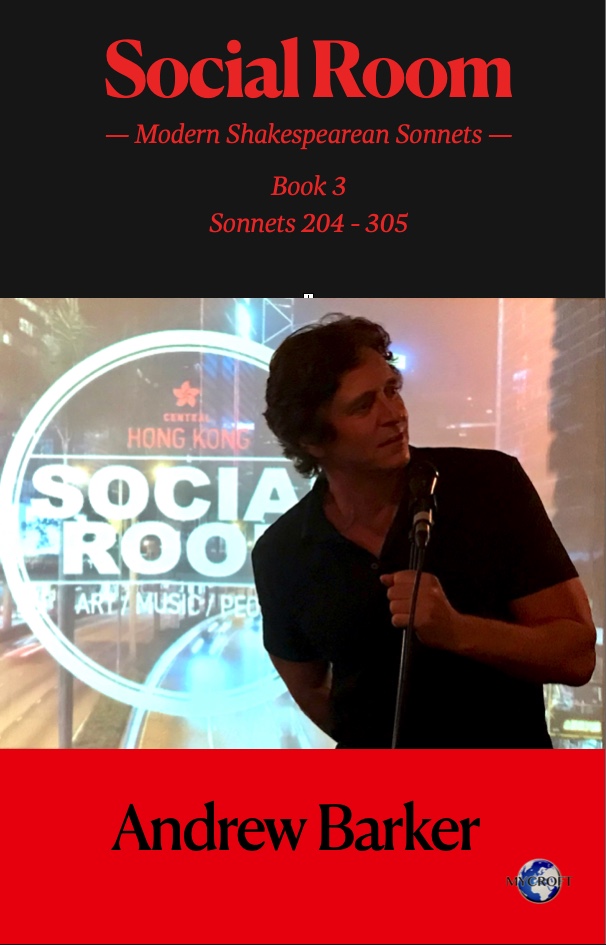
Named after the bar where the majority of these poems were first performed, Andrew Barker’s third book of sonnets, Social Room: Modern Shakespearean Sonnets, continues the poet’s engagement with matters both personal and political, while also signalling a gradual evolution in poetic style.
There are poems composed during sojourns in the UK, while on holiday, and during the writer’s decades-long residence in Hong Kong. Some are inspired by Freud’s waiting room; others respond to a performance of Richard III in Manila, in the shadow of President Rodrigo Duterte’s violent crackdown and extrajudicial killings. And there are, of course, poems drawn from the extended—predominantly Anglophone—poetry community that continues to shape and inspire much of Barker’s work.
Many of the collection’s preoccupations are self-referential, meditating on the act of writing itself, while simultaneously acknowledging the poet’s own position and privilege within a globalised city. As ever, Barker does not hesitate to showcase his vast repertoire of Western popular cultural references and literary affinities (if the extensive notes section is any indication). There are pointed allusions to canonical figures such as William Shakespeare, George Orwell, Seamus Heaney, Patrick Kavanagh, Oscar Wilde, Wilfred Owen, and Paul Theroux. Yet alongside these are an increasingly diverse range of references—including Chinese poets Li Shen and Louise Ho—reflecting a deepening engagement with the poet’s immediate cultural milieu.
One of the most discernible developments—one might even suggest improvements—in the collection is its accessibility to the general reader (by which I mean the non-specialist or cultural outsider). There are fewer persona poems or tributes to friends and acquaintances, and instead, a broader array of shared reference points that speak to our angst-ridden, globally connected yet communally fragmented age.
This is most effectively realised in the sequence of 35 lockdown sonnets, which chronicle the past few years of the Covid pandemic. There is an openness in Barker’s tone and an incisiveness in his commentary that remains just on the right side of non-judgement: “It’s clear we just don’t know what we don’t know” (Sonnet 225). There is also a marked humility in the writing, evident in lines such as: “What’d you have to lose / By just believing’s? not so stupid when / The fate of others rests upon your choice” (Sonnet 234). These poems reveal Barker’s growing cultural sensitivity and social consciousness, expressed through a newfound sense of belonging to a local community brought together by crisis.
There is also a more assertive engagement with the climate emergency—the boiling frog scenario—and the ecocritical imperative tied to the widespread culling of wild boars, Chinese white dolphins, and other endangered species. On the latter, Barker offers an imaginative leap: aliens receiving audio clips of whale song from the Voyager spacecraft and remarking, “The whale song? That was lure, or trap, or hype, / The chances are we’ll get there, they’ll be gone” (Sonnet 245).
Other poems remain outward-looking, positioning Barker as an émigré poet—reflecting on Brexit, the illusion of trickle-down economics, the war in Myanmar, the bewildering lead-up to and debacle of Trump’s first term, and the echo chamber of social media. The latter is especially well rendered in taut, forceful lines that lay bare the numbing effects of mass media: “To cauterise our sensitivity / To lies, by just repeating each tirade / Against the truth until we don’t believe / So much as leave unchallenged what’s been said” (Sonnet 216).
Of course, much of this revision of actual events is also entwined with the fallibility of memory itself, given that “We make life what it wasn’t when we write / Of life, then we remember what we wrote” (Sonnet 205). It is particularly in these moments of post-truth reflexivity and the absurdities of contemporary political discourse that Barker most compellingly emerges as a documentarian witness—eager to make sense of cognitive dissonance by interrogating “How history impacts outside our heads” (Sonnet 217).
Despite being an avowed secularist and “anti-theist”, Barker’s poetry nonetheless undertakes lucid and philosophically rich turns. Does the robin redbreast in a cage truly “put all of heaven in a rage” (Sonnet 215)? Or is the phrase symbolically anchored in our recurring impulse to imprison all that is beautiful in the world? Extending a poetic lineage from Blake to Keats, Barker meditates on the problematic interrelation of truth and beauty—the beauty here lying in the crafted nature of poetic form and its ability to render meaning palatable in a media-saturated, fact-resistant age.
Yet, as he reflects in Sonnet 207 (“An Assessment of Energy and Creation”), “Whenever we take wholesale truth from life / The strangest psychic taxes must be paid.” That old truism—“nothing comes from nothing” (oh, speak again, fair Cordelia)—reveals not only the poet’s labour and sacrifice, but affirms the significance of this transaction, whereby “life gains / From being recreated, spoken, read / Aloud before those listeners who had missed / Those truths that drain us, rising when word-kissed.”
As a rule, Barker’s sonnets are best appreciated when read aloud—the subtle inflections of tone allow the work to travel more effectively, and the register feels less bombastic than it may initially appear on the page. There are regular, often understated stresses that reveal a gentle, distinctly British humour in these contemporary sonnets: rage yields to restraint, evoking a sentiment that is transformed in performance. Consider, for instance, his wry reflection on attaining middle-class respectability—dining with cultured people in cultured homes, eating cultured food—where the poet quips: “Beyond what’s pleasant, more than merely nice, / I choose my word with care, it’s civilized” (Sonnet 262).
This is not to suggest a wholesale departure from his earlier work, but there is a discernible mellowness in the voice of a poet now in his mid-fifties, who observes with quiet resignation: “Invincible though youth is, soon they’ll see / How time must catch them as it once caught me” (Sonnet 301). This growing awareness of mortality seeps into his reflections on fatherhood—an enduring theme from previous collections—captured poignantly in a Larkinesque sonnet addressed to a friend’s son. Despite their religious differences, the poet can still affirm a “solid father’s love, a ground that’s firm / From which to face the universe and learn” (Sonnet 259).
What does mark a departure from earlier volumes, however, is the formal experimentation. Barker extends the boundaries of the sonnet, playfully disrupting its traditional metre through variations that include erasure poems, mirror poems, and shape poems. He introduces new lyrical textures by employing off-rhyme, deliberately polysyllabic stresses that challenge the conventional iambic rhythm, and occasional refrains or rhyming couplets that push beyond the classic 14-line constraint. For readers unfamiliar with Barker’s oeuvre, this latest sequence offers a poetic voice that is at once more mature and more supple—less rigid, more attuned to the reader’s sensibility. This shift is particularly evident in Sonnet 230, “A Crack in the Stage”—one of Barker’s more playful reimaginings of the sonnet’s visual form and a compelling example of content dictating structure.
Within the sonnets themselves, there are expertly sustained conceits and deftly timed tonal shifts that uphold the depth of the imagery while allowing for a measured, cumulative reading experience—layered and deliberate, a far cry from the tendency in much contemporary poetry to rely on surprise and rapid-fire momentum, piling image upon image. There is also less overt use of the traditional volta than one finds in the Petrarchan or Shakespearean models—few explicit markers suggest a turn at the close of the octave or final quatrain, and there are no obvious cues in the manner of “But thy eternal Summer shall not fade” or “And yet, by heaven, I think my love as rare”. Instead, the movement towards poetic insight often arrives later, sometimes only within the final rhyming couplet itself, revealing a finely attuned instinct for timing—the ability both to withhold the coup de grâce and to deliver it with subtle precision in the home stretch.
Like all diligent craftsmen, Barker pares each poem down to its essence, rendering his sonnets remarkably clear and well-paced, despite the complexity and layering of ideas. In an age that often disdains the tidy ending, Barker’s poems nevertheless resonate with what might be called an earnt simplicity—a fitting reward for a poet who, it seems, has rehearsed the same form ten thousand times.
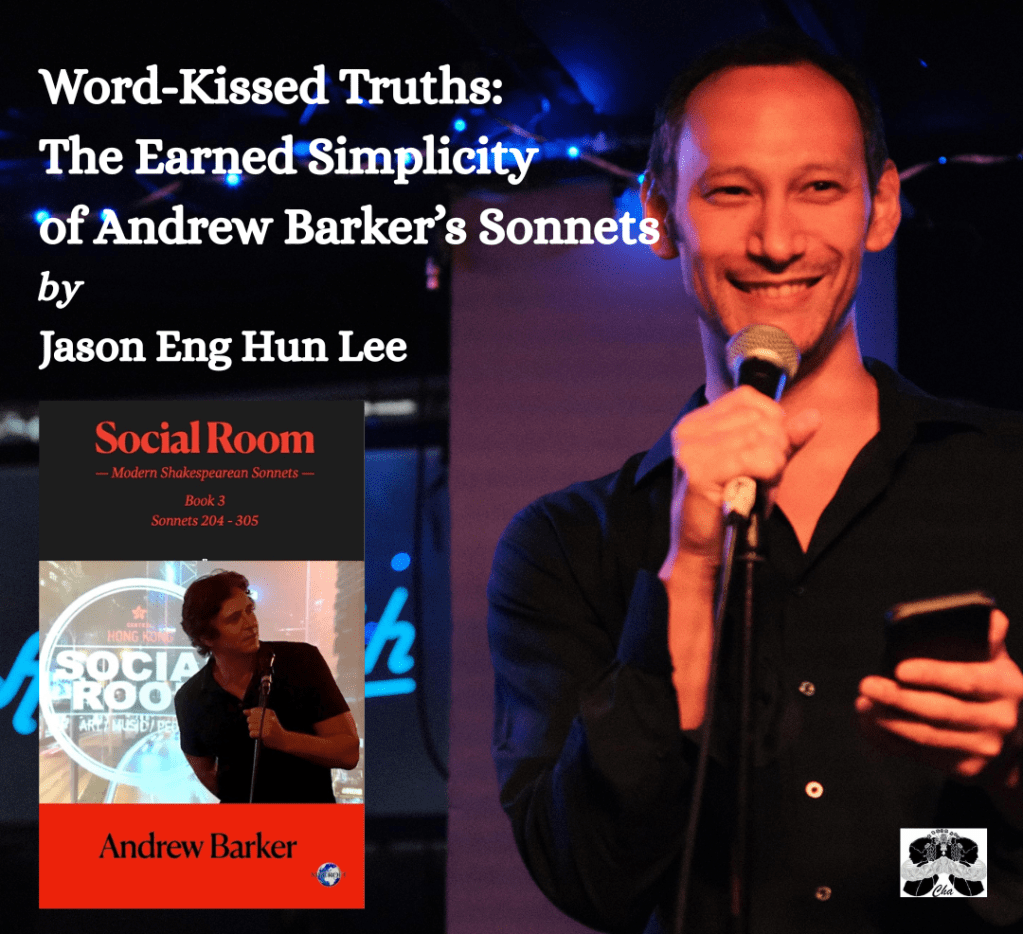
How to cite: Lee, Jason Eng Hun. “Word-Kissed Truths: The Earned Simplicity of Andrew Barker’s Sonnets.” Cha: An Asian Literary Journal, 19 Jun. 2025, chajournal.blog/2025/06/19/social-room.

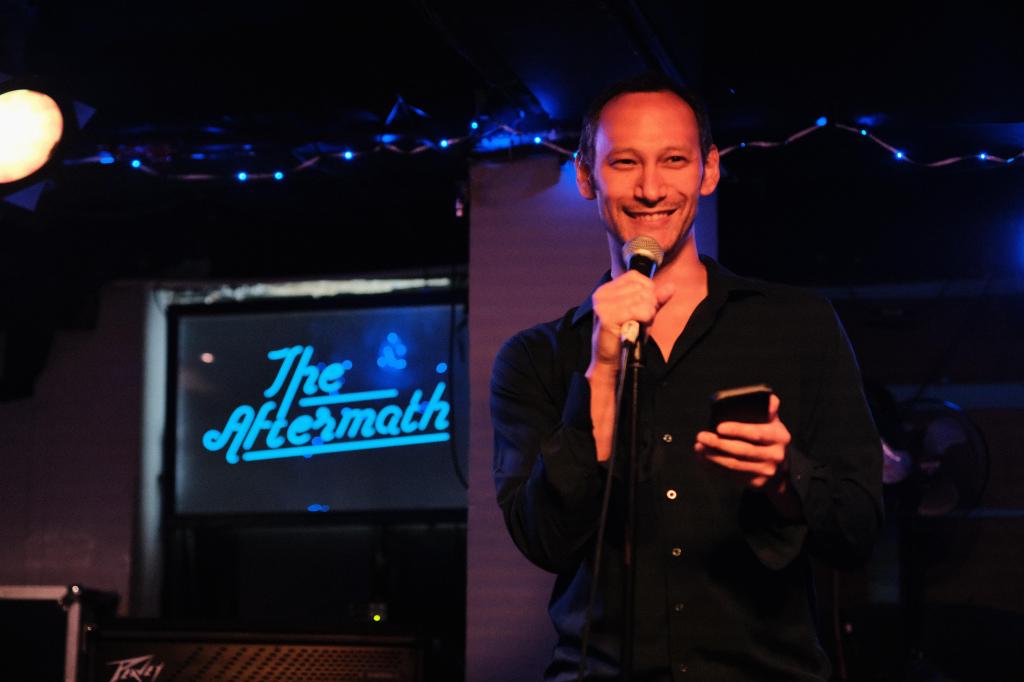
Jason Eng Hun Lee is Senior Lecturer in Literary and Comparative Studies at the Academy of Language and Culture, Hong Kong Baptist University. A scholar, creative writer, stage performer, and community advocate, his research and practice areas include postcolonial and diasporic Asian writing, global Shakespeares, creative pedagogy, and performance studies. His work has appeared in Shakespeare, Wasafiri, Journal of Postcolonial Writing, Textual Practice, and World Literature Today. He is co-editor of Where Else: An International Hong Kong Poetry Anthology (with Jennifer Wong and Tim Tim Cheng), and his first poetry collection, Beds in the East (2019), was a finalist for the Melita Hume Prize. He serves as literary editor for Postcolonial Text, is an executive committee member of the Asian Shakespeare Association, and is the chief organizer of OutLoud HK 隨言香港, Hong Kong’s longest-running poetry collective. He holds a PhD from the University of Hong Kong.
 Cha
Cha 