

📁 RETURN TO FIRST IMPRESSIONS
📁RETURN TO CHA REVIEW OF BOOKS AND FILMS
Click HERE to read all entries in Cha on Social Room.
Andrew Barker, Social Room: Modern Shakespearean Sonnets (Book Three, Sonnets 204—305), Mycroft Publishers, 2025. 186 pgs.
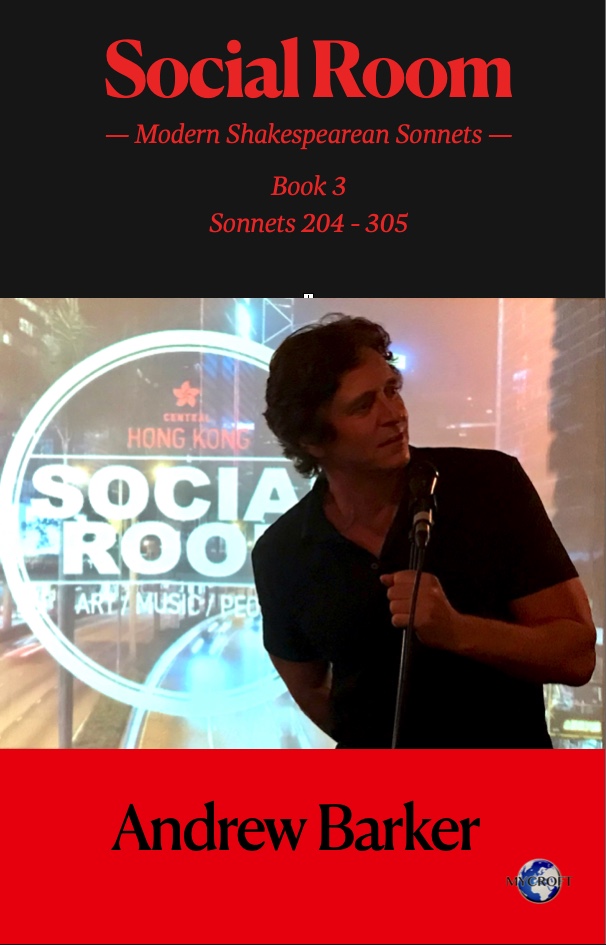
“So choose your enemies, I’ve chosen mine,” writes Andrew Barker in one of the final sonnets of this fascinating and variegated collection of (principally) Shakespearean sonnets—the latest instalment in his ongoing anthology series. This invitation from the prolific and occasionally pugilistic sonneteer to join him in railing against his oligarchic bêtes noires—the trochaic “kleptocratic kakistocracy”, with Trump and his ilk chief among them—typifies his adept use of the compact sonnet form to pour scorn upon our present-day simulacra of “leaders” and “captains of industry”.
Yet despite the combative persona this Hong Kong-based poet has so carefully cultivated, the volume you hold shimmers with incisive observations, paradoxes and—by no means least—tender, affectionate reflections on, and tributes to, significant figures both intimately known and more distant. This softer dimension is seldom on display at local poetry readings, where his boisterous performances render him a cross between pantomime villain and performance poet on amphetamines. Within the familiar stomping grounds of Hong Kong’s Peel Street Poetry and OutLoud, he is the entertainer par excellence, often accompanied by good-humoured heckling.
On the page, however—particularly on these pages—we are granted access to a markedly different poetic voice, one no longer declamatory or insistent. Instead, we hear, often though not invariably, the inner voice: candid, reflective, and imbued with both the disquiet of personal doubt and the humane, measured critique of a world beset by absurdities and injustices. It is a voice that not only articulates acerbic views on our social and political malaise but also invites the reader into a more intimate interiority—one that grapples with the ineffable, with the fears and vulnerabilities we often struggle to communicate.
Just as Barker’s more confrontational verse is sometimes searingly direct and uncompromising, so too does this introspective register reveal an unflinching, almost disarming honesty—one that may startle, but ultimately moves the reader with its candour. Much of this inward turning is meta-cognitively preoccupied with creativity and the act of writing itself, to the extent of questioning the very legitimacy of thinking of oneself as a poet. This becomes something of an idée fixe recurring throughout the collection—a sentiment entirely comprehensible within a creative context where English remains a minority language.
Above all, it evokes a profound sense of vulnerability and self-doubt, as poignantly exemplified in Sonnets 209 and 213, written during a visit to a literary festival in Jaipur. The poet’s ego is momentarily buoyed when he is misidentified (“she was the third that day”) as a headline author whose book he has just purchased. Yet his dry, assertive riposte in the closing couplet wittily encapsulates the quiet ambition that underpins the entire enterprise: “When someone said, ‘You’re Kevin Powers, I bet!’/ I looked up slowly from his book, ‘Not yet!’” In penning the sonnet to voice that aspiration, the would-be acknowledged author lays down yet another brick in the edifice of his literary project—one whose present manifestation is this very collection.
Another of the early sonnets, 205, meditates on how the act of writing captures thought retrospectively—yet in so doing, fossilises and distorts the original, lived experience. It contains the brilliant aperçu: “We make life what it wasn’t when we write / Of life, then we remember what we wrote”; the brutal honesty and clarity Barker deems essential to the poet render the word itself suspect when measured against the deed: “So write if you want, but what you say, / In ten years, you’ll remember it that way.”
Likewise, Sonnet 204, entitled “The Stage for Important Activities”, appears at first glance to be self-questioning—the double-voiced title simultaneously expressing conviction and ironic self-doubt, as the poet wonders what he cares deeply enough about to write. However, the concluding assertion of a reason to write poetry reverberates throughout the collection: “But silenced voices screaming from the real” (one might recall Munch’s painting here, perhaps?) “To bring these to attention, get them heard / I know no more important use for words.”
While such self-reflexive sonnets—concerned with the creative process and its attendant challenges—recur throughout the collection, there is also a contiguous sequence that articulates a shared experience of what the poet calls “the real”: his Lockdown Sonnets. These begin with recollections of two earlier epidemics in Hong Kong—the avian flu scare of 1997 and the SARS outbreak of 2003—before moving to the first of the Covid-19 sonnets. This retrospective approach seeks to contrast the poet’s changing responses to crisis: his youthful nonchalance in 1997, and his distant observation of eerily empty Lan Kwai Fong streets in 2003, differ starkly from his reaction in 2020. The resulting triptych of sonnets captures his evolving perspective on life in the city—not merely its public life but also his interior world as an older man and father during Covid: “Our instincts have our ears cocked to the news/ That howls at how we’ve so much here to lose” (Sonnet 222).
This group of 35 sonnets stands as a testament to a time when the world appeared suspended, with no clear end in sight to what became a global pandemic. The sequence charts various stages of the Covid era—compulsory mask-wearing, closed borders, mandatory proof of vaccination—and offers a richly experiential commentary on Hong Kong’s comparatively moderate lockdown. Nevertheless, a pervasive anxiety regarding the unknown underpins the sequence, allowing these sonnets to resonate with a broader audience—indeed, with most, if not all, save the deniers.
In one of these poems—Sonnet 225, “Clap for Carers”—Barker references Eliot’s observation that April is “the cruellest month” (here, for its grim fatality statistics), one of numerous intertextual allusions to the literary canon he so evidently reveres. Eliot, of course, was as influential a critic as he was a poet, and it is worth recalling his taxonomy in The Three Voices of Poetry: “The first is the voice of the poet talking to himself—or to nobody. The second is the voice of the poet addressing an audience, whether large or small. The third is the voice of the poet when he attempts to create a dramatic character speaking in verse.”
In many sonnets—particularly those from the Lockdown sequence—the poet’s solitary voice, speaking inwardly, is clearly discernible. Yet the second voice—addressing an audience—is equally present. For instance, in the sonnet inspired by a widely circulated meme in which Coronavirus, the Black Death and Spanish Flu sit together discussing their respective “missions”, a wry, whimsical humour surfaces, culminating in the lines: “I’m not sure who the joke drops on or whom / It’s mocking with its merriment. Are you?” (Sonnet 227). Here, the imagined addressee stands in for the poet’s temporarily lost live audience—a spectral substitute for the weekly poetry gatherings curtailed by the pandemic.
In this sense, his sonnet writing, once nourished by the collective energy of public performance, now requires a deeper mining of the self for creative impetus. It is only natural, then, that the quietude of the first poetic voice should come to the fore. One imagines it is precisely this solitude and introspection that has fostered the growth of the inward voice—whereas in earlier collections, the second voice has tended to predominate.
As for Eliot’s “third voice”—that dramatic monologue persona, the assumed or borrowed “other”—there are sporadic but telling instances in the collection. Among these is a deft lampoon of the archetypal evangelical preacher in Sonnet 240, “The Evangelical Preaches Against Coronavirus”. In this piece, the sheer self-righteous idiocy of the preacher, who interprets Covid as a Satan-sent plague intended as atonement for humanity’s original sin, is rendered with persuasive satirical flair. The sonnet convincingly pastiches those irritating and opportunistic homilies that reliably emerge in the wake of any major epidemic.
Strikingly different in tone is another persona poem, Sonnet 275, “My Guitar”, in which Barker adopts the voice of the dedicatee to evoke her relationship with her musical instrument. This poem, while less overtly aligned with Eliot’s third voice, blurs the lines between lyrical empathy and dramatic impersonation. A touch of biographical knowledge enhances our reading here: the poet is no musician, as anyone who has heard him sing will attest (imagine Sham 69’s “Hurry Up Harry, We’re Going Down the Pub”—only less tuneful).
Perhaps the most compelling of these third-voice sonnets is the imaginative impersonation of George Orwell’s Big Brother in Sonnet 293, “2031: The Shrivelled Tyrant Wants an Off-Switch”. Here, the irony is sharp: whereas the semi-mythical despot of Nineteen Eighty-Four is a byword for totalitarian repression and torture, Barker’s Big Brother is now a weary, disillusioned old man, disenchanted with the very dystopia he once engineered. Meanwhile, the proles and party members persist in their vacuous celebration of strength-through-ignorance—a pointed allusion to today’s cultural polarities and post-truth absurdities.
In Sonnet 271, “Threatening the Second Person”, the poet’s internal voice manifests not merely as a conventional first-person interior monologue but as a dialogue between “I” and “you”, splitting the poetic consciousness into two distinct voices. This technique enables an accusatory self-interrogation, as the “I” castigates its alter ego for adopting the “POSE of POET” (his capitalisation) and for failing to diligently record poetic ideas. The poem reveals an underlying crisis of creative confidence: the ‘you’ becomes a convenient scapegoat for the poet’s own inertia and vulnerabilities. He drily observes that, when given the option to take or leave his poems, most readers will simply leave them.
The sonnet concludes with the “I” assuming responsibility for his own creative output, refusing to shift the blame for artistic inertia onto the second person. It is, ultimately, the ego—self-esteem, pride, call it what you will—of the first person that propels him back to the task, while the second merely reflects criticism from his “honest eye”. This I / you duality appears elsewhere in the collection too—for example, in Sonnet 205, “What Happens If I Write About It”, previously discussed.
Whether this interior dialectic can be meaningfully compared with Yeats’s split-self poem, “A Dialogue of Self and Soul”, is debatable. For one thing, our present author, a self-avowed atheist, almost certainly regards the notion of the ‘soul’ as purely metaphorical—if not altogether dispensable.
An idiosyncratic feature of “Threatening the Second Person” is that it appears to be a sonnet in name only (rather like those poor, disestablished remnants of what was once the Republican Party in the dis-United States). There are two ways of interpreting this: either the author is flagrantly violating the Trades Descriptions Act and deserves to be summoned before the Pure Literature Tribunal, or he is taking justified liberties with the form—experimenting to see how far it might be expanded while still retaining the recognisable architecture of four-line stanzas and a final rhyming couplet. These extended sonnets, whether comprising fifteen stanzas plus closing couplet (as in “Threatening the Second Person”) or seventeen stanzas plus couplet (as in Sonnet 235, “American Lies”, which opens with a pastiche of Don McLean’s classic American Pie), may thus be viewed as legitimate exercises in subverting and reimagining the sonnet tradition.
The pith and succinctness of the conventional sonnet remain among its chief pleasures—for both the eye and the ear—so these extended outliers succeed precisely because they are unexpected and rare. In performance, their subversion of expectation can elicit amusement; on the page, their power lies in their exceptionality. That said, the slow-burning accumulation of stanzas in “American Lies” (The Year that Satire Died) builds a compelling indictment, all the more effective for its defiance of formal constraint: “How perverse / That those who laugh at fools get criticised / For foolishness, by fools who fail to see What’s happening.” The poet’s use of enjambment—running across lines and even stanzas—is consistently deft, and an aesthetic delight for those who value poetic technique as much as content.
This formal finesse is equally evident in another ‘non-sonnet’ sonnet, number 289, “Palindrome Douzaine”—a 12-line mirror poem in which the final six lines repeat the first six in reverse order. The result is a beautifully executed meditation on memory, regret, and the reciprocity between past and present.
Turning to pastiche and allusion in American Lies, the poet further develops this practice through several sonnets that echo lines and imagery from admired predecessors. Sonnet 212, “A Refusal to Mourn the Death, by Rape, of a Child in Delhi. Or the Death of Another Group of Children Mown Down in a School in America”, invokes Dylan Thomas’s “A Refusal to Mourn the Death, by Fire, of a Child in London”. However, this is less homage than a dialogue with Thomas, interrogating the poet’s role in responding to suffering, cruelty and death. While Thomas’s poem serves as a threnody for humanity during wartime—an acceptance of mortality amid chaos—Barker’s poem confronts the modern horrors of violence against children, underpinned by a critique of the societal forces that enable such depravity.
The line “You did though, didn’t you?”—directed at Thomas—is a sardonic comment on the original poem’s rhetorical avoidance: its passionate, incantatory immersion in nature and death as a way of not directly addressing the child’s demise. Barker’s sonnet performs a similar sleight of hand, using the earlier poem as a prism to refract unspeakable grief—while simultaneously questioning whether poetry, in the face of such brutality, has anything adequate to offer. “Poetry has use / When obvious and simple sympathy / Is all that seems on offer. But some days / We wait till we have something more to say.”
By contrast, Sonnet 231, “Dulce et Decorum Est, 2020: It’s Never Sweet or Fitting”, engages more directly with its source. Phrases from Wilfred Owen are repurposed in the context of the Covid-19 pandemic and seamlessly interwoven with Barker’s own language: “I thought of froth-corrupted lungs as gone / With trenches, five-nines, gas masks that don’t fit.” Yet Owen’s old indictment remains chillingly relevant: “The new lie comes upon us every day, / And lame, blind, drunk and deaf we fear the tweet / Of leaders who deny, disown, downplay / What’s happening before our helpless sight.”
In all, this is a remarkably diverse and intellectually stimulating collection by a poet who demonstrates an evident affinity with one of our most cherished and enduring poetic forms. At its core, the collection finds its genesis in his voracious appetite for reading and his deep appreciation of poetic forebears whose work animates his own creative impulses. As becomes especially apparent in the quieter, more ruminative pieces, a central motif throughout is one of self-interrogation—an ongoing inner struggle with creative inspiration and desire, flowing like a quiet but persistent stream through the entire volume.
Equally recurrent is the theme of exposing hypocrisy and humbug, whether in others or, with admirable candour, in himself. Sonnet 249, “A Factory-Farmed Pig Responds to a Boar Cull”—a non-human persona poem referencing the cretinous government officials who claimed that Hong Kong’s wild boars were vectors of Covid and thus required culling—is simultaneously a critique of residents who condemned the cull while continuing to consume factory-farmed pork. The poem reveals a sometimes underappreciated facet of the poet: a deep and empathetic concern for animals, as well as for humans suffering under the relentless machinery of the ultra-capitalist dystopia we presently inhabit.
His appreciation for those he deems deserving also comes to the fore in his tribute poems. These include dedications to his grandmother in Sonnets 290–91, a touching diptych entitled “To My Grandmother on Her 90th Birthday”; to friends, as in “For Ciaran on His 40th”; and to fellow Peel Street and OutLoud regulars—Sonnet 256, “To Make Memorable the First Minutes of Susan Lavender’s 70th Birthday”, and Sonnet 259, “To Kai Jeje at One, From a Difference of Opinion that will Never End”. In the latter, the poet alludes to a long-standing theological disagreement with his close friend, the child’s father—yet the poem exudes a counterintuitive warmth that transforms disagreement into a gesture of lasting affection.
Sonnet 298, “Reading Rimbaud in Japan”, forms an unexpected connection between his son’s possible future and the poetic legacy of Rimbaud, the French symbolist and enfant terrible. Riffing on the title of Rimbaud’s A Season in Hell, the poem imagines a time when his son may experience a dark passage of life—a secular prayer, of sorts, that he will ultimately emerge into serenity and enlightenment. Composed in solitude during a writing retreat, the sonnet reflects on the costs of creative withdrawal: “Insisting this withdrawal does me good / Though writing here comes at a cost: / Who doesn’t pay to earn their livelihood?” These lines acknowledge the sacrifice and dedication demanded both by what one writes and by how one chooses to write it.
Though this poet is undeniably a consummate performer—entertaining in every sense of the word—when reading his sonnets aloud, this collection offers us a privileged glimpse into a more private creative spirit: one that is reflective, pensive, and—dare I say it—caring. In this latest collection, he appears to have discovered his most compelling and mature voice, not only in his trenchant sociopolitical critiques, but, above all, in the more introspective and quietly powerful pieces. Enjoy this thought-provoking and richly rewarding reading experience.
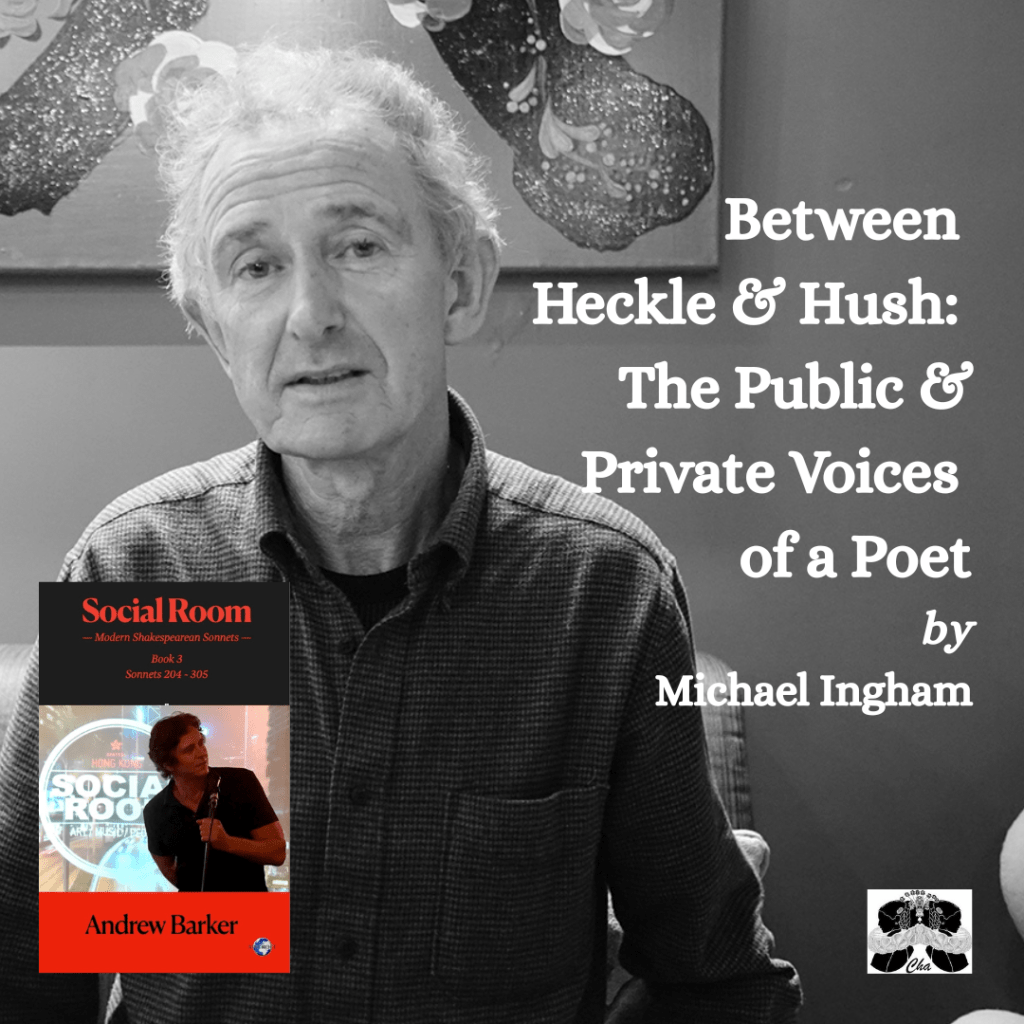
How to cite: Ingham, Michael. “Between Heckle &Hush: The Public & Private Voices of a Poet.” Cha: An Asian Literary Journal, 19 Jun. 2025, chajournal.blog/2025/06/19/social.


Michael Ingham is Adjunct Professor of English Studies in the Department of English at The Chinese University of Hong Kong. A dedicated tertiary educator and former teacher-trainer, his research interests encompass stage and screen drama, Shakespearean studies, Hong Kong literature in English, and drama in education. His published works include Stage-play and Screen-play: The Intermediality of Theatre and Cinema (2017), The Intertextuality and Intermediality of the Anglophone Popular Song (2022), and Anglo-American Stage and Screen Drama: The Post-democratic World Order (2024). He has also contributed journal articles and book chapters on stage and screen adaptation, early modern drama and Shakespeare, Hong Kong creative and critical writing in English, and drama pedagogy. His earlier publications on Hong Kong writing in English include City Voices and City Stage (Hong Kong University Press, 2004 & 2005), as well as Hong Kong: A Cultural and Literary History (Cities of the Imagination series, Signal, Hong Kong University Press, 2007).
 Cha
Cha 