
茶 FIRST IMPRESSIONS
茶 REVIEW OF BOOKS & FILMS
[ESSAY] “Simmering, Steaming, Spilling: On Hongwei Bao’s Queer Playtext Hot Pot” by Ronny Chan
Click HERE to read all entries in Cha
on Hot Pot.
Hongwei Bao. Hot Pot, Poetic Edge Publishers, 2026. 112 pgs.
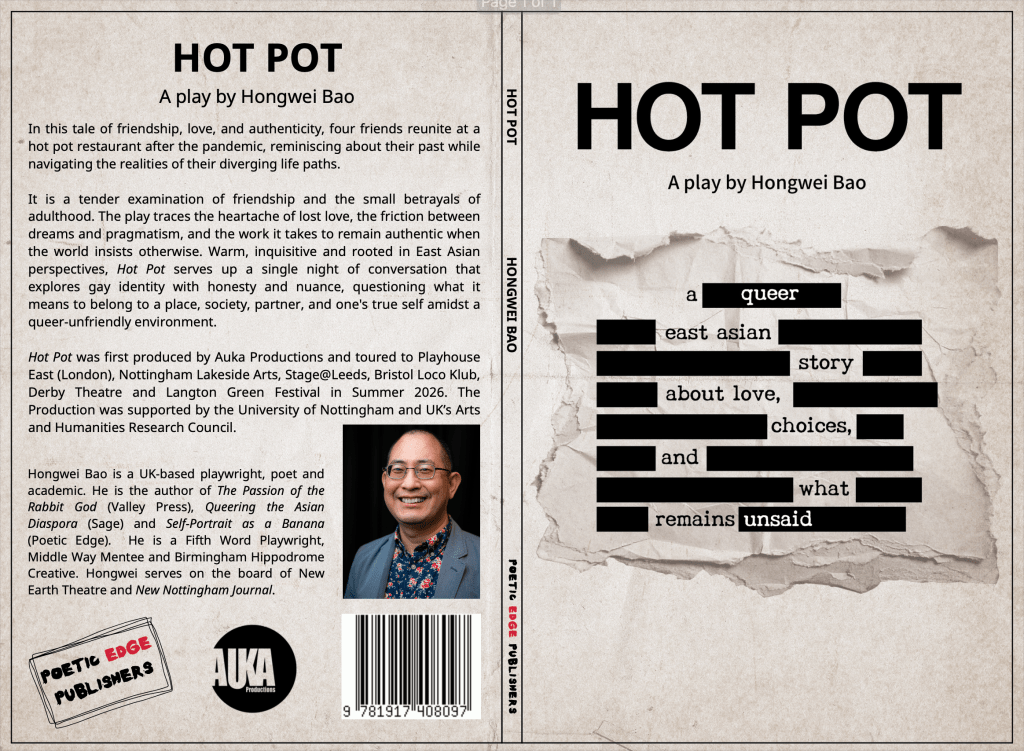
“To our reunion, 干杯! (Cheers!)” In Hongwei Bao’s playtext Hot Pot, adapted from his short story “Reunion,” four university friends huddle around a steaming pot in an Asian restaurant, clinking glasses to celebrate their twentieth graduation anniversary. Amid the hiss of gas fire and the gurgle of hot soup, they reminisce about their past and swap stories about pandemic lockdowns, artistic freedom, and sexual politics.
Bao resists Western cultural productions that often reduce Asiatic presence to exotic spices sprinkled into White gay fantasies.
At first blush, the pot seems to symbolise the harmonious mingling of four characters who have made different life choices under the intersecting pressures of state governance, heteropatriarchy, family, and class. But as the play unfolds, we see how they, like ingredients in the broth, heat up, bump together, drift apart, and spill over. Constellating the lives of four Asian (and likely Chinese) characters, Bao resists Western cultural productions that often reduce Asiatic presence to exotic spices sprinkled into White gay fantasies, while refusing to let their stories dissolve into a homogeneous category of Chineseness.
)
Alternating between their university years and present lives, the play unravels the queer intimacy between Tao and Ming and the homosocial bond between Lin and Mei, tracking how their relationalities sink and surface. Secret lovers during their undergraduate years, Tao and Ming hold divergent views on queer futures. As they grow up, Tao becomes a London-based artist with his British partner, Josh, while Ming lands a job as Head of News at a government-owned newspaper, married with a child. Paralleling Tao and Ming are Lin and Mei, who team up to initiate feminist campaigns during university but now lead separate lives. Whilst Lin is a single freelance writer, Mei is a married editor-in-chief of Shishang magazine. As fumes rise from the broth, their conversations steam, conflicting political stances and views on sexual freedom bubbling up, boiling over, and spilling out. The mist dissipates; the meal remains unfinished, leaving the ingredients floating in the cooling broth. Lin and Mei step outside, chat about their life choices, and exit hand in hand. Tao and Ming, by contrast, linger in the restaurant, dwell on their queer memories, glance back at each other, and depart in opposite directions.
)
Their unspoken relationship is visualised through the redaction bars on the playtext’s cover.
During their university years, the queer bond between Tao and Ming simmers in their shared intimacy, but homophobic pressure from the state, school, and family keeps it submerged. Their unspoken relationship is visualised through the redaction bars on the playtext’s cover and encapsulated by an ephemeral gesture, in which Ming wraps a used condom in toilet paper and pockets it after having sex in Tao’s dorm room (Act 2 Scene 5). Though it passes in the blink of an eye, his action intimates that their queer desires must be folded, crammed, and swept to the edges of the bed. Ming, the more conservative of the two, voices a pessimistic view of their future: “I mean, life at university is like a big bubble. We can do all kinds of things here that we can’t do out in the ‘real world’. But that freedom is just an illusion” (Act 1 Scene 4). Just as bubbles rise and burst in the broth, so too will the university bubble pop under the heat of the real world. His words call to mind the “just a phase” rhetoric, whereby queer moments flicker only to be subsumed into the straight time of marriage and child-rearing. In contrast to Ming’s pragmatism, Tao turns sideways towards a queer future unmoored from the normative coordinates of adulthood, embracing all its indeterminacy and instability. “None of us knows what the future will bring,” he retorts (Act 1 Scene 4).
But the play also stirs in the sociopolitical circumstances that shape their trajectories, refusing to let the costs of their choices sink. Ming, who hails from the countryside, is steeped in conservative family expectations and subject to discrimination against rural migrants. Invoking the Chinese idiom, “There are three ways to be unfilial; having no sons is the worst,” he exposes how Confucian ideologies and familial biopolitics commingle to constrain queer lives (Act 2 Scene 5). By elaborating on Ming’s background, Bao attends to how the “queer desires” of rural migrants carry “a much heavier undertone” than the “cosmopolitan dreams” of the middle class (p. 125), as he writes of the “inequalities, distinctions and hierarchies” (p. 3) produced by postsocialist neoliberalism in Queer China. Under such pressure, Ming becomes a Party member who recites official state ideologies, shoving his queer desires back into the closet, steering his life along the normative track, and shoring up heteropatriarchal norms. Tao, by contrast, comes from the city, though he too faces homophobic pressure from his family. After completing an MFA in London, he becomes a queer diasporic artist living with his British partner. Yet Tao’s path comes with its own bitter aftertaste: he struggles with financial precarity, the tokenistic art scene, and the daily realities of Sinophobia and anti-Asian racism. The play thus debunks the fraught dichotomy between the West as free and the non-West as unfree, revealing that queer survival, like the hot pot itself, demands gruelling negotiation just beneath the surface.
)
Paralleling the underground relationship between Tao and Ming is the minor intimacy between Lin and Mei. Though not explicitly queer, they engage in a bond that “bypass[es] the couple or the life narrative it generates,” as Lauren Berlant puts it (p. 285). During their undergraduate years, the two women unite around their shared feminist politics. On International Women’s Day, they create the assertive banner “My sexy look is not an invitation for your harassment” to counter a misogynistic, victim-blaming official poster (Act 2 Scene 7). The scene portrays their feminist horizontal alliance, one that exceeds the genre of heteropatriarchal kinship. As they reach adulthood, however, their lives morph into different shapes. Cognisant of how many “women’s lives [are] limited by kids” and heteronormative families, Lin is reluctant to have children (Act 2 Scene 8). Mei, in contrast, marries a husband “from a decent family” and sends her daughter to a competitive “international school” (Act 2 Scene 8). But when Lin asks if Mei is happy, Mei gives an enigmatic response: “I’m not unhappy. What’s happiness, anyway?” (Act 3 Scene 12). The double negative signals uncertainty about her feelings, intimating the pressure imposed by what Sara Ahmed calls “happiness scripts,” “gendered scripts” that “orient subjects toward heterosexuality” (p. 90).
)
Their political disagreements and opposing views on sexual freedom rise and spill over the edge.
As the hot pot heats up and steam fogs their faces, the conversation between the four sizzles with tension. Their political disagreements and opposing views on sexual freedom rise and spill over the edge. Over the course of the hot pot scenes, Ming’s phone buzzes and rings, pulling him away from the table, interruptions that foreshadow how his allegiance to state power will rupture their relationships. His hesitations in conversations about freedom and stringent pandemic lockdown measures hint at his pro-Party stance, signalling the ideological fault lines that eventually split the group.
Their major conflict erupts over the debate on danmei fiction, also known as Boys’ Love, which portrays homoerotic love between beautiful young men. Since university, Lin has been writing danmei; she and Mei are fujoshi who delight in speculating about the queer relationship between Tao and Ming. Whilst Lin continues to pen danmei fiction in her adulthood and defends it as “queer literature,” Ming dismisses it as “pornography,” warns her to stop publishing, and stamps out non-heteronormative desires (Act 3 Scene 11). He resorts to the rhetoric of cultural tradition that frames queerness as foreign and aberrant, a claim that Lin refutes by invoking the queer genealogies of cut sleeve (断袖), Long Yang (龙阳), and the Rabbit God (兔儿神) in Chinese history and mythology. This spectacle around the dining table miniaturises the tightening grip on queer expression by the nation-state. As Bao and Ma suggest in Queer Literature in the Sinosphere, China’s broadcasting regulator (the National Radio and Television Administration) prohibited danmei-adapted dramas in 2021, imposing “a chilling effect on the production and consumption of queer literature in the PRC” (pp. 7-8). The steaming of the broth thus refracts the escalating tension between sexual expression and political crackdown, reflecting how it constrains queer subjectivities and friendships.
)
With the conflict boiling over, Lin and Mei give Tao a hug, exit the restaurant, and leave Ming standing awkwardly inside. The steam dissipates, the pot cools, and their friendship along with it. As Bao writes in an article on food-related diasporic digital arts, the mundane acts of eating and cooking can serve as dense sites for negotiating differences, where “the exposure of human face to the other” carries “the potential to humanize cultural identities” and the “sensory regime of taste” “challenge[s] established ways of seeing and knowing the world” (p. 142).
The hot pot offers a space of encounter, but it cannot suture the rifts wrought by state authority and heteropatriarchy.
This play, however, tests the limits of food in bridging such differences: the hot pot offers a space of encounter, but it cannot suture the rifts wrought by state authority and heteropatriarchy that the four carry with them to the table. Whilst the reality appears bleak and murky, Tao’s soliloquy on the Rabbit God in Act 2 Scene 6 serves as a formal rupture, introducing a queer surplus time in excess of the plot and linear progress. A Daoist deity, the Rabbit God, in Bao’s words, shows us “how religion can treat sex and sexuality positively, challenging the popular, often Eurocentric, perception that religion and queer sexuality are incompatible” (p. 137). It is the reincarnation of Hu Tianbao, a low-ranking clerk who was sentenced to death during the Qing Dynasty for his erotic desire for a senior male official at the imperial court. By drawing out the Chinese folk tradition, Bao implies that queer resistance has a longer genealogy than the state’s crackdown. Scrambling and recoding the homophobic slur directed at gay men, the Rabbit God glimmers with queer possibility:
He sings:
Come to my temple,
my dear children, I shall
offer you sanctuary,
bless you with my magic,
and witness your love
as it buds, blossoms and spreads.
Like flowers.
Like grass.
Like fire.
With the switch to verse, Tao is able to articulate his suppressed queer feelings through the mythological figure. Directly addressing the audience, the Rabbit God’s blessing collapses the distance between stage and spectator. It vitalises an esoteric space that animates all forms of love and offers shelter to queer subjects both onstage and off. The language of “sanctuary” and “magic” fashions an occult realm for unruly desires, one that eludes institutional rationality, exceeds state regulation, and remains inscrutable to the dominant gaze. Sliding from the organic to the elemental, the three similes, flowers, grass, and fire, highlight the vibrancy and fabulosity of queer intimacies, the anaphora lending intensity to the rhythm. The verse, in José Muñoz’s words, is a “warm illumination of a horizon imbued with potentiality” (p. 1).
What should we make of these leftovers from an unfinished meal?
As the play closes, we are left with the cooling broth and the remaining ingredients still bobbing in the pot. What should we make of these leftovers from an unfinished meal? Perhaps they are the unresolved tensions among the four friends, the simmering desires that never quite surface. Or perhaps they gesture towards something more hopeful: that queer friendship, like the ingredients in the pot, waits to be heated up again, in a utopian future that is “not yet here” (p. 1).
Bibliography
▚ Ahmed, Sara (2010). The Promise of Happiness. Duke University Press.
▚ Bao, Hongwei (2026). Hot Pot. Poetic Edge Publishers.
▚ Bao, Hongwei (2025). “Performing the Rabbit God: Imagining Queer Identity and Heritage in the Chinese Diaspora,” Made in China Journal, vol. 10, no. 2, pp. 136–141.
▚ Bao, Hongwei (2020). Queer China: Lesbian and Gay Literature and Visual Culture under Postsocialism. Routledge.
▚ Bao, Hongwei (2021). “Sharing Food, Vulnerability and Intimacy in a Global Pandemic: The Digital Art of the Chinese Diaspora in Europe,” Journal of Contemporary Chinese Art, vol. 8, nos. 2–3, pp. 129–145.
▚ Bao, Hongwei and Yahia Zhengtang Ma (2024). Queer Literature in the Sinosphere. Bloomsbury.
▚ Berlant, Lauren (1998). “Intimacy: A Special Issue,” Critical Inquiry, vol. 24, no. 2, pp. 281–299.
▚ Muñoz, José Esteban (2009). Cruising Utopia: The Then and There of Queer Futurity. New York University Press.
How to cite: Chan, Ronny. “Simmering, Steaming, Spilling: On Hongwei Bao’s Queer Playtext Hot Pot.” Cha: An Asian Literary Journal, 18 Jun 2026, chajournal.com/2026/06/18/bao-hot-pot.


Ronny Chan is a writer and researcher based in Hong Kong. They are completing an MPhil thesis on queer literature from postcolonial Hong Kong, alongside a secondary project on queer experimental approaches to life writing. [All contributions by Ronny Chan.]
 Cha
Cha 