
📁 RETURN TO FIRST IMPRESSIONS
📁RETURN TO CHA REVIEW OF BOOKS AND FILMS
Also read “Feature: Lu Xun” in Cha.
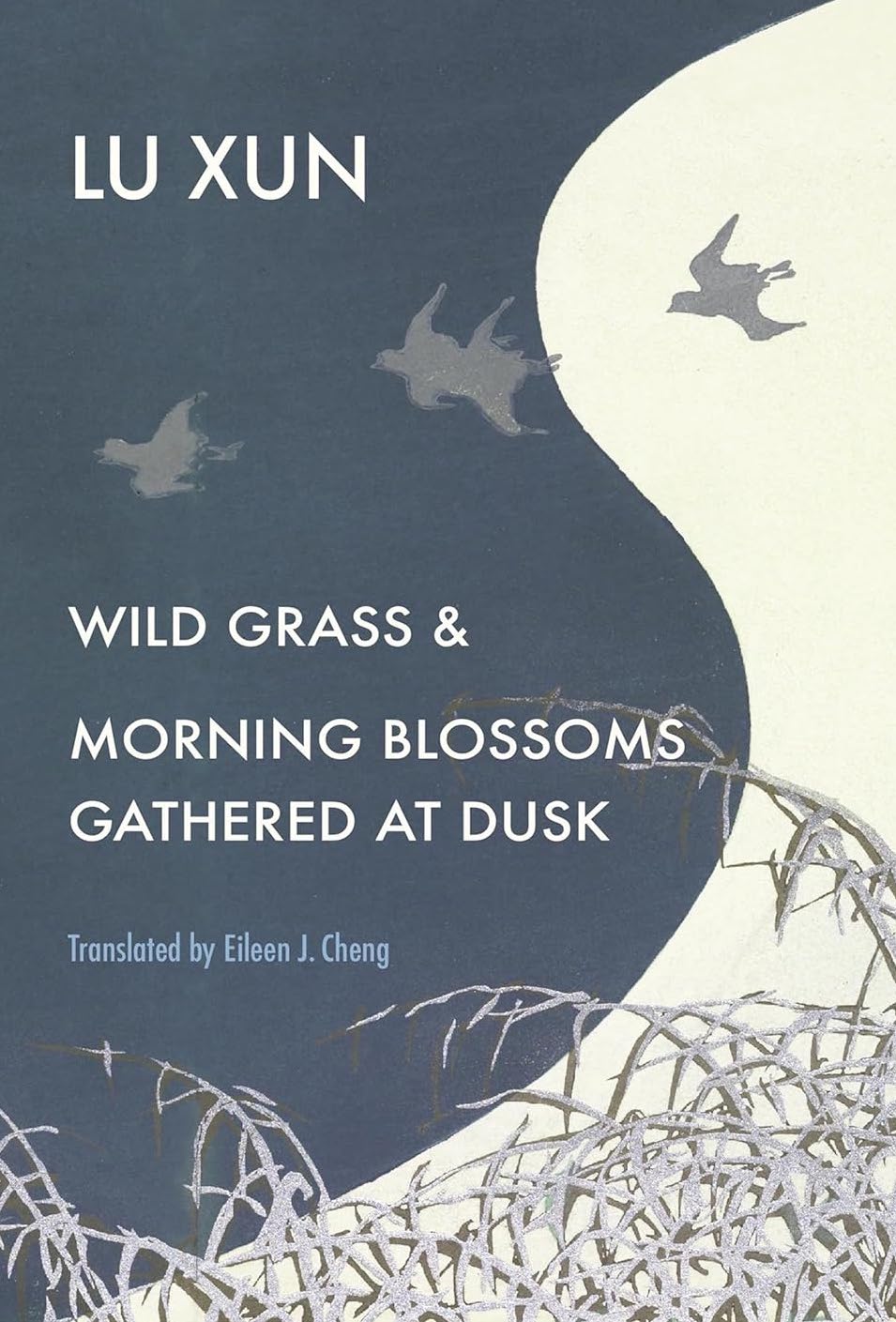
Lu Xun (author), Eileen J. Cheng (translator), Theodore Huters (editor), Wild Grass & Morning Blossoms Gathered at Dusk, Harvard University Press, 2022. 272 pgs.

“Lu Xun is widely considered one of the greatest writers of twentieth-century China,” opens the introduction to Wild Grass & Morning Blossoms Gathered at Dusk, translated by Eileen J. Cheng. This is lofty—yet undeniably warranted—praise. However, it nonetheless understates Lu Xun’s significance. It imposes caveats of time, geography, and discipline that diminish the role he played not only in Chinese literature, but in China’s broader intellectual and cultural history; the striking relevance of his legacy in contemporary China; and the global stature he ought to command.
One of the most immediate accomplishments of this volume is its success in presenting a broader selection of Lu Xun’s writings to a Western audience. Cheng’s is not the first contemporary translation of Wild Grass. Matt Turner also published a translation in 2019, under the title Weeds. However, as Turner notes in his prelude: translations can be done “again and again”.
Outside China, he is perhaps best known for his short stories—particularly “The Real Story of Ah-Q” from his seminal collection Call to Arms (吶喊 Nàhǎn)—which have previously been available in more accessible, less academic translations, such as those published by Penguin. These translations, however, represent only one facet of Lu Xun’s formidable literary oeuvre.
The works presented in this volume—Wild Grass (1927), a collection of imaginative prose essays, and Morning Blossoms Gathered at Dusk (1928), an experimental memoir—are less well known outside China. While not his most celebrated writings, they are arguably among his finest.
The description of Wild Grass as a collection of prose essays is not entirely accurate, though it serves as a convenient shorthand. As Cheng observes, Wild Grass “is an eclectic mix of genres, including prose poems, anecdotes, parables, dream-writing, and short memoirs; it also includes a one-act play and a parody of a classical poem.” Often imbued with melancholy, the texts nonetheless contain glimmers of hope—reflections of Lu Xun’s position as a writer committed to critiquing society.
Morning Blossoms Gathered at Dusk, meanwhile, is an experimental memoir composed of ten essays that reflect on Lu Xun’s formative years in Shaoxing.
Eileen J. Cheng has rendered these two collections into English with exceptional skill, preserving both their stylistic richness and intellectual depth, while making them eminently accessible. This volume offers a vital opportunity to appreciate the full breadth and creative range of Lu Xun’s literary vision.
Reading through the book, it is difficult to find a line that does not stir the emotions: “Even that last time I saw it, seven or eight years ago, I am almost certain that nothing but some weeds were growing there. But at one time it was my paradise.” So translates Cheng in From the Garden of Myriad Grasses to the Three Flavours Studio, a piece from Morning Blossoms Gathered at Dusk.
Beyond the translations, Cheng provides a wealth of notes and introductory material—ample, yet never excessive—that deepen the reader’s understanding without rendering the work overly academic.
These additions illuminate the fact that Lu Xun’s significance extends far beyond the words he committed to the page. His writing was animated by a sense of purpose: he wrote to critique China and to participate in reshaping it into a society he deemed more just and humane.
Lu Xun underscores this intent in the preface he wrote for the original 1932 English edition of Wild Grass, which is also included in this volume:
I wrote “My Lost Love” to satirize the poems on failed love affairs in fashion at the time; I wrote part one of “Revenge” because I detested the large numbers of bystanders in our society; astonished by the passivity of our youths, I wrote “Hope.” “Such a Fighter” reflected my attitude toward those writers and scholars who supported the warlords; “The Preserved Leaf” was written for those who loved me and wanted to protect me. After the Duan Qirui government gunned down an unarmed crowd, I wrote “Amid the Pale Bloodstains”; at the time, I had already gone into hiding at another location. When the Fengtian and Zhili warlord factions were at war, I wrote “An Awakening,” and from then on, I could no longer reside in Beijing.
He described his writings as “mostly small, pale white blossoms blooming on the edges of an abandoned hell, so of course one can’t expect them to be beautiful. But this hell must also be eradicated.”
Beyond the critiques, arguments, and insights into early twentieth-century China conveyed in his work, there is much more that contributed to Lu Xun’s enduring legacy and his status as a literary giant.
His early short stories, including Diary of a Madman and The Real Story of Ah-Q, were written in vernacular Chinese and published serially in magazines and newspaper supplements. This was highly significant, as these were among the first literary works in China to be composed in the vernacular, rather than the archaic literary Chinese that had previously dominated. In doing so, Lu Xun helped make literature more accessible to the broader public—a cultural shift of considerable importance.
Beyond his literary output, he was also an influential public intellectual, delivering speeches and teaching. His contributions to the New Culture and May Fourth Movements were profound—movements that, in turn, helped shape China’s pivotal twentieth century.
This legacy remains palpable today. One need look no further than a visit to his grave and memorial in Lu Xun Park, Shanghai. There, cartons of cigarettes and blank notebooks are still left—offerings to the prodigious writer (and inveterate smoker) as if for his continued use.
The enduring reverence for Lu Xun in contemporary China can be understood by returning to his writings. Though often composed in response to the conditions of early twentieth-century China, his work resonates with truths that transcend time. In Wild Grass, he writes: “They are, for the most part, little more than impromptu reflections. Since it was difficult to say things directly at the time, the wording is sometimes rather ambiguous.”
Any contemporary Chinese writer—whether contributing to a literary magazine or composing a post for WeChat—can feel the weight of those words.
And that significance ought not to be confined by geography or era. In his introduction to Morning Blossoms Gathered at Dusk, he writes:
For a period of time, I frequently recalled the fruits and vegetables that I ate as a child in my hometown: water chestnuts, broad beans, water bamboo shoots, musk melons. All of them so delectable and mouthwatering, they seduced me into thinking of home. Afterward, on tasting them again long after my departure, I found nothing remarkable about them; only in the realm of memory did the old flavors still linger.
This feeling—though steeped in specifically Chinese circumstances—is nonetheless universal, speaking to the enduring relevance and timeless significance of Lu Xun.
Returning to the introduction: “Lu Xun is widely considered one of the greatest writers of twentieth-century China.” This statement is something of an understatement, and Cheng’s excellent translation and contextualisation of Wild Grass and Morning Blossoms Gathered at Dusk does much to correct it—contributing to the recognition that Lu Xun is one of the greatest writers, full stop.

How to cite: Postings, Robert. “One of the Greatest Writers, Full Stop: Lu Xun’s Wild Grass and Morning Blossoms Gathered at Dusk.” Cha: An Asian Literary Journal, 16 Jun 2025, chajournal.blog/2025/06/16/wild-grass.


Robert Postings is a freelance journalist based in London, specialising in reporting on China. He has previously filed reports from both the Middle East and China. His work has appeared in The Times, Time Out Shanghai, The PIE, The Defence Post, and other publications. He is also a co-founder of the China Correspondents’ Club of London.
 Cha
Cha 