

📁 RETURN TO FIRST IMPRESSIONS
📁RETURN TO CHA REVIEW OF BOOKS AND FILMS
Click HERE to read all entries in Cha on The Milk Tea Alliance.
Jeffrey Wasserstrom, The Milk Tea Alliance: Inside Asia’s Struggle against Autocracy and Beijing, Columbia Global Reports, 2025. 104 pgs.

The twentieth century in Asia was, in many ways, characterised by protest, revolution, and upheaval—not everywhere at all times, but in enough places, often enough, to define the era. In the waning years of the Cold War, after much of the region had shed imperial dynasties, monarchies, and overt colonial rule, the Japanese scholar of Chinese literature Takeuchi Yoshimi wrote that Asia must now “re-embrace the West.” Yet what he envisioned was not a bland diplomatic rapprochement. Rather, Takeuchi called for Asia to “change the West in order to further elevate those universal values that the West itself produced.” In other words, only those nations that had overthrown French colonial rule could, by that very act, teach France the true meaning of liberté, égalité, fraternité.
Liberation from French (or American, British, Dutch, Spanish) rule was merely the first step. The second was to hold the West to account—globally—for its own professed ideals, such as universal human rights. By the second decade of the twenty-first century, young people across Asia were indeed at the vanguard of efforts to universalise what are often labelled Western values. This time, however, in places such as Hong Kong, Thailand, and Myanmar (Burma), the principal adversaries were domestic—and, to varying degrees, China itself. This latter transnational struggle is the subject of historian Jeffrey Wasserstrom’s concise new book, a kind of academic novella, The Milk Tea Alliance: Inside Asia’s Struggle Against Autocracy and Beijing (Columbia Global Reports, 2025). Lucid, well-researched, and interesting, the book merits wide discussion.
The Milk Tea Alliance began as a hashtag on Twitter. In April 2020, a Thai actor from the internationally popular drama 2gether, Vachirawit Chivaaree (nicknamed Bright), liked a tweet that referred to Hong Kong as a “beautiful country.” Fans in the People’s Republic of China (PRC) perceived this as a subtle affront to their government’s One China policy and launched a mass online campaign of denunciation and investigation. They soon discovered that Bright’s girlfriend had retweeted and liked posts that transgressed political sensitivities surrounding China’s role in the COVID-19 pandemic and the status of Taiwan. Calls to boycott 2gether followed—despite the show never having been officially released in the PRC. In response, Twitter users in Thailand, Hong Kong, and Taiwan rallied around the hashtag #MilkTeaAlliance, generating millions of tweets opposing the imposition of Chinese nationalism across the region. The hashtag swiftly evolved to encompass not only resistance to Chinese authoritarianism but also to local autocracies, all while celebrating regional variants of milk tea.
There is a certain absurdity to the online dimension of the Milk Tea Alliance. It bears the air of counter-trolling frivolity—an unseriousness accentuated by the widespread adoption of imagery drawn from Hollywood films aimed at young adults, repurposed as sincere gestures of resistance against authoritarianism. I refer here to the now-iconic use, originating in Thailand, of the three-finger salute from The Hunger Games franchise, and, again in Thailand, the appropriation of Voldemort from the Harry Potter series to symbolise the king—he who must not be named, lest one violate lèse-majesté laws and face a lengthy prison sentence.
Taken at face value, such surface-level expressions would seem to render the Milk Tea Alliance an unworthy heir to the lineage of political struggle that defined Asia throughout the last century. Imagine Ding Ling in Yan’an critiquing gender hierarchies within the Chinese Communist Party while cosplaying as Hermione. Imagine Mao delivering his rebuke, insisting she fall in line, with a lightning bolt scrawled across his forehead.
In some respects, the appeal of young adult fiction’s iconography reflects the age of the activists Wasserstrom profiles in his book. In Thailand, Netiwit Chotiphatphaisal was only fourteen when his political awakening began, influenced by the conservative Buddhist social critic Sulak Sivaraksa; by seventeen, he had become the first conscientious objector to Thailand’s military conscription policy. Agnes Chow and Joshua Wong were still in secondary school when they joined Hong Kong’s Umbrella Movement. Nickey Diamond was in his mid-twenties when he participated in Myanmar’s Saffron Revolution—practically middle-aged by comparison. The repurposing of Hollywood franchise imagery also speaks to the role of humour in political movements. For—and here lies the essential contradiction—the stakes of the actions taken offline by those broadly aligned with the Milk Tea Alliance were, and remain, deadly serious.
Young activists in Thailand—who receive the longest chapter in Wasserstrom’s book—mobilised in opposition to the military junta led by Prayuth Chan-ocha, demanding governmental and monarchical reform despite facing police violence, a byzantine legal system, and the threat of lengthy prison sentences. Prayuth seized power via a coup d’état in 2014 and ruled Thailand under various titles until 2024. His overthrow of a democratically elected government, along with well-documented human rights abuses, barely disrupted Thailand’s deepening economic ties with China and, following some brief handwringing in Washington, caused minimal disturbance in its relationship with the United States.
Prayuth’s government faced repeated waves of protest, but some of the most significant opposition emerged in the wake of the 2019 elections. In that contest, the progressive Future Forward Party secured enough parliamentary seats to challenge Prayuth for the premiership. In response, Prayuth dissolved the party and retained his grip on power for another four years. Weary of police harassment and the onset of the COVID-19 pandemic, activists in Thailand nevertheless reignited their efforts, staging mass demonstrations in Bangkok. Netiwit, who had travelled to Hong Kong in 2016 to meet Joshua Wong, was a key organiser. At one such demonstration, a young woman named Panusaya Sithijirawattanakul (nicknamed Rung) read aloud a ten-point manifesto for reforming the Thai monarchy before thousands of protesters. For this supposed defamation of the monarchy, Rung was subjected to harassment and arbitrary detention by Thai authorities.
Rung’s willingness to risk years of imprisonment in order to speak out drew popular comparisons to Agnes Chow, who fought for full democracy in Hong Kong alongside Joshua Wong and Nathan Law during the Umbrella Movement. Over the course of 80 days in 2014, that movement occupied three sites, pitting young activists against “riot police [using] pepper spray, tear gas, and batons to disperse protesters.” Following the movement’s defeat, Chow co-founded the Demosisto party with Law and Wong. In 2017, Law was elected to the Legislative Council but refused to take the mandated oath of allegiance to the PRC. He was promptly removed from office, and Chow renounced her British citizenship in order to stand as his replacement.
Wasserstrom notes that the Hollywood iconography so closely associated with Thai activism also found expression in Chow’s campaign. One poster depicted her drawing a bow and arrow in the style of Jennifer Lawrence’s character from The Hunger Games, accompanied by the caption “The Younger Games.” Though disqualified from standing for office, Chow became a prominent organiser in the subsequent—and markedly more militant—Be Water movement of 2019 and 2020. In December 2020, she was sentenced to ten months’ imprisonment for her involvement in the largest protest movement in Hong Kong’s history.
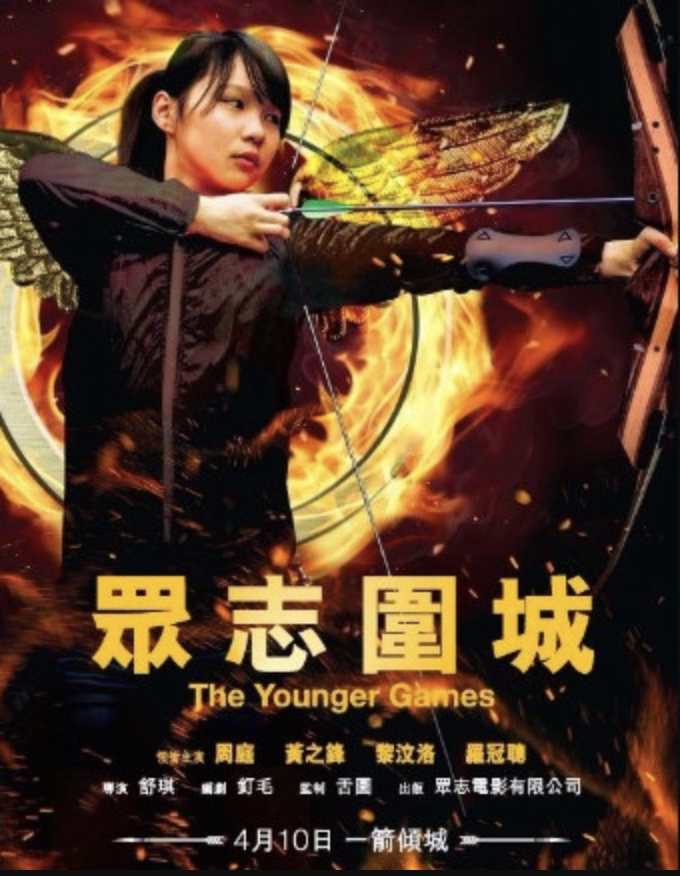
Agnes Chow, as Katniss Everdeen in The Hunger Games. Image circulated by Demosisto.
Activists in Myanmar aligned their political struggle with the Milk Tea Alliance beginning with the Spring Revolution—a mass movement opposing Min Aung Hlaing’s military coup d’état in February 2021. Adopting the now-familiar three-finger salute, activists in Myanmar faced the most brutal repression of any group affiliated with the Milk Tea Alliance. It is estimated that as many as 6,000 civilians have been killed by the military and 27,000 arrested. Armed resistance has resulted in a death toll approaching 70,000, with approximately 3,000,000 displaced. The Milk Tea Alliance may have originated as a meme, but the stakes of the individual struggles Wasserstrom chronicles in his book are undeniably real.
Demonstrating the substance—and the tangible, often dire implications—of an international solidarity movement is no easy task. How much does solidarity actually count? Materials and tactics—such as the defensive use of umbrellas—were shared from Hong Kong to Thailand. The three-finger salute became a ubiquitous emblem. Protesters in one country organised demonstrations to mark the anniversaries, victories, and defeats of protesters in another. Songs circulated across borders; edited volumes were published in tribute to the leaders of fellow movements. Some accounts overstate the online dimension of the movement—a pitfall Wasserstrom avoids. Others rightly observe that the Milk Tea Alliance’s moment has passed. Yet Wasserstrom convincingly argues that the Milk Tea Alliance served as the capstone to a decade of unrest across Asia—and in this, he is undoubtedly correct.
The aims of the various movements identifying with the Milk Tea Alliance were deeply rooted in their distinct and often divergent political contexts. Nevertheless, Wasserstrom offers a synthesis that merits quoting at length:
The primary goal of Milk Tea Alliance activists is to see their communities governed in a more just and democratic fashion. They champion fundamental rights such as free elections, free speech, free assembly, and civil liberties. The activists do not engage extensively with questions of governance post-revolution, instead maintaining a narrower focus on opposing authoritarianism and countering the global, bullying influence of the Chinese Communist Party.
Participants in the Milk Tea Alliance were committed to fundamental liberal rights. They engaged in political struggle in the narrowest sense of the term: they demanded elections, freedom of expression, and the civil liberties they observed elsewhere. Their vision of the future was, in essence, the present they perceived in the West. This constitutes a serious limitation of the movement—but one that should elicit sympathy rather than scorn from external observers. The paradox of liberal rights is that they are radical in contexts where they do not exist, yet often serve as impediments to deeper justice in societies where they are already established.
In August 2020, the Chinese government sanctioned eleven U.S. citizens for their vocal support of Hong Kong’s pro-democracy activists. The list included, among others, then-serving Secretary of State in the Trump administration Marco Rubio, as well as Ted Cruz, Tom Cotton, and Josh Hawley—all of whom attempted to align themselves with Hongkongers’ demands for liberal rights and condemnation of abuses against Uyghur minorities in Xinjiang. This, along with Joshua Wong’s high-profile visit to Washington, provided further ammunition for Beijing’s claims of foreign interference.
Yet no credible observer of American politics would mistake figures like Rubio or Cruz for advocates of genuine political equality—particularly not as Black Lives Matter protests swept across American cities that same year. Liberalism carries with it a discourse of individualism and a studied silence on economic rights, which has created space for authoritarian-tinged conservatism throughout much of the West. It would be unreasonable to expect activists in Hong Kong to manage or pre-empt the ways in which their cause might be co-opted by Western conservatives. Nonetheless, the absence of a positive, forward-looking political vision makes such co-optation all the more feasible.
The danger lies in the fact that the world is far more complex than the binary of U.S.–China rivalry—yet that rivalry casts its shadow everywhere. To underthink this is to risk exchanging one form of oppression for another. Take Thailand, for instance: Prayuth’s government never faced serious condemnation from the United States, placing him squarely within a long tradition of Thai military dictators effectively endorsed by Washington’s “he may be a bastard, but he’s our bastard” logic of foreign policy. In Myanmar, although the U.S. government has condemned the military for its genocide of Rohingya Muslims, it has also defended the government of Aung San Suu Kyi under whose watch those atrocities occurred.
Yet China is the common adversary uniting all participants in the Milk Tea Alliance. Beijing’s influence is both real and expanding—even if experienced unevenly from Hong Kong to Bangkok to Naypyidaw (a deliberate understatement). This shared opposition is justifiable for reasons far beyond the conniption fit thrown by PRC Twitter users that first gave rise to the hashtag #MilkTeaAlliance. From territorial claims in the South China Sea to demands for repatriation from neighbouring states, every nation in Southeast Asia has cause for vigilance. However, if the ultimate aim is to model one’s government after Western democracies, activists would do well to recall that Western intervention in the region is a major reason why liberal democratic demands remain so radical. This is not to suggest that democracy is unworkable in Asia—such claims are both racist and serve the interests of authoritarianism. Rather, it is a reminder that the enemy of your enemy is sometimes also your enemy. Wasserstrom does not address this tension.
What, then, following Takeuchi, might the Milk Tea Alliance teach the world about universal values—the “fundamental rights” that Wasserstrom outlines? Perhaps it is this: that enemies of these values exist on all sides, eager either to crush them or co-opt them. Most certainly, we are reminded that where such rights are absent, people will risk their freedom—and often their lives—to secure them. We also learn that the possibility of international solidarity remains as present as it was in the previous century, and that transforming solidarity into enduring international action remains just as difficult. The Milk Tea Alliance has already faded—but its brief existence proves that it can happen again. And that is no small thing. The world is in need of a new non-aligned movement, and Southeast Asia could still be where it begins.
How to cite: Zeller, Nick. “oba, Grass Jelly, Light Tea, Democracy: On Jeffrey Wasserstrom’s The Milk Tea Alliance.” Cha: An Asian Literary Journal, 28 May 2025, chajournal.blog/2025/05/31/alliance.


Nick Zeller is a senior program associate in The Carter Center’s China Focus initiative and Editor of The Monitor, a Carter Center newsletter about U.S.-China relations.
 Cha
Cha 