

📁 RETURN TO FIRST IMPRESSIONS
📁RETURN TO CHA REVIEW OF BOOKS AND FILMS
Click HERE to read all entries in Cha on In the Mood for Love.
Wong Kar-wai (director), In the Mood for Love, 2000. 98 min.

Some films are simply like that—from the moment you encounter them, they leave an indelible impression on the heart and mind. In the Mood for Love, by Wong Kar-wai, is one such film. Remarkably, it has now been 25 years since its release. Even today, the film’s emotional texture, its aesthetic sensibility, and the delicate love it evokes—all continue to feel utterly fresh. This is not merely a film; it is a work of art that exquisitely captures the unspoken desires of a bygone era and of particular individuals, rendered with sublime sensitivity on screen.
The film is set in 1960s Hong Kong. For Wong Kar-wai, himself an immigrant from Shanghai, it was more than just a backdrop—it was a space imbued with personal resonance. The narrow alleys, crowded apartment buildings, and perpetually rainy atmosphere all coalesce to shape the film’s mood. Subtly, the narrative conveys how the social constraints of the time—the rigid expectations and moral codes—served to repress the desires of those who lived within them. Chow Mo-wan (Tony Leung) and Su Li-zhen (Maggie Cheung) move into adjacent flats, and a small yet pivotal twist in their lives becomes the core of the story.
On the surface, the plot is disarmingly simple. Chow and Su gradually come to realise that their respective spouses are unfaithful. That discovery, and the loneliness it engenders, draws them together. Yet their bond unfolds with a quiet restraint—a kind of moral control. There is an unspoken pact between them: “We won’t be like them.” Longing, betrayal, time, memory, and moral duty—these are the film’s central pillars. The silences they share, the glances they exchange, the hours spent in a hotel room—each moment conveys the poignant beauty of love unspoken. A single glance is offered, and yet that glance lingers, resonating with a thousand possible meanings.
The film’s production process is, in itself, a fascinating tale. The shoot reportedly extended over 15 months. Wong Kar-wai’s improvisational directing style—that is, a mode of direction driven by instinct and spontaneity—lent the film an organic, fluid quality. The Asian financial crisis precipitated several changes, including a notable transition from Christopher Doyle to Mark Lee Ping-bing as cinematographer, further complicating an already unconventional shoot. An intriguing detail is that this film forms part of a loose trilogy, alongside Days of Being Wild and 2046. Amidst all this turbulence, a cinematic masterpiece emerged.
Every frame of the film is pure visual poetry. The lush imagery plays masterfully with vibrant reds and blues. Slow-motion sequences etch each emotion with lingering intensity. Shigeru Umebayashi’s haunting “Yumeji’s Theme” weaves a sensual melancholy that seems to resonate deep within the soul. Maggie Cheung’s iconic cheongsams are more than mere garments—they are aesthetic signifiers, reflecting her inner world and unspoken confessions. Each cheongsam tells its own silent story. Together, these elements offer a richly immersive sensory experience.
When the film premiered at the 2000 Cannes Film Festival, Tony Leung was awarded Best Actor. It was also met with widespread critical acclaim. In the Mood for Love has since served as a wellspring of inspiration for filmmakers such as Barry Jenkins and Sofia Coppola. Its influence has rippled through fashion, music, and contemporary visual storytelling. This is not merely a film—it is a cultural phenomenon.
Now, a quarter of a century later, in this year 2025, a director’s cut has been released in China on Valentine’s Day. This new version reportedly includes nine minutes of additional footage—featuring modern settings and even more deeply intimate moments. For long-time admirers, it is a rare gift; for new viewers, an opportunity to experience the film’s emotional resonance with renewed depth.
The scene in which Chow whispers his secret into the wall at Angkor Wat, the moment Su weeps alone in the hotel room—when we witness these, a sense of what might have been, a yearning for “what if it had happened this way?”, arises within us as well. The fragility and endurance of love—the film captures both with exquisite subtlety, revealing love’s vulnerabilities even as it endures the passage of time.
Across the world, unspoken desires and a quiet longing often pervade relationships. Yet few films express these emotions so beautifully, so poetically. Every silence, every fleeting glance, every delicate strand of music in In the Mood for Love pays homage to those unspoken feelings. In its own way, the film awakens such emotions within us, allowing us to journey intimately alongside its characters.
Just as the rain in the film is not merely a backdrop but almost a character in itself—mirroring their sorrow and solitude—the shadows, too, harbour their secrets. Wong Kar-wai is less a filmmaker than an alchemist, transmuting time, memory, and silence into cinematic gold. He transports us to 1960s Hong Kong, invites us to walk gently beside Chow and Su, and makes us not just spectators, but participants in their mood for love. Never mind 25 years—however many years may pass, In the Mood for Love will endure in our hearts as a timeless classic. It’s all in the mood, isn’t it?
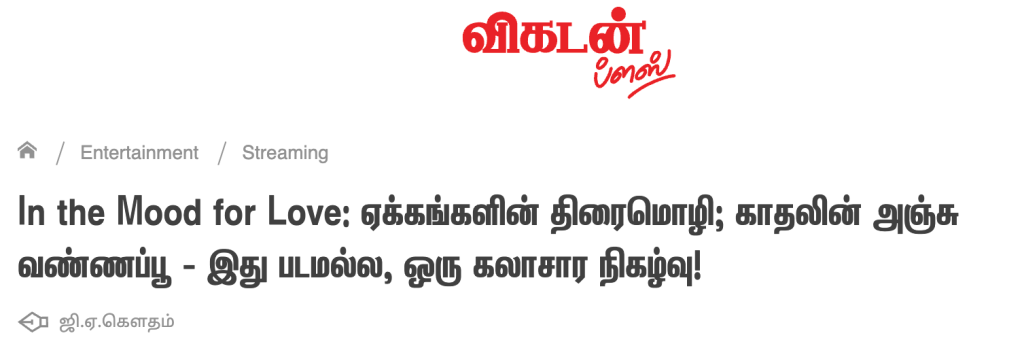
Tamil Version :
How to cite: Gowtham, G.A. “In the Mood for Love at 25: Wong Kar-wai’s Cinematic Language of Longing.” Cha: An Asian Literary Journal, 24 May 2025, chajournal.blog/2025/05/24/in-the.

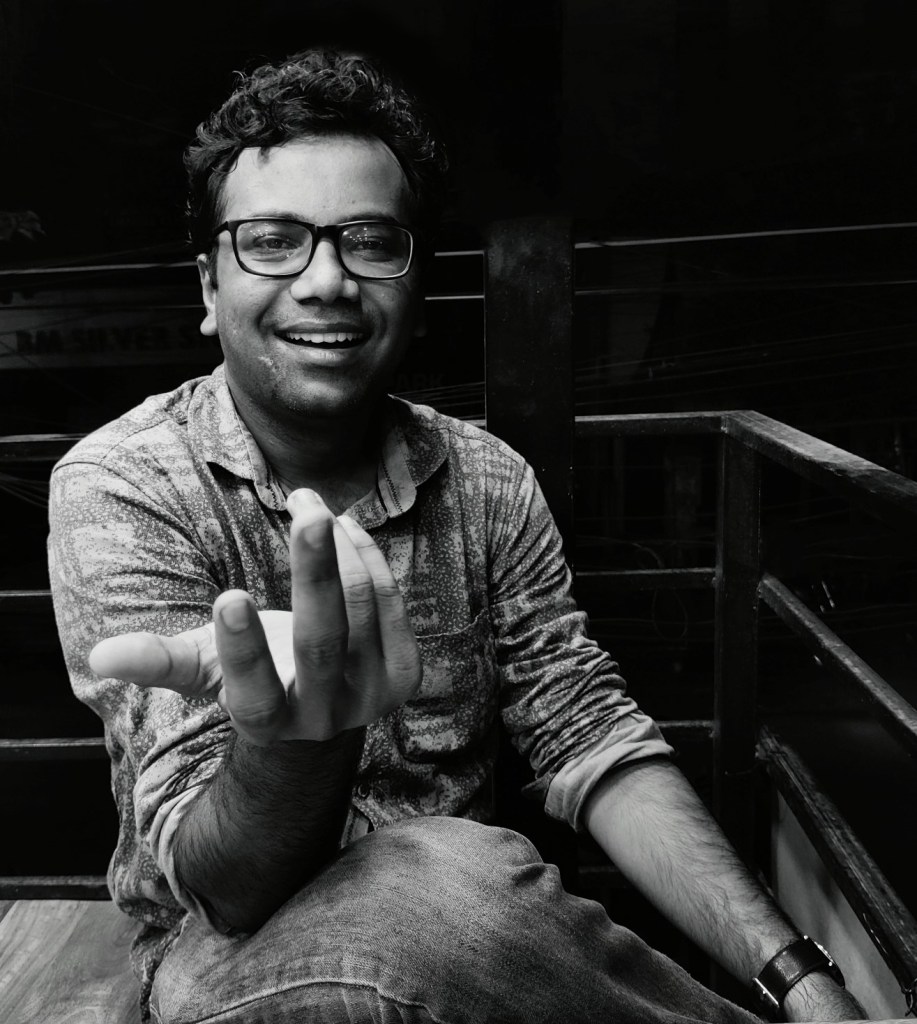
G.A. Gowtham is a film editor and writer based in Chennai, India. His professional experience in shaping narratives on screen profoundly informs his perspectives as both a writer and a literary translator (from English to Tamil). A keen observer of cinema, politics, and culture, his critical essays and reviews have appeared in esteemed Tamil publications such as The Hindu Tamil, Ananda Vikatan, and Kalachuvadu, as well as in English for ThePrint. Gowtham’s work often delves into the nuanced intersections between artistic expression and societal dynamics. Through his multifaceted engagement with storytelling—both visual and textual—he endeavours to cultivate a deeper understanding of contemporary art and its cultural significance. For further information on his work,please visit his website. [All contributions by G.A. Gowtham.]
 Cha
Cha 