

📁 RETURN TO FIRST IMPRESSIONS
📁RETURN TO CHA REVIEW OF BOOKS AND FILMS
Alex John Catanese, Buddha in the Marketplace: The Commodification of Buddhist Objects in Tibet, University of Virginia Press, 2019. 334 pgs.
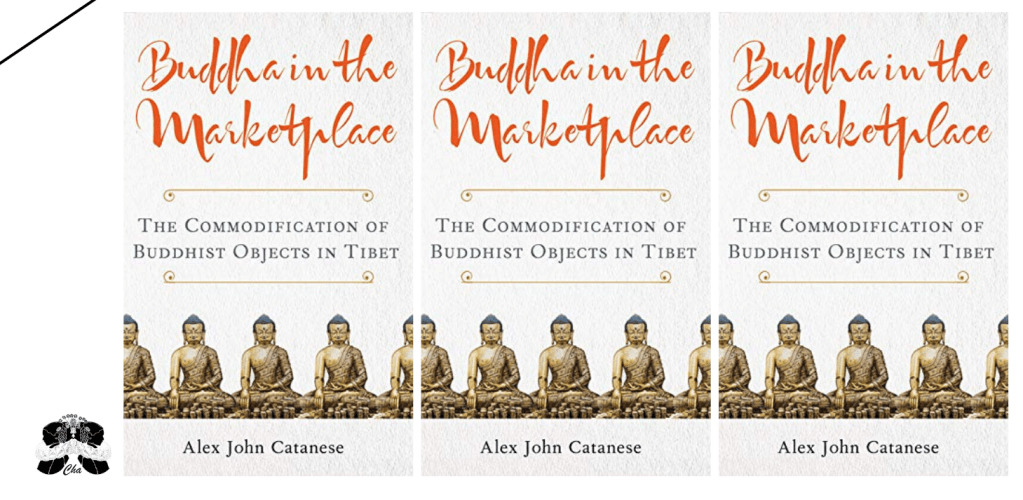
The phenomenon of religious commodification across diverse religious traditions has, in recent years, garnered increasing scholarly attention. Investigations into the convergence of religion and the market not only expose inherent tensions and contradictions between religious and commercial values, but also open up fertile avenues for examining contemporary religious and social life. Unsurprisingly, both Buddhist and Tibetan studies have also begun to reflect a growing interest in the entanglement of Buddhism and commerce. Buddha in the Marketplace traces the commodification of religious objects by Tibetans to the 1980s—the post-Cultural Revolution reform era (gaige kaifang) when China officially and selectively embraced a market economy. Through a nuanced combination of textual, historical, and ethnographic inquiry, Alex John Catanese contends that this commodification emerged in response to both the advent of free-market capitalism in China and the socioeconomic and political conditions resulting from specific policies enacted by the Chinese Communist Party. Structured into seven chapters preceded by an introduction, Catanese’s study is anchored in a theoretical framework that deftly draws on several concepts from Arjun Appadurai’s The Social Life of Things (1986).
Chapter 1 engages with a wide array of Indian and Chinese Buddhist texts to delineate the doctrinal background concerning the sale of religious objects. Analysing materials from both the sūtra and Vinaya corpora, the author presents numerous instances of scriptural injunctions that liken the commercial production or sale of Buddha images to the ingestion of poison. According to Catanese, two categories of proscriptions against the sale of Buddhist objects circulated in Indian and Chinese contexts. The first aimed to prohibit the sale of monastic property, while the second denounced such practices as a form of “wrong livelihood”. It is this latter category of proscriptive statements—and its various interpretations—that, he argues, came to dominate Tibetan Buddhist literature.
Chapter 2 explores various genres of Tibetan Buddhist literature—from stages of the path (Tib. lam rim) and refuge precepts (skyabs ’gro) texts to hagiographies (rnam thar) and commentaries—ranging from as early as the eleventh century to contemporary works. Catanese presents numerous examples from influential Tibetan Buddhist figures such as Tsongkhapa (1357–1419), Patrul Rinpoche (Dpal sprul rin po che, also known as O rgyan ’Jigs med chos kyi dbang po, 1808–87), and Jigme Lingpa (’Jigs med gling pa, 1730–98), all of whom explicitly forbade the buying, selling, or pawning of religious objects—including scriptures, ritual instruments, and the like—for material gain. Such actions were viewed not only as karmically detrimental and sinful (sdig pa), but also as forms of “wrong livelihood” (log ’tsho). The well-known narrative of Kyergangpa (Skyer sgang pa chos kyi seng ge, 1154–1217), recounted in the writings of Ngulchu Dharmabhadra (Dngul chu dharma bha dra, 1772–1851), illustrates the potentially contagious nature of the karmic consequences associated with engaging in these unwholesome practices. In this context, the author engages with two interrelated theological concepts—lu (blu or glud, “to buy off, ransom, or redeem”, used honorifically in reference to the buying and selling of religious goods) and kor (dkor, “wealth”, often used to denote the mismanagement of religious funds or faith offerings)—both of which offer valuable insights into Tibetan Buddhist attitudes towards the use and sale of sacred objects. I shall return to these points in my concluding remarks.
Chapter 3 shifts to a historical examination of the nature and practice of the exchange of Buddhist objects in Tibet prior to the Cultural Revolution (1966–76). Drawing on Arjun Appadurai’s assertion that commodities are primarily social in nature and regulated under specific social conditions, Catanese argues that religious commodification did not occur in Tibet before the Cultural Revolution. Citing Tibetan sources as well as the accounts of foreign visitors, he maintains that while the commissioning of Buddhist objects—such as thangkas, statues, and scriptures—did take place, the religious principles and pragmatic considerations guiding the practice resisted commodification. As such, these items did not circulate as commodities but were treated as socially regulated, religiously sanctioned artefacts.
Regarding the circulation of religious texts, Catanese confronts earlier scholarship that has characterised them as commodities for centuries. He contends that such interpretations conflate religious objects with mundane goods, overlooking the crucial distinction between sacred and secular economies. In his view, religious texts and objects were neither conceived of as commodities nor exchanged in the manner of ordinary items like salt or wool. Arguing that it was the Chinese invasion and the Cultural Revolution that redefined the “commodity candidacy” of such objects and disrupted traditional modes of exchange, Catanese proceeds—over the next two chapters—to investigate what Appadurai terms the “commodity context”: the specific social, economic, and political conditions that enabled and accelerated their commodification.
Drawing extensively on his fieldwork in Rebgong, Chapter 4 examines the evolution and dynamics of the market for Tibetan Buddhist objects in Amdo. Catanese observes that Tibetans are operating within a market largely dominated by Chinese and Muslim entrepreneurs. Despite being the originators and custodians of their religious heritage, Tibetans remain economically marginalised in both the trade and production of their own sacred objects. Although the Chinese government has promoted thangka painting and encouraged other forms of cultural production, it has simultaneously contributed to the commercialisation and commodification of religious artefacts by investing in tourism as a strategy for regional development.
In Chapter 5, Catanese addresses more explicitly the sociopolitical context surrounding commodification in order to elucidate the “commodity context” of Tibetan religious objects and their entrance into what he terms “new regimes of value” (p. 166). He argues that Tibetan engagement in the market for Buddhist objects was chiefly driven by state policy—particularly the promotion of ethnic tourism as a development strategy. Central to his argument is the assertion that the state’s control over Tibetan monasticism and its institutions compelled monasteries to participate in economic development by cultivating markets for religious and cultural heritage. While Catanese identifies ethnic tourism and related policies as the principal catalysts of commodification, he also recognises Tibetan participation in this market as a response to the appropriation of Buddhist religious goods by non-Tibetan merchants and entrepreneurs, as well as a corrective effort to redefine appropriate modes of religious exchange. Here lies a point at which Catanese might have alleviated some of the emphasis on Tibetan victimhood by restoring a degree of agency to Tibetan actors. Instead, he situates the driving force behind commodification firmly within the framework of development discourse—arguing that such policies created a “context of encouragement” in which Tibetans were left with little choice but to participate for economic survival.
Chapter 6 investigates how Tibetan painters, merchants, and monks understand and reconcile their involvement in the sale and pawning of religious objects with the traditional proscriptions against such practices. Drawing again on ethnographic research in Rebgong, Catanese focuses on the concept of lu to explore how these actors justified, contested, or rationalised the commodification of religious goods as a means of livelihood. Through conversations with monks, painters, and traders, he finds that lu entails a virtuous motivation—one grounded in the alleviation of sentient beings’ suffering—and that the act of selling is framed not as a transaction involving the sacred object itself, but as a sale of one’s time and labour. The continued invocation of lu by those engaged in this commerce suggests that, despite the overt commodification of religious objects, the rhetoric of exchange has not fundamentally shifted, and longstanding proscriptions still shape the moral and religious consciousness of participants within a market-driven economy. From a sociological perspective, this chapter is arguably the most compelling in the volume, and it offers a particularly fruitful avenue for further exploration of contemporary Tibetan religious and social life.
The final chapter addresses the consequences of the transformation of religious objects from their historical status as “market-inalienable” and protected items into seemingly mundane and saleable commodities. With the increasing exoticisation of Tibetan culture in tourism literature and discourse, the commodification of Buddhist objects has become a highly lucrative enterprise for Tibetans—as evidenced by the substantial rise in the income of craftsmen in Rebgong, now earning more than three times that of the average farmer or herder in the region. Despite these economic opportunities, there is a prevailing sense that, as religious objects such as thangkas are now sold without undergoing proper consecration rituals, their quality and spiritual potency have been diminished—if not wholly desacralised. While this sentiment might suggest a form of resistance to religious commodification, Catanese argues that we are, in fact, witnessing a broader shift in how normative and historical views are articulated and understood. This shift, he contends, has enabled a previously proscribed activity to be reframed as a legitimate means of livelihood—an outcome brought about, he maintains, by the integration of Tibetans into the free-market economy.
Given the broad temporal and thematic scope of the study, there is much to commend in Buddha in the Marketplace. Yet, inevitably, there are aspects in which the work appears underdeveloped or insufficiently argued. The absence of a concluding chapter and the lack of integrative dialogue across the chapters may leave readers somewhat unsettled. A concluding section would have provided the author with the opportunity to synthesise his findings and consolidate his arguments. One of Catanese’s central assumptions is that the commodification of Buddhist objects in Tibet could only have occurred following the cultural and political upheaval of the Cultural Revolution and subsequent exposure to Western-style capitalism. His insistence on this periodisation, however, comes at the expense of acknowledging earlier instances of religious commodification. For example, the writings of Ekai Kawaguchi (1866–1945) report the sale of religious books at bookstalls in Lhasa in the early twentieth century—yet Catanese dismisses such accounts by asserting that “attitudes toward those who made their livelihood from such activities remained critical” (p. 99). This conflates two distinct temporalities: the historical existence of commodification and the normative attitudes toward it. The latter persists to this day, despite the intensification of commodifying practices. This conceptual tension appears to stem, in part, from the author’s effort to apply Appadurai’s notion of “diversion” to explain the transition of Tibetan religious objects from sacred and protected items to mundane and marketable goods, a transition attributed chiefly to the disruptions of the Cultural Revolution.
Although Catanese rightly identifies the importance of the concept of lu—which he discusses at length in Chapter 6—he stops short of developing it as a substantive analytical lens for examining the recent decades of religious commodification and for distinguishing it from earlier Tibetan attitudes toward religious exchange. Such an approach may have offered a more fruitful means of historicising commodification than the current theoretical framework. Indeed, the continuing relevance and application of lu in contemporary Tibet complicate the narrative of rupture or diversion he attributes to the Cultural Revolution. A closely related concept, unfortunately confined to a lengthy footnote, is that of kor, which Catanese translates as the “mishandling of religious funds or faith offerings” (p. 249). A deeper engagement with these indigenous concepts might have yielded a more nuanced understanding of both the continuities and transformations in Tibetan attitudes toward the commodification of religious goods—an opportunity that appears to have been sidelined in favour of a more seductive theoretical model.
Finally, it is puzzling that the author omits discussion of a critical genre of Tibetan literature: monastic constitutions, or chayik (bca’ yig). These texts, doctrinally grounded and prescriptive in nature, contain detailed guidelines governing the use, exchange, and prohibition of religious objects and monastic property—making them highly relevant sources for the present study.
Despite these shortcomings, Buddha in the Marketplace remains a timely and valuable contribution to an emerging field of inquiry, and will be of considerable interest to scholars of contemporary Tibet, the sociology of religion, and Buddhist studies.
Editor’s note: This review is a revised and expanded version of one originally published
on H-Buddhism in May 2022.
How to cite: Gyal, Palden. “Commodifying the Sacred: Alex John Catanese’s Buddha in the Marketplace.” Cha: An Asian Literary Journal, 21 May 2025, chajournal.blog/2025/05/21/buddha.

Palden Gyal is a historian of modern Tibet and late imperial China, with a particular focus on statecraft and governance in the Sino-Tibetan borderlands. He is also a literary translator from Tibetan and Chinese, and contributes reviews and essays on the politics and culture of contemporary Tibet and China to publications such as Himal Southasian. Visit his website for more information.
 Cha
Cha 