

📁 RETURN TO FIRST IMPRESSIONS
📁RETURN TO CHA REVIEW OF BOOKS AND FILMS
Sundar Sarukkai, The Social Life of Democracy, Seagull Books, 2022, 184 pgs.
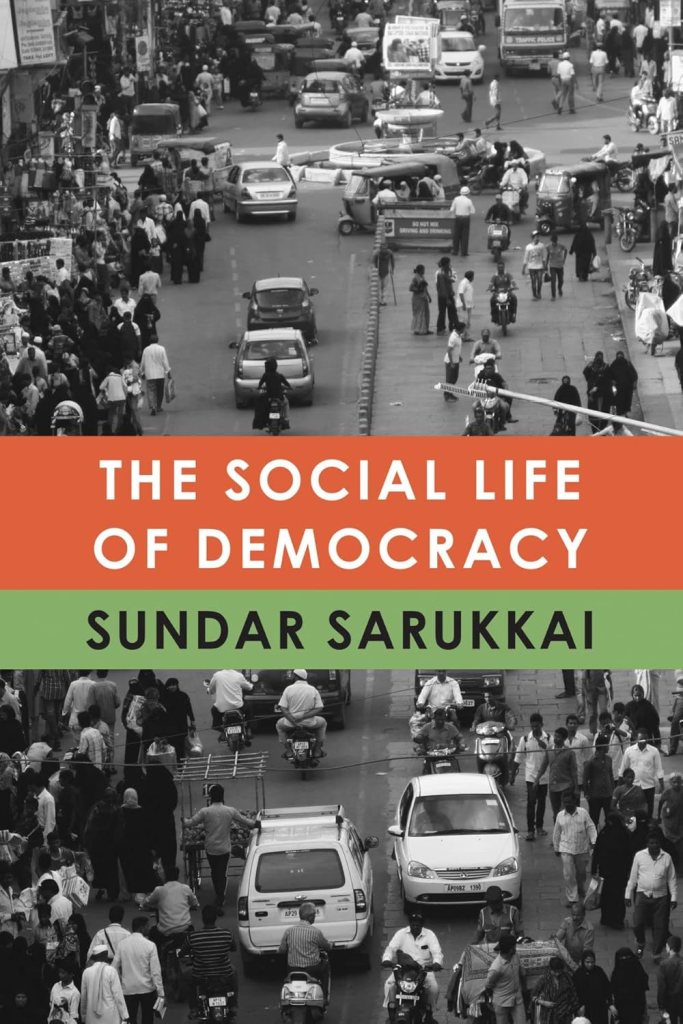
When I reflect on democracy in India today, I see a concept confined largely to the political domain—elections, voting, and parliamentary debate. Yet democracy ought to be more than this. It should inform the way we live, shape our relationships with one another, and define the functioning of our institutions. This is precisely what Sundar Sarukkai explores in his thought-provoking book, The Social Life of Democracy. Drawing on Bhimrao Ramji Ambedkar’s vision that “there cannot be democratic government unless the society for which it functions is democratic in its form and structure,” Sarukkai challenges us to reimagine democracy beyond the realm of politics. For Ambedkar, democracy was founded on the principles of liberty, equality, and fraternity—with fraternity occupying a central role, as it mediates the tension between individual freedom and social equality. Sarukkai extends this framework into a rich and nuanced exploration of how democracy should manifest in the texture of our daily lives.
What distinguishes this book is its emphasis on democracy as a social practice rather than merely a political system. While most scholarship tends to focus on electoral processes and institutional frameworks, Sarukkai examines how democratic values intersect with various facets of everyday life—from family structures and workplace dynamics to interpersonal interactions and community engagement. He develops the idea of the “democratic self,” arguing that democratic institutions can function meaningfully only when individuals embody democratic principles in their everyday conduct. This shift—from democracy as abstract political theory to democracy as lived experience—not only follows in the footsteps of Ambedkar, but also reveals why political democracy alone is insufficient to bring about genuine social transformation.
In the book, Sarukkai also engages with the ethical foundations of democracy. In doing so, he examines the intricate relationship between truth, freedom, free speech, and democratic practice. What is truth? How does it intersect with democracy? What does “free” truly signify in free speech? What role do science and technology play in shaping our democratic imagination? By probing these questions, Sarukkai uncovers the deeper philosophical dimensions of democracy. He reminds us that democracy is not merely a form of governance—it is a mode of thought that influences how we approach knowledge, progress, and human relationships. This expansive philosophical perspective invites us to reimagine democracy not as an isolated political system but as a principle that structures our understanding of, and engagement with, the world around us.
The most compelling aspect of Sarukkai’s argument lies in his articulation of the distinctive character of Indian democracy. In contrast to Western models that centre individual liberty, Indian democracy has historically borne the weight of a more ambitious aspiration: social justice and collective transformation. Sarukkai builds on this legacy when he contends that “the only meaningful evaluation of democracy has to primarily be with respect to governance for the well-being of the worst-off in society.” This is not a mere idealistic claim—it is a fundamental redefinition of how democratic success should be measured. Has democracy improved the lives of Dalits who continue to endure systemic discrimination? Has it amplified women’s voices in public life and decision-making? Has it rendered the poor visible within our political discourse? These, Sarukkai insists, are the questions that truly matter.
Seen through this lens, genuine democratic achievement lies not in the procedural act of voting alone, but in the dismantling of entrenched hierarchies and the empowerment of those historically marginalised. In his view, democracy must serve as an instrument of social transformation, not simply a mechanism for maintaining political order.
Perhaps, then, the true test of our democracy is not how frequently we vote, but how consistently we recognise and uphold the dignity of those different from ourselves. As I close The Social Life of Democracy, I cannot help but reflect: in a nation that prides itself on being the world’s largest democracy, why must we still be reminded that democracy is meaningless if it fails to transform the lives of its most vulnerable citizens? Sarukkai’s work is both a mirror reflecting our democratic shortcomings and a roadmap towards the more inclusive, justice-oriented future that Ambedkar envisioned—if only we are willing to look beyond the ballot box.
How to cite: Annamalai, Kathiravan. “Democracy as Social Practice: Sundar Sarukkai’s The Social Life of Democracy.” Cha: An Asian Literary Journal, 19 May 2025, chajournal.blog/2025/05/19/social-life.



Kathiravan Annamalai is a Research Scholar in the Department of English at Pondicherry University. His doctoral research explores comparative perspectives in the dramatic literature of the Harlem Renaissance and the Dravidian Movement. His broader research interests encompass Indian Literature in English, Subaltern Studies, Drama, and Translation Studies. He has presented papers at various national conferences and has published research articles in peer-reviewed academic journals. [All contributions by Kathiravan Annamalai.]
 Cha
Cha 