

📁 RETURN TO FIRST IMPRESSIONS
📁RETURN TO CHA REVIEW OF BOOKS AND FILMS
Mandira Chakraborty, Firefly Games, Sambhavna Prakashan, 2025. 217 pgs.
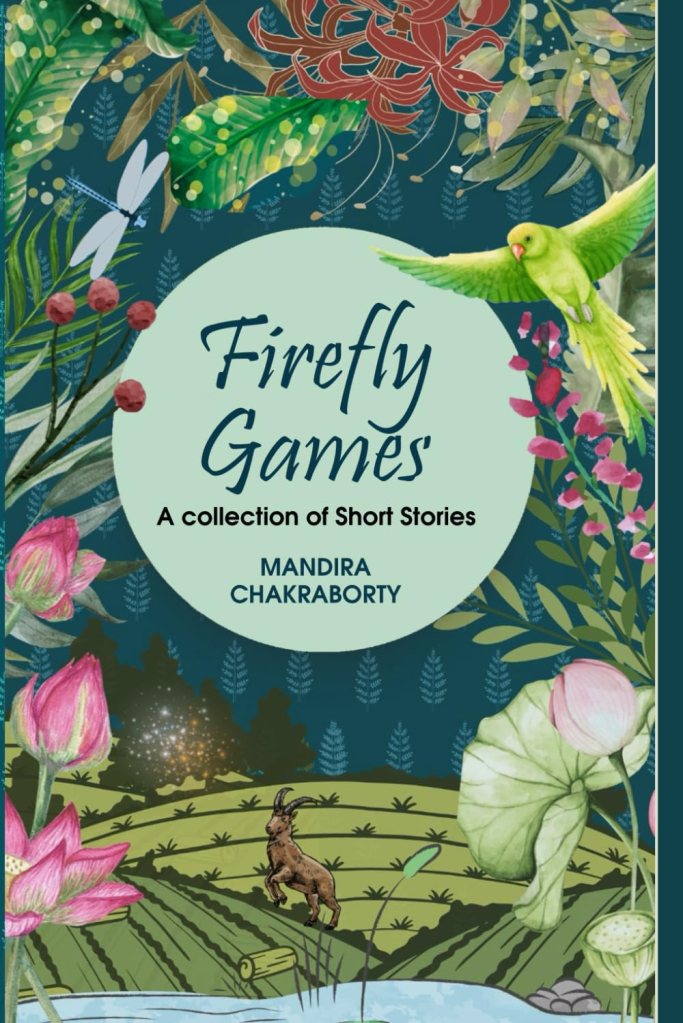
The world we inhabit today is a curious interplay between misinformation and an overwhelming excess of information—one click or tap unleashes a deluge of articles and links, entangling us in a labyrinthine maze of hyperlinks that lead endlessly from one to another. To sift through this complexity, to uncover the core of a narrative, to trace its origin and distinguish truth from post-truth, is an odyssey in itself. Amid this informational chaos, we seek out personal narratives—micro-stories that counter hegemonic, official, societal, or political discourses; narratives that stand as counterpoints in a world urgently in need of alternative perspectives.
It is within this context that Mandira Chakraborty’s debut collection of short stories arrives as a timely reminder of the enduring power of storytelling—that ancient, communal practice which once bound villages together, uniting their people in shared experiences of education and delight. The stories in this collection transport us to a time when life felt simpler, and understanding the world was shaped through human interaction—face-to-face conversations with people of flesh and blood—rather than through the facades of social media, which now often permit the unchecked circulation of animosity.
Chakraborty conjures a world where humankind and nature coexisted in harmony, rather than in conflict; where the young and old cherished the intergenerational distance as a space of shared memory and wisdom. The stories unfold across varied temporal and spatial settings. Her recollections of growing up in a government residential colony in Madhya Pradesh offer a poignant glimpse into a bygone era. These colonies—products of Nehruvian planning—emerged across the country as emblems of national progress and middle-class aspiration. One is prompted to reflect on how these communities, composed of individuals from diverse linguistic, cultural, religious, and sartorial backgrounds, represented a microcosm of India itself—an India once grounded in democratic and secular ideals, now increasingly imperilled by right-wing majoritarianism.
In “Sita’s Last Act”, Chakraborty transports us to a time untouched by communal strife, when Ram Leela celebrations brought together people of all castes, creeds, and religions in a spirit of joyous festivity. It was a cultural carnival celebrating the triumph of good over evil—not the Hindutva-fuelled chest-thumping spectacle that seeks to monopolise and homogenise Indian culture today.
Indeed, although the author presents the work as a collection of “short stories”, I would argue that they do not conform to the conventional understanding of the term, or to what we have come to recognise as the short story genre since its emergence nearly two centuries ago. Chakraborty’s “first-person narratives” are vignettes drawn from her childhood and formative years. She dispenses with the traditional structure of plot—featuring a clear beginning, middle, and end—and avoids the Modernist penchant for fragmentation. Instead, her narratives resemble intimate conversations with an engaged audience—akin to listeners gathered around a cherished storyteller within a family or close-knit community.
Some of these “stories” challenge rationality and plausibility, appearing at times incongruous or stretching the boundaries of belief. Yet it is precisely here that the storyteller’s licence becomes invaluable. We are less concerned with what is strictly possible than with what feels probable—not fixated on what definitively occurred, but rather on what might have.
This, indeed, is the chief appeal of Chakraborty’s narrative voice. The charm lies not only in the substance of her tales but in their delivery—infused with empathy, pathos, and a generous measure of wry humour. Are we not, perhaps, losing this type of storyteller—the kind who once held court in living rooms, whose tales effortlessly blurred the lines between truth and fiction, fact and embellishment—in an era increasingly preoccupied with narrative experimentation at the expense of the sheer joy of storytelling?
The stories are situated in a world deliberately crafted with men at the periphery and women at the centre—mothers, mothers-in-law, grandmothers, housemaids. Women who were expected to care for everyone but themselves; women who endured the quiet burdens imposed by a society that systematically denied them agency. With her inimitable style, marked by candour and a keen eye for the small details that illuminate daily life, Chakraborty captures moments of sorrow as well as glimpses of fleeting joy. Her anecdotal approach brings these women vividly to life—as though we are reading about someone from our own family: long forgotten, relegated to a footnote beneath more illustrious names in the family tree, but now, their stories unearthed, returned to us for reflection and remembrance.
Firefly Games may be read as a social document that captures the many facets of Bengali culture—both in erstwhile Calcutta (its Communist past, the commercialisation and commodification of leisure, and the evolving dynamics of the city’s cultural DNA) and among Bengalis in exile in the heart of India, in the states of Madhya Pradesh and Jharkhand. The intricacies of growing up, friendships and heartbreaks, corruption in government offices, and relationships between parents and children—Chakraborty touches on these themes and more. She takes us on a journey, offering the world through her eyes: at times as a child not yet in her teens, at others as an adult meditating on loneliness and longing while attempting to make sense of life during the pandemic. Her stories are deeply rooted in the city—its world, its language, its dialects, and diction.
Students of literary form may be tempted to locate postmodern concerns in Chakraborty’s narrative style—multiple timelines and spatial registers, open-ended episodes and anecdotes, and the deliberate breaking of the fourth wall to address readers directly. This metafictional gesture challenges authorial intention and readerly expectation in ways reminiscent of Chapter 13 of John Fowles’ The French Lieutenant’s Woman. Added to this is her irreverent humour—sometimes scandalous, sometimes deadpan, yet always laced with razor-sharp wit. This is most evident when she exposes the dysfunction of government offices, with their legendary tales of misadventure, mismanagement, corruption, and ennui. Whether describing her father being forced to resign under life-threatening pressure for seeking to investigate corruption and money-laundering in his office, or recounting the harrowing incident of a relative being hacked to death by miscreants in the troubled tea gardens, Chakraborty remains unapologetically direct and searing in her portrayal.
Her voice becomes most powerful, however, in moments of personal reflection—when she turns to her own family and history, writing as chronicler, observer, and flâneuse of the world around her. Her childhood fashion icon, first crush and heartbreak, the near misses and emotional stumbles—Chakraborty captures these with great sensitivity and a tenderness akin to butterfly wings, delicately outlining universal experiences that resonate with readers. She does so in a language unmistakably her own, shaped by the rhythms and idioms of Indian English—a “chutnification” of the language, as famously termed after Rushdie. Yet this linguistic hybridity does not detract from the lyricism or poetry of the text; rather, it enriches it.
Chakraborty’s long engagement with the liberal arts—first as a doctoral scholar, then as a lecturer at prominent undergraduate institutions in West Bengal—is clearly reflected in her writing. The text is densely interwoven with references and quotations from literature and popular culture, a feature that, while intellectually rewarding, may prove challenging for the general reader due to the absence of footnotes or endnotes. This, perhaps, is the only criticism one might level at the book. But it is a minor one. For as we immerse ourselves in her words, in the solemn recollections of people and days gone by, we are reminded of Jane Austen’s own description of Pride and Prejudice as “light, bright, and sparkling”. Chakraborty, however, adds the necessary “shade” and gravitas.
Firefly Games is a book not merely to be chewed or tasted—it is one to be savoured, and returned to again and again.
How to cite: Aich, Sayan. “Mandira Chakraborty’s Firefly Games: Stories of Light and Shadow.” Cha: An Asian Literary Journal, 19 May 2025, chajournal.blog/2025/05/19/firefly-games.

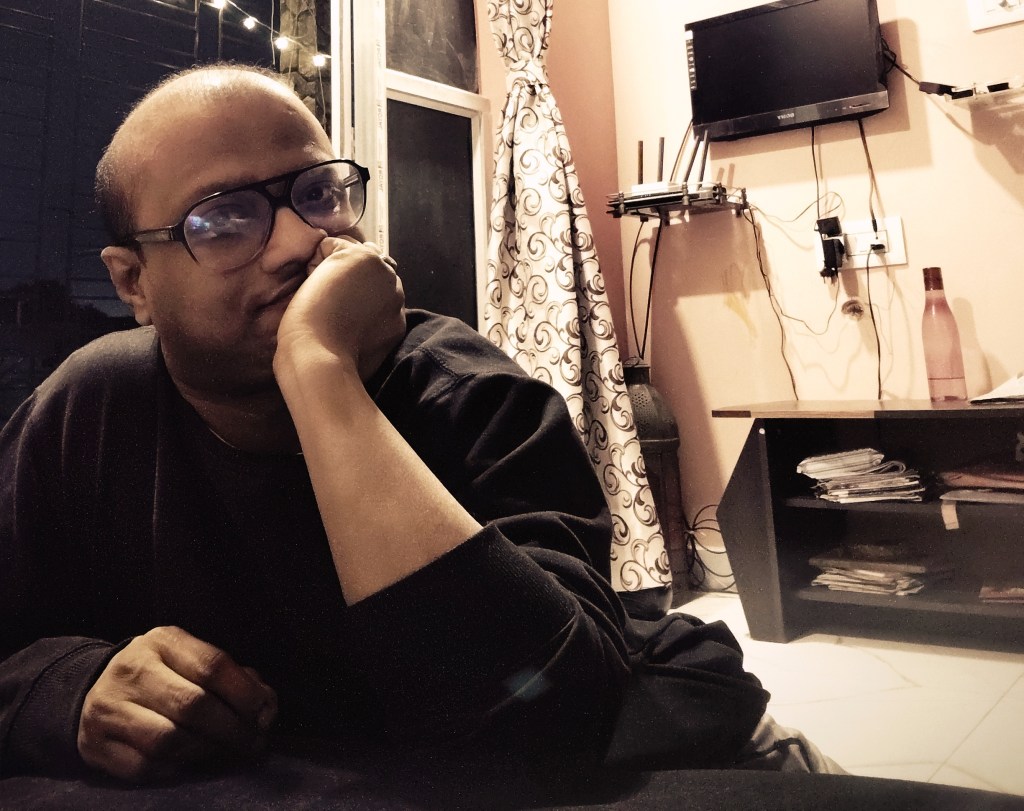

Sayan Aich Bhowmik is currently Assistant Professor in the Department of English, Shirakole College, Kolkata. He is the co-editor of Plato’s Caves Online, a semi-academic space on poetry/culture and politics. [All contributions by Sayan Aich.]
 Cha
Cha 