

📁 RETURN TO FIRST IMPRESSIONS
📁RETURN TO CHA REVIEW OF BOOKS AND FILMS
Nobuhiro Doi (director), Hanamizuki, 2010. 128 min.
Water plays a significant role in the work of many filmmakers. One might, for instance, recall the rainwater and silvery puddles that so frequently permeate the films of Andrej Tarkovskij—or the tranquil lakes and seas from whose surfaces memories and love stories emerge in the works of Ingmar Bergman and Jean Vigo. Throughout the history of cinema, the camera has seemed like a desert nomad—perpetually in search of water. Water attracts cinema. It draws filmmakers to its reflections and shifting imagery. Perhaps this is due to the many affinities between the ever-moving images of film and the drifting reflections upon water? Perhaps because film is a fluid medium—ceaselessly in motion, flowing through cinemas like a river on its way to the sea? Films remain elusive, intangible: one does not so much grasp them as move with them—one does not so much watch as immerse oneself in their imagery. For this very reason, film analysis has always been a difficult and somewhat ungainly exercise—rather like attempting to carry water in one’s cupped hands: one is almost certain to let most of it slip away.
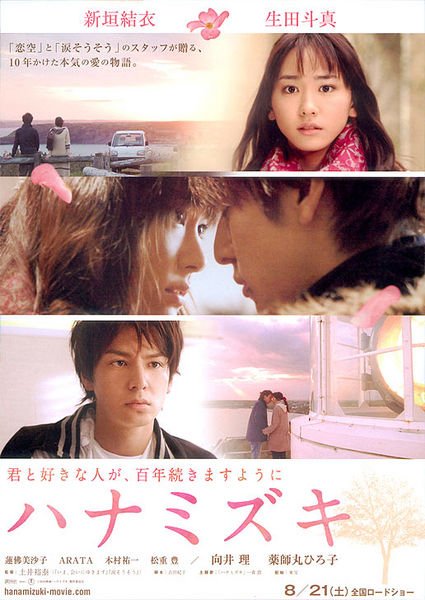
In the Japanese drama Hanamizuki (2010), directed by Nobuhiro Doi, water also assumes a central role—manifested here in the form of a vast blue sea that serves as a constant backdrop for the narrative and its romantic encounters. The male protagonist, Kouhei, is a local fisherman who falls in love with a college student, Sae. Their affection for one another develops swiftly, yet it is tested by their diverging ambitions and perspectives on life: while she is adventurous and eager to see the world, he feels a deep sense of duty to his family and community, bound to his life as a fisherman. Consequently, the sea carries different meanings for the two protagonists: for Sae, it is chiefly a threshold to be crossed—a passage to a promising and unknown future; for Kouhei, it represents a way of life and the very foundation of his being. Emotions break like waves against these opposing visions: does the sea suggest an escape—or does it signify continuity and return? Sae ultimately chooses to leave—first for Tokyo, then New York—in pursuit of her career and personal aspirations. Yet, after many years abroad, unable to forget Kouhei and the love they once shared, she does, in the end, return.
One might wonder why not only Hanamizuki, but a great many love stories, are set by the sea. Is the sea inherently romantic? Does it naturally evoke passion and longing? Or is it perhaps its beauty—its vastness—that speaks so compellingly to scriptwriters and filmmakers across the globe? In the case of Hanamizuki, the answer is simple: both life and love appear more expansive by the sea. The constant presence of the ocean allows every gesture and movement, every expression and emotion, to emerge with exceptional clarity. The sea becomes, in other words, a consistent and unvarying backdrop that enables our attention to remain wholly focused on the characters and their inner lives. Nothing distracts, nothing detracts. In this sense, the sea is much like a Zen garden: its minimalism and serenity render movement almost startlingly visible, turning life itself into a kind of transgressive noise—an interruption of peace. Breathing, thinking, feeling are all magnified to the point of ecstasy.
The sea contributes something else of equal importance to the story: in its unwavering horizon, a measure is provided for both actions and emotions. The curve of Kouhei’s smile and the joy in Sae’s face appear all the more vivid when set against the sea’s straight and unchanging line. It is through contrasts—through the interplay of difference—that expressions and gestures attain their fullest, most emphatic meaning. It is only when measured against the untouchable and unimpressionable that touches and impressions reveal their richest significance. Unsurprisingly, Sae becomes lost once she moves away from the bay and into the city—no longer able to distinguish what is meaningful from what is trivial, for she now lacks a horizon by which anything might be measured. In the metropolis she encounters a dilemma characteristic of modern urban life: the measure is drowned amidst a chaos of intersecting lines and incessant noise. Love no longer appears large or small—joy and sorrow blur, becoming entangled and indistinct. In the end, then, it is not only for love but also out of necessity that she returns to the bay—and to Kouhei. She needs the horizon, without which neither departures nor returns hold any true meaning.
Hanamizuki is, at its core, a conservative film with a conservative message: returns are preferable to departures, continuity superior to rupture. This ideology is reflected in the steadiness of the sea—far removed from the new waves, tempests, and experiments of avant-garde cinema. All images flow effortlessly into the film, just as rivers run into the sea. The result will strike some as comforting and reassuring, while to others it may seem objectionable: images drifting before our eyes as though in obedience to a natural law.
How to cite: Kølle, Anders. “The Measure of Love in Nobuhiro Doi’s Hanamizuki.” Cha: An Asian Literary Journal, 16 May 2025, chajournal.blog/2025/05/16/hanamizuki.



Anders Kølle is lecturer of Communication Arts at Khon Kaen University, Thailand. Holding a PhD in Media and Communications from The European Graduate School, he has taught art and philosophy at several universities, including the University of Copenhagen and Assumption University, Bangkok. His work focuses on contemporary encounters between philosophy and art, and on art’s potential to produce new modes of thinking and create new forms of critique. His publications include On Being Ridiculous (Delere Press, 2024), The Technological Sublime (Delere Press, 2018), and Beyond Reflection (Atropos Press, 2013). [All contributions by Anders Kølle.]
 Cha
Cha 