
📁RETURN TO FIRST IMPRESSIONS
📁RETURN TO CHA REVIEW OF BOOKS AND FILMS
Click HERE to read all entries in Cha on Mending Bodies.
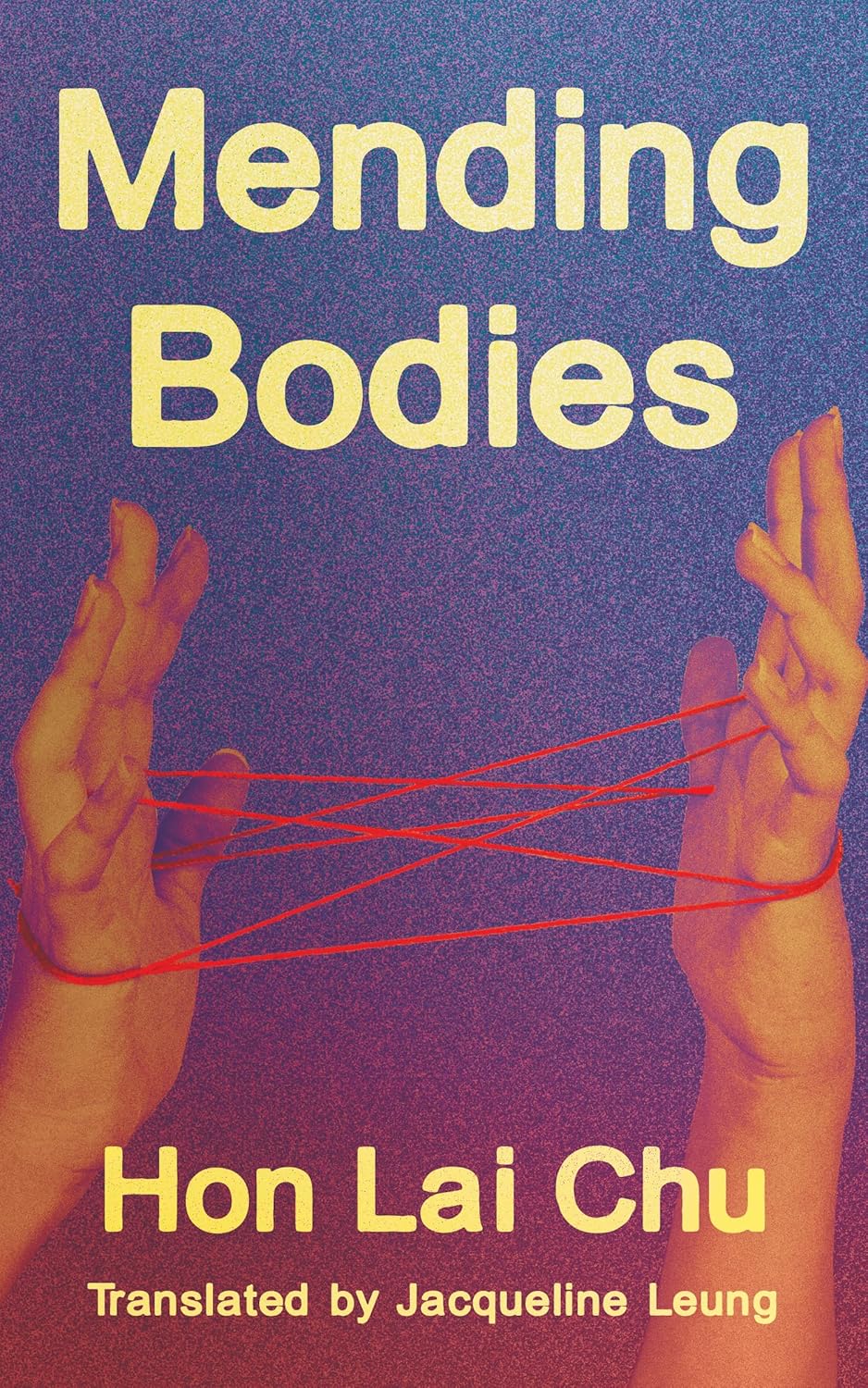
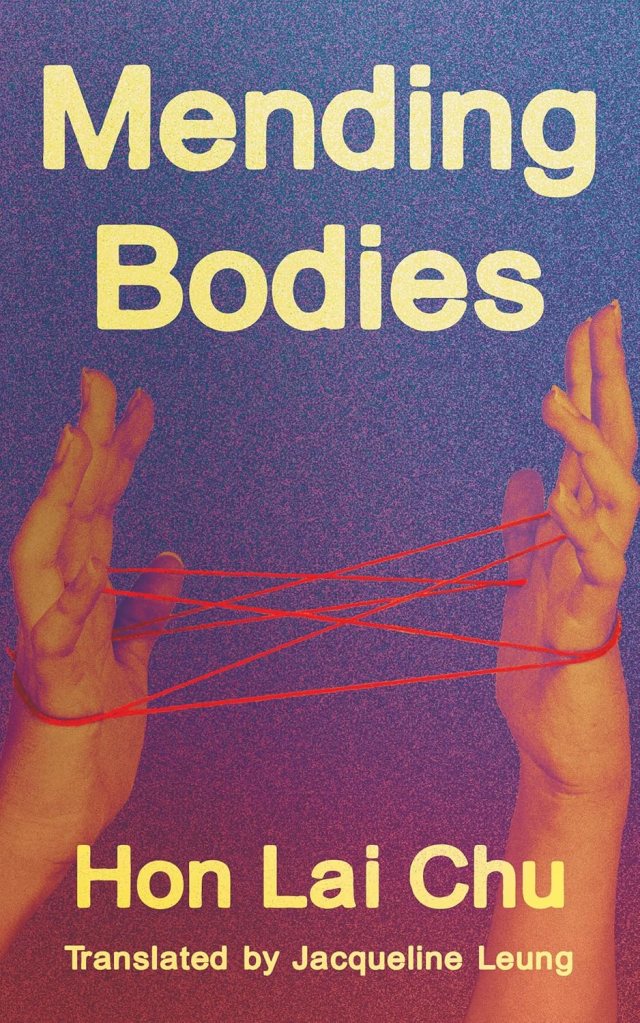
Hon Lai Chu (author), Jacqueline Leung (translator), Mending Bodies, Two Lines Press, 2025. 240 pgs.
For those who haven’t read the original Chinese version of Mending Bodies, this review contains some spoilers.
When Hon Lai Chu published Mending Bodies in Chinese as 《縫身》 (which translates literally to “Sewn Body”) fifteen years ago, the world was a markedly different place. At the time, concerns about personal autonomy and governmental overreach may have seemed somewhat alarmist; Mending Bodies could thus be read as an imaginative foray into magical realism—or even speculative fiction. Now, with Jacqueline Leung’s recent English translation, the narrative assumes an entirely new resonance.
The unnamed female protagonist, a disillusioned graduate student, finds herself unable to complete her thesis. Her research focuses on conjoined twins, echoing the recent implementation of the Conjoinment Act in Hong Kong. Under this law, individuals are surgically joined to a partner in an effort to reduce resource consumption. Proponents of the Act argue that such enforced companionship will alleviate the loneliness that once plagued society. Should someone wish to engage in a private conversation, the conjoined counterpart may take a powerful sleeping pill in order to be effectively “absent” during the exchange.
Hon, a celebrated writer from Hong Kong, never explicitly names the city’s locales in her novel. Yet the protagonist appears to be studying at the Chinese University of Hong Kong—a campus nestled along a mountain ridge. In one memorable scene, she and her thesis advisor, a man she refers to as Professor Foot, travel from the university to a love motel. To readers familiar with Hong Kong’s geography, the journey seems to trace the scenic drive from the New Territories to Kowloon Tong.
We traveled past a harbor of fluttering waves, then entered a dark and narrow tunnel, two rows of fluorescent lights receding endlessly on the ceiling. By the time we emerged, we were under a different sky. I couldn’t name the place we were in. The trees, shops, gas stations, bus stops, and pedestrians all came together in an unfamiliar way, but I wasn’t apprehensive in the slightest.
The protagonist’s advisor takes her to a love motel so she might gain a better understanding of what it feels like to be conjoined—but there is nothing remotely romantic about the experience. The professor binds their legs together with rope, allowing her to simulate the physical constraints of conjoined existence. He explains that, following the passage of the Conjoinment Act, people began frequenting these love motels as a means of escaping the anxiety provoked by the prospect of surgical attachment to another individual.
Back at the university, the protagonist’s close friend and roommate, May, holds her own views on conjoinment. May believes that individuals form their convictions independently and are not easily influenced by others. Thus, when certain psychologists claim that conjoinment fosters a sense of completeness and fills existential voids, May remains sceptical. The protagonist, by contrast, believes that people are capable of expanding their perspectives—that we are always learning, always evolving. Yet these remain speculative ideas: at the novel’s outset, neither she nor May has undergone surgical attachment.
Interspersed among the chapters detailing the protagonist’s personal journey are excerpts from her thesis. Presented in the form of outlines and case studies, these fragments introduce additional layers to the narrative, illuminating the lived experiences of conjoined twins and the historical injustices they have endured.
In the nineteenth century, conjoined people were seen as monsters, and so circuses and expos were the few places where they could make a living, even though they were excruciatingly exploited. This was hardly a secret for the crowds who marveled as conjoined people sang, played the saxophone, and danced on stage, as if they were born jolly and with these talents.
Beyond the strain of her unfinished thesis, the protagonist suffers from insomnia and consults a sleep specialist named Lok. The two ultimately decide to become surgically conjoined. Yet, despite this radical change, her thesis remains incomplete. As part of her research, she interviews her aunt, who once underwent a surgical procedure to detach from her own conjoined partner. Naturally, Lok must accompany her—being conjoined—but in order to preserve her aunt’s privacy during the conversation, she asks Lok to take a sleeping pill so that he will not be “present” during the interview. Eventually, she succeeds in completing her thesis and submits it to Professor Foot—yet her life takes an unforeseen turn.
While reading Mending Bodies, I found myself constantly reflecting on the events that have unfolded between 2010 and 2025. When Hon first penned this story, the notion of surrendering one’s individuality may have seemed implausible. Today, however, with increasing constraints on speech and expression, it is not difficult to interpret the novel as a metaphor for our current predicaments.
In the context of Hong Kong in particular, the following excerpt—positioned at the heart of the book—is especially chilling. It could well serve to encapsulate the very impetus behind Hon’s decision to write her story:
A newspaper article predicted that we would no longer see any mountain peaks, seas, or adult bodies that were whole in twenty years. We had grown accustomed to these horrifying speculations, the same way we read about faraway countries with long and foreign-sounding names wrecked by war, earthquakes, storms, and massacres. There would be a moment when we fell into wordless grief, but with the turn of a page, we would get inundated by job and real-estate listings and restaurant advertisements again. People weren’t indifferent; it was just that, for those of us who lived here, the future always felt so surreal.
How to cite: Blumberg-Kason, Susan. “Magical Realism or Political Prophecy? Hon Lai Chu’s Mending Bodies Reexamined.” Cha: An Asian Literary Journal, 4 May 2024, chajournal.blog/2025/05/04/mending-bodies.


Susan Blumberg-Kason is the author of Good Chinese Wife: A Love Affair With China Gone Wrong. Her writing has also appeared in the Los Angeles Review of Books‘ China Blog, Asian Jewish Life, and several Hong Kong anthologies. She received an MPhil in Government and Public Administration from the Chinese University of Hong Kong. Blumberg-Kason now lives in Chicago and spends her free time volunteering with senior citizens in Chinatown. (Photo credit: Annette Patko) [Susan Blumberg-Kason and ChaJournal.]
 Cha
Cha 