
📁 RETURN TO FIRST IMPRESSIONS
📁 RETURN TO CHA REVIEW OF BOOKS AND FILMS
Nicholas de Villiers, Cruisy, Sleepy, Melancholy: Sexual Disorientation in the Films of Tsai Ming-liang, The University of Minnesota Press, 2022. 216 pgs.
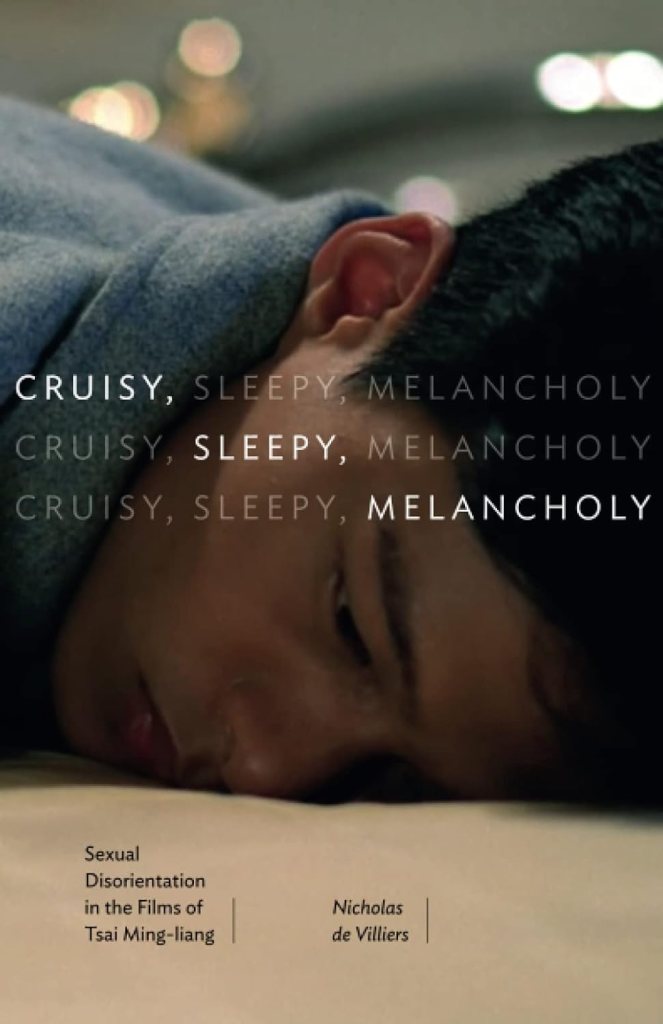
As one of the most celebrated Chinese-language filmmakers of the “Second New Wave” of Taiwanese cinema, Tsai Ming-liang’s status as auteur—and, consequently, his provocative body of work—has firmly established itself within academic, filmic and literary canons. Tsai’s oeuvre comprises twelve feature films, numerous short and television films, and several museum exhibitions. Among his many accomplishments, he was the first filmmaker to have a film commissioned by the Louvre. His projects are grounded—and often dreamily drift away—through their explorations of sexuality and queerness in a metacinematic mode. In other words, Tsai approaches his films self-reflexively: they frequently draw from and upon each other, layering and creating conversations not only between the audience and their viewing experience but also between the characters and the worlds they inhabit.
Nicholas de Villiers ruminates on this metacinematic quality, among other insights, in Cruisy, Sleepy, Melancholy: Sexual Disorientation in the Films of Tsai Ming-liang, through the lens of sexual disorientation. The monograph details how Tsai expands notions of queerness via regional and local specificities, and through the bodily knowledge of displaced characters—whether diasporic, migrant or otherwise—and their experiences of and with sexuality in Taiwan, Malaysia and France. These ideas draw heavily from Tsai’s own life, adding further layers to the meta-textual universe(s) he creates. De Villiers’ work, written in the wake of Tsai’s announcement of his retirement, articulates a goal of aligning the affects of feeling cruisy and sleepy with that of melancholy, using terms, references and insights offered with clear enthusiasm for Tsai, his oeuvre and, more broadly, for cinema itself.
Cruisy, Sleepy, Melancholy comprises a preface and introduction, in which de Villiers’ argument is initially presented and situated; five chapters developing the thesis, each focusing on one or two principal films with references to others (either Tsai’s own works or those by other directors); and a conclusion, followed by acknowledgements and notes. In the Preface and Introduction, de Villiers historically situates Taiwanese cinema and the Second New Wave, as well as Tsai himself—a Chinese Malaysia-born director who moved to Taiwan at the age of twenty. From the outset, de Villiers articulates how Tsai embodies and presents a cinema of disorientation, before proposing his central argument: that Tsai disorients space, sexuality and temporality, explored through the notions of the cruisy and the sleepy, and therefore the melancholy.
The text then moves into five chapters. In Chapter 1, “Spatial and Sexual Disorientation,” de Villiers focuses on nostalgia and locality versus globalism, distinguishing his use of “queer” as that which “challenges the fixity implied by the logic of sexual orientation” (20), expressing a desire to deconstruct binaries. In Chapter 2, “Leaving the Cinema,” he examines the metacinematic qualities of Tsai’s films as well as the film viewer’s experience within—and upon leaving—the theatre. Chapter 3, “Queer Camp and Porn Musicals,” explores definitions and depictions of camp through Tsai’s juxtapositions of fantasy, via the musical genre, and reality, via the disaster film, proposing camp as a queer mode of engaging with both pornography and musicals, and drawing out similarities between the two. In Chapter 4, “Different Time Zones,” de Villiers investigates the folding of meaning and space-time through representations of cruising, before following Tsai’s commissioned films concerning institutions and the filmmaking process. Chapter 5, “Haunted, Rented, Queer Spaces,” traces the centrality of space to queerness in Tsai’s films from a disorientating standpoint. Finally, the Conclusion considers how Tsai’s modes of disorientation extend beyond the cinematic space into the museum and art gallery.
The argument that de Villiers asserts and pursues throughout the book’s five chapters is, like any strong argument, multi-layered and nuanced without becoming inaccessible. To begin with, his articulation of queerness—what it means to embody queerness as well as how queerness operates within Tsai’s films—seeks to deconstruct binaries and disorient spaces of reality/fantasy, public/private and waking/sleeping. Frequently drawing from the critical work of affect theorist Eve Kosofsky Sedgwick, de Villiers invokes her concept of the “beside” in order to avoid dualistic ways of imagining identity.
Each chapter, in its own way, utilises incoherence as a queer possibility: through the dreamy and sleepy aspects of I Don’t Want to Sleep Alone (2006); the history of cruising in public spaces such as movie theatres in Goodbye, Dragon Inn (2003); the exploration of camp and music/pornography in The Hole (1998); the portrayal of dislocation through time and time zones in What Time Is It There? (2001); and the depiction of space as both static and a palimpsest of the world in Stray Dogs (2013).
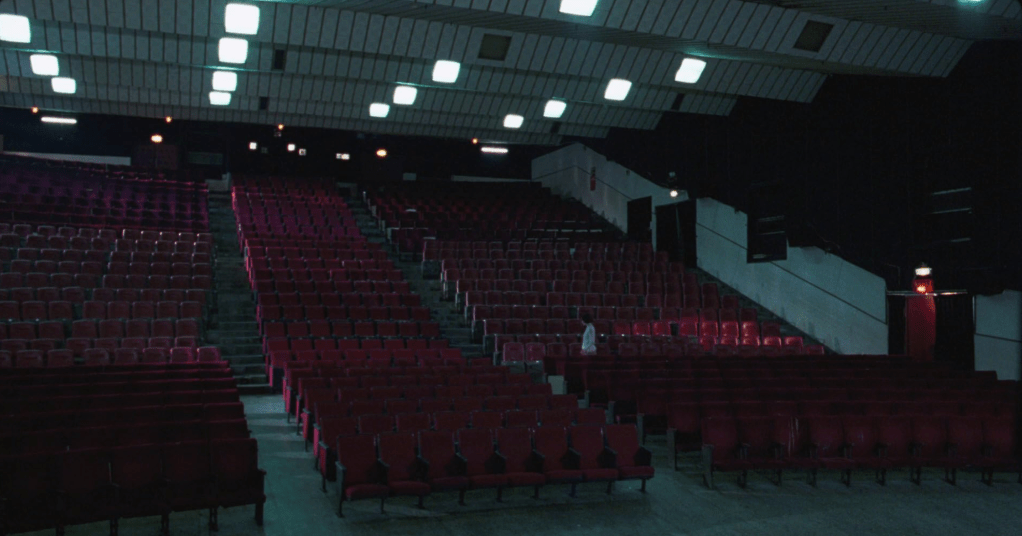
A still from Goodbye, Dragon Inn (2003)
Tsai’s fixation on dislocation—as social, political and environmental commentary, and as a force shaping the relationships between his characters—manifests in how space and time are communicated throughout the monograph. De Villiers frequently connects Tsai’s films and New Taiwan Cinema to the work of other Taiwanese filmmakers such as Hou Hsiao-hsien, while also more broadly linking the sleepy and dreamy affects to the films of Thai director Apichatpong Weerasethakul and to the nostalgic fixation haunting both Taiwanese and Hong Kong cinema. He references the work of Andy Warhol and other filmmakers worldwide, simultaneously globalising his argument while firmly situating it within Tsai’s distinctive oeuvre.
De Villiers also draws on writers such as Sedgwick, José Esteban Muñoz, Jacques Lacan, Roland Barthes and Linda Williams, among others, to foster conversations across genre and form. By reading Tsai’s films through the lenses of cultural criticism, psychoanalysis, film scholarship and affect theory, de Villiers presents a discussion that is both specific and transcendent of regional borders and temporality. He articulates how queerness is inextricably entwined with issues of space and time, and how queerness—more than merely an identity—can describe the lives of characters and people living at the margins.
Cruisy, Sleepy, Melancholy puts the work of Tsai Ming-liang into conversation with that of various critical scholars, filmmakers and writers. The argument is presented plainly; de Villiers’ language is accessible and patient with readers across audiences—though for those more familiar with either the work of Tsai or the other authors discussed, de Villiers synthesises cultural texts and critical assertions in a manner that remains richly rewarding. In other words, Cruisy, Sleepy, Melancholy offers a beautifully succinct yet poetic exploration of Tsai Ming-liang, both as an auteur and through the reception of his body of work.
Over the course of my reading of the monograph, de Villiers’ writing and his meditations on Tsai’s work genuinely made me feel sleepy—in the sense of entering the very sleepiness he conveys when navigating Tsai’s films as imbued, and imbibed, dreamscapes. Upon my screening of Goodbye, Dragon Inn, I witnessed de Villiers’ articulation of the affects of sleepiness and cruisiness come alive (and find rest) in the depiction of the Fu Ho Grand Theatre’s final night before closing for good, with water dripping through a hole in the roof and muffled murmuring from the movie screen punctuating the theatre’s—and the film’s—transience.
In reading and watching, I slowly became more and more sleepy—more patient, more translucent, more appreciative—while simultaneously being introduced to the world of Tsai Ming-liang and de Villiers’ distinctive mode of film analysis. In terms of criticism, however, and perhaps as a result of his clear style, some of de Villiers’ insights are expressed plainly and then swiftly set aside, as in the concluding paragraph of Chapter 1, where he almost in passing notes how the characters’ sleepy bodies are also a consequence of hard labour. Such clear yet fleeting insights may at times feel jarring, leaving the reader wishing for deeper elaboration. Be that as it may, de Villiers nonetheless presents a wonderfully woven argument—centred, disoriented, and culminating in what is, not coincidentally, the very last word of the monograph: queer.
How to cite: B., Haley Agcaoili. “Feeling Queer—Nicholas de Villiers’s Cruisy, Sleepy, Melancholy: Sexual Disorientation in the Films of Tsai Ming-liang.” Cha: An Asian Literary Journal, 28 Apr. 2025, chajournal.blog/2025/04/28/tsai-ming-liang.


Haley Agcaoili B. is a lover of all things film, feelings, and felines. She is graduating with her MA in English, with a focus on Literary Studies, from the University of Hawaiʻi at Mānoa. As an aspiring writer and film scholar, her MA project and academic research are concerned with depictions of the city, the work of love, and affective imprints on the body in Asian film.
 Cha
Cha 