
茶 FIRST IMPRESSIONS
茶 REVIEW OF BOOKS & FILMS
[REVIEW] “Adam Mars-Jones’s Box Hill: A Bold Celebration of Queer Love and Desire” by Hongwei Bao
Click HERE to read all entries in Cha
on Pillion & Box Hill.
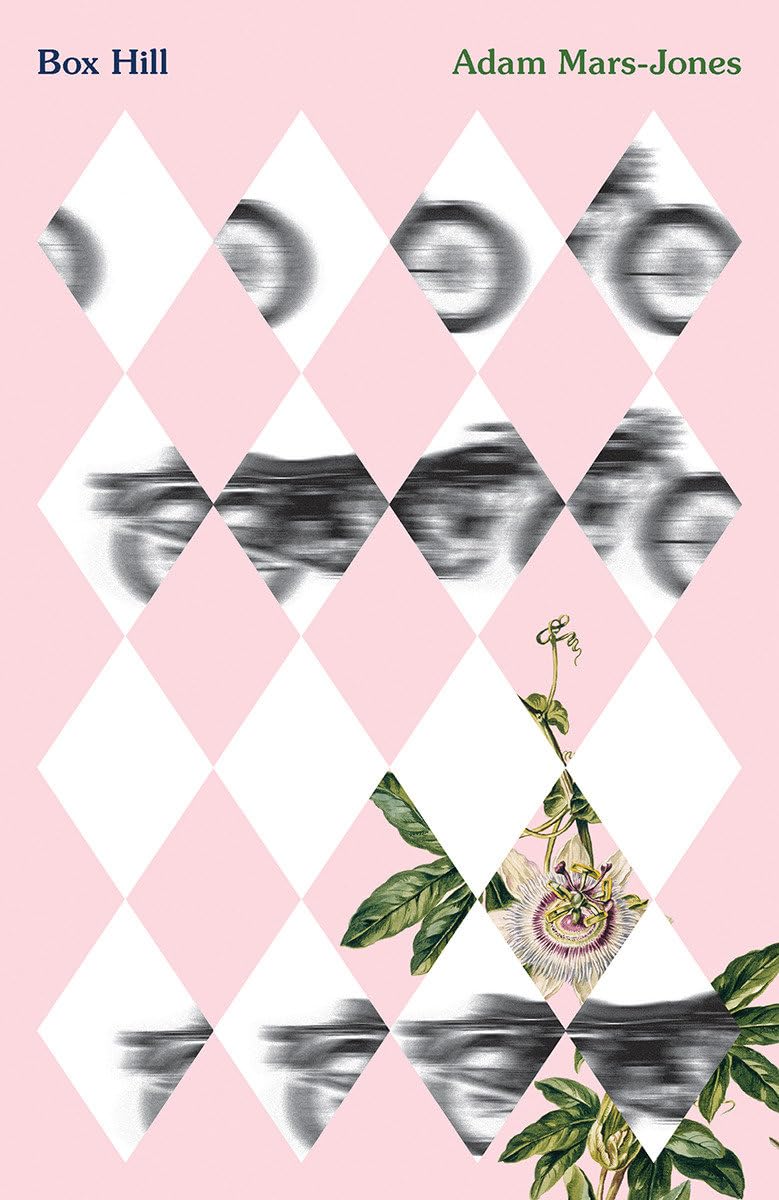
Adam Mars-Jones, Box Hill, Fitzcarraldo Editions, 2020. 128 pgs.

At only 120 pages, British novelist Adam Mars-Jones’s 2020 novella Box Hill is a slim volume, yet it was the winner of the 2019 Fitzcarraldo Editions Novel Prize. The book offers rich detail on the gay motorbike culture and social life of 1970s Britain; its candid and empathetic narration of a transgressive queer relationship establishes it as a new classic of queer literature.
Box Hill tells the coming-of-age story of a young Englishman named Colin Smith, who explores his sexuality while navigating the gay motorbike scene and living through an unconventional relationship. The central part of the story takes place at Box Hill, a popular biker gathering spot in Surrey, England. On the Sunday of his eighteenth birthday in 1975, motorbike enthusiast Colin stumbles upon Ray, the charismatic leader of a gay motorbike club. Colin falls for Ray—around ten years his senior—and subsequently becomes Ray’s slave (also referred to as his submissive or boy). The narrative centres on their six-year relationship, from their first encounter in 1975 to Ray’s fatal motorbike crash in 1981, as well as Colin’s life afterwards and his remembrance of Ray in the late 1990s.
The title Box Hill refers to an actual location where gay bikers used to assemble and run their bikes. The place name Leatherhead also offers an explicit nod to gay fetish culture. Box Hill is named after the box trees that grow there. On the book’s opening page, the narrator, Colin, offers meticulous botanical details—owing to his prior training in gardening—about the box tree: it is the heaviest of European woods; it does not float; its roots were traditionally used for knife handles; it is toxic; and it is often shaped into topiary and admired for its artificial beauty. A particular sentence is repeated twice in the book: “The leaves of the box are ovate, entire, smooth, thick, coriaceous and dark green” (7, 119)—first at the beginning and then near the end, carrying contrasting emotional intensity. The narrator later explains that the word “coriaceous” means “leather-like.” It is at the second mention that readers come to realise the symbolic resonance of the box tree: it stands as a metaphor for the strong, determined, glamorous and perfectly crafted personalities that Ray embodies, as well as for the world he inhabits.
Ray’s world is one that privileges masculinity, hierarchy, order, rules, fraternity and, above all, loyalty. While this subculture rebels against the middle-class social norms of the time, it also establishes its own codes and protocols—some of which are decidedly problematic. The book notes that Ray practises wrestling and martial arts, and that he passes on his old martial arts magazines to Colin. Ray seems a perfect embodiment of the spirit of the samurai (武士), youxia (遊俠, knight-errant) or jianke (劍客, swordsman). Even during Ray’s lifetime, the “old guard” gay biker culture is already in decline, and Ray is one of its few remaining guardians. With Ray’s disappearance, that world seems to vanish altogether, its demise accelerated by the advent of AIDS, the gentrification of gay culture, the decline of the British motorbike industry and the National Trust’s erasure of queer heritage. Box Hill is thus a profoundly nostalgic book, attempting to salvage fragments of a lost world—one that may never have existed exactly as it is remembered.
For a novel centring on the unconventional relationship between Ray and Colin, the news of Ray’s death, arriving midway through the book, feels almost anti-climactic. This, however, is compensated by the layers of mystery surrounding Ray’s life and death. The second half of the book focuses on Colin’s existence—his sadness and his painstaking efforts to understand Ray. Ray becomes a haunting presence in Colin’s mourning and melancholia. Colin’s relentless pursuit of what might have been in Ray’s mind raises more questions than it answers. He eventually finds a fragile solace in realisations such as “Ray was good to me—he was” (108) and “you have to be cruel to be kind” (111).
It is perfectly possible that Ray has died from the bike crash, as Colin is led to believe. Yet it is also possible that there was no accident at all—that Ray simply chose to end the relationship in a way that preserved their happy memories of one another, as people and relationships inevitably change, just as in the case of Colin’s mother and father. Equally, Ray may still be alive but living with severe repercussions from the accident. A perfectionist, Ray cannot tolerate the idea of falling short of the ideal he projects—if he cannot embody that ideal, he must disappear, and on his own terms. “Ray never broke the spell” (51), reflects the young Colin after an hour-long, quiet observation of Ray cleaning his bike on a Saturday morning—in one of the most beautifully written and erotically charged passages of the book.
Box Hill is a masterclass in the use of first-person point of view and narrator’s voice in storytelling. The story of Ray is recounted by Colin, fifteen years after Ray’s motorbike crash. Colin’s voice is one of the most unforgettable narrative voices in queer literature—by turns funny, witty, sad and nostalgic; matter-of-fact even when describing the most shocking aspects of their relationship. Colin is an unreliable narrator, partly due to the fifteen years that have elapsed, partly because of his innocence and obsession, which may prevent him from grasping the full picture, as well as the asymmetrical nature of the pair’s relationship: Colin does not even know Ray’s full name, birthday or profession. This makes the story all the more intriguing—Ray becomes a mystery, a legend, a larger-than-life presence within the narrative. Readers must use their own imaginations to piece together the scant fragments available. No explanation or resolution is offered at the end of the book; there is a deliberate rejection of narrative closure by the author. This narrative openness renders the reading experience highly engaging.
Box Hill is a book with a haunting effect—the story lingers in readers’ minds long after the final page, owing to the author’s virtuoso storytelling. Once a Somerset Maugham Award winner, Mars-Jones has crafted a unique narrative voice that feels wholly authentic to both character and historical context. In a video interview with Seán Hewitt for the Red Line Book Festival 2020, Mars-Jones admitted that the book is loosely based on the true story of a friend, who later commented that the novel “brings back happy memories.” Despite the controversial nature of some scenes, the book gives voice to a largely invisible queer fetish community and preserves a portrait of the lost gay biker culture of 1970s Britain. It refuses to pass moral judgement. Instead, it allows readers to recognise that alternative forms of relationship exist, and that “love is love” (110). The book thus stands as a bold celebration of all kinds of queer love, however transgressive some may seem.
Box Hill also offers rich and vivid sociological detail of life in 1970s and 1980s Britain. Mars-Jones has done a remarkable job of creating an authentic feel of the era through his use of language. The intersectionality of class, age and sexuality within gay culture is explored with empathy, complexity and ambivalence. The relationship between Colin’s mother and father provides a counterpoint to Colin’s relationship with Ray, grounding this seemingly incredible story in social realism. Together, they form a powerful commentary on the simultaneous endurance and vulnerability of love, whether gay or straight.
It is perhaps no surprise that this moving story has recently been adapted into a feature film titled Pillion, directed by Harry Lighton. The film is set to premiere at the Cannes Film Festival in May 2025. This leaves the book’s readers with much to anticipate—and much to worry about: even with the participation of celebrity actors such as Harry Melling and Alexander Skarsgård, will the film capture the excitement, mystery and magic that binds the book together?
How to cite: Bao, Hongwei. “Adam Mars-Jones’s Box Hill: A Bold Celebration of Queer Love and Desire.” Cha: An Asian Literary Journal, 28 Apr. 2025, chajournal.com/2025/04/28/box-hill.



Hongwei Bao is a queer Chinese writer, translator and academic based in Nottingham, UK. He is the author of Queer China: Lesbian and Gay Literature and Visual Culture under Postsocialism (Routledge, 2020) and Queering the Asian Diaspora (Sage, 2025) and co-editor of Queer Literature in the Sinosphere (Bloomsbury, 2024). His poetry books include The Passion of the Rabbit God (Valley Press, 2024) and Dream of the Orchid Pavilion (Big White Shed, 2024). [All contributions by Hongwei Bao.]
 Cha
Cha 