
📁 RETURN TO FIRST IMPRESSIONS
📁RETURN TO CHA REVIEW OF BOOKS AND FILMS
Téa Sernelj, The Confucian Revival in Taiwan: Xu Fuguan and His Theory of Chinese Aesthetics, Cambridge Scholars Publishing, 2021. 280 pgs.
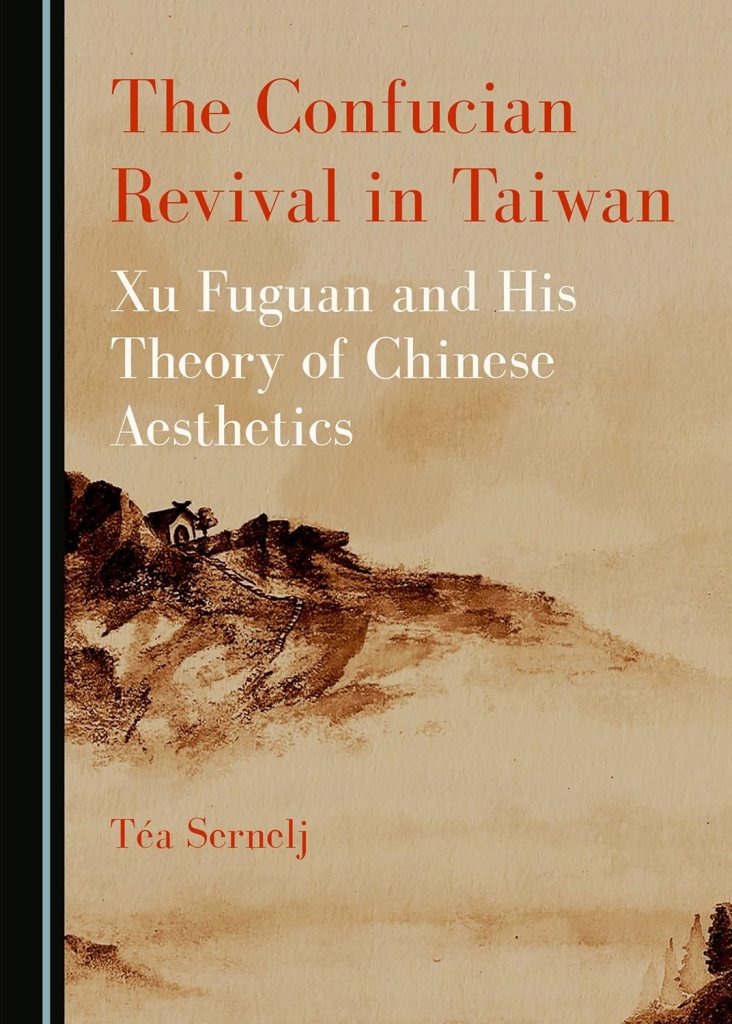
In The Confucian Revival in Taiwan: Xu Fuguan and His Theory of Chinese Aesthetics, Téa Sernelj offers a broad and balanced review of the work of an often-overlooked New Confucian thinker. While the scholarly spotlight has typically favoured heavyweights such as Xiong Shili and Mou Zongsan, the Slovenian Sinologist foregrounds Xu Fuguan 徐復觀 (1903–1982) as a key figure who has contributed significantly to both Confucianism and Chinese aesthetics. The dual focus of the book mirrors the breadth of Xu’s oeuvre: first, his insistence on the enduring relevance of Confucian principles; and second, his illumination of Chinese art’s Confucian–Daoist roots, placing its native sensibilities in dialogue with Western philosophy.
The book begins with an overview of New Confucianism, highlighting its tenet of preserving Chinese heritage in the face of Western dominance. While the May Fourth generation famously rejected Confucianism as the cause of stagnation, New Confucians like Xu argue not only for its compatibility with modern life but also for its potential to serve as the moral foundation of Chinese modernity. In addition to interpreting Confucian values such as “rule by virtue” (dezhi 德治) and “the people as the foundation” (minben 民本) as early expressions of democratic governance, Xu further contends that the Confucian belief in intrinsic human goodness could provide a moral grounding for Chinese democracy. Rather than negating its traditions, China should draw on its own intellectual resources—such as “concerned consciousness” (youhuan yishi 憂患意識), the Confucian notion of the unity of the subjective and objective, and its vision of learning as an active process of self-cultivation rather than passive knowledge acquisition—to realise its democratic aspirations.
Sernelj then turns to Xu’s second major contribution: his aesthetic theory, which seeks to understand the axiological character of Chinese aesthetics as shaped by both Confucianism and Daoism—with Zhuangzi’s thought representing the “Chinese aesthetic spirit” through the pursuit of unity between life and art, leading to an “aestheticised outlook on life.” For Xu, practices such as “fasting the heart-mind” (xinzhai 心齋) and “sitting in forgetfulness” (zuowang 坐忘) mark the pathways to absolute freedom, which is at once the wellspring of human creativity and the highest, aesthetic mode of human existence.
It is in her discussion of Xu’s aesthetics that Sernelj adopts a more critical stance. In reviewing his comparisons between Eastern and Western traditions—such as the Dao and the Hegelian Absolute Spirit—Sernelj argues that Xu’s limited grasp of Western philosophy and art weakens his analyses. Figures such as Hegel and Husserl, as well as abstract artists, do not mean what Xu interprets them to mean; as a result, his points of comparison fail to hold.
Although comprehensive in scope and often perceptive in its analysis, Sernelj’s monograph occasionally falters in its engagement with the finer points of Xu’s thought. Some assertions—for example, that Xu viewed post-Han Confucianism as incorporating elements of Legalism—are introduced without textual support. Other aspects, such as his shifting stance towards the Chinese Communist Party, are repeated verbatim in multiple places (53–54, 63) without meaningful expansion.
Another shortcoming lies in the disconnect between the book’s title and its actual content. Although it foregrounds “The Confucian Revival in Taiwan,” the study offers limited engagement with either the nativist resistance during Japanese colonial rule or the Kuomintang-led “Chinese Cultural Renaissance” 中華文化復興運動 in the post-war era. Readers anticipating a broad exploration of the Taiwanese context—in particular its political dimensions—may find it underdeveloped. Ultimately, the monograph focuses more on Xu’s theoretical contributions than on the social or historical conditions of their reception.
Nevertheless, Sernelj’s work stands as a broad and balanced appraisal of Xu Fuguan’s intellectual endeavours. By critically recovering his contributions, she deepens our understanding of how modern Chinese thinkers have responded to the challenges of modernity. Her study invites renewed attention to a tradition that seeks to reconcile indigenous thought with global discourses—and to a thinker whose work remains vital to that ongoing project.
How to cite: Zhang, Hantian. “Broad and Balanced: Téa Sernelj’s The Confucian Revival in Taiwan.” Cha: An Asian Literary Journal, 26 Apr. 2025, chajournal.blog/2025/04/26/confucian-revival.


Hantian Zhang holds a PhD in anthropology and lives in San Francisco. His writing has appeared, or is forthcoming, in AGNI, Prairie Schooner, West Branch, and elsewhere.
 Cha
Cha 