

◉ On Becoming a Hong Kongese Writer
◉ Sunset at Lion Rock: An Excerpt

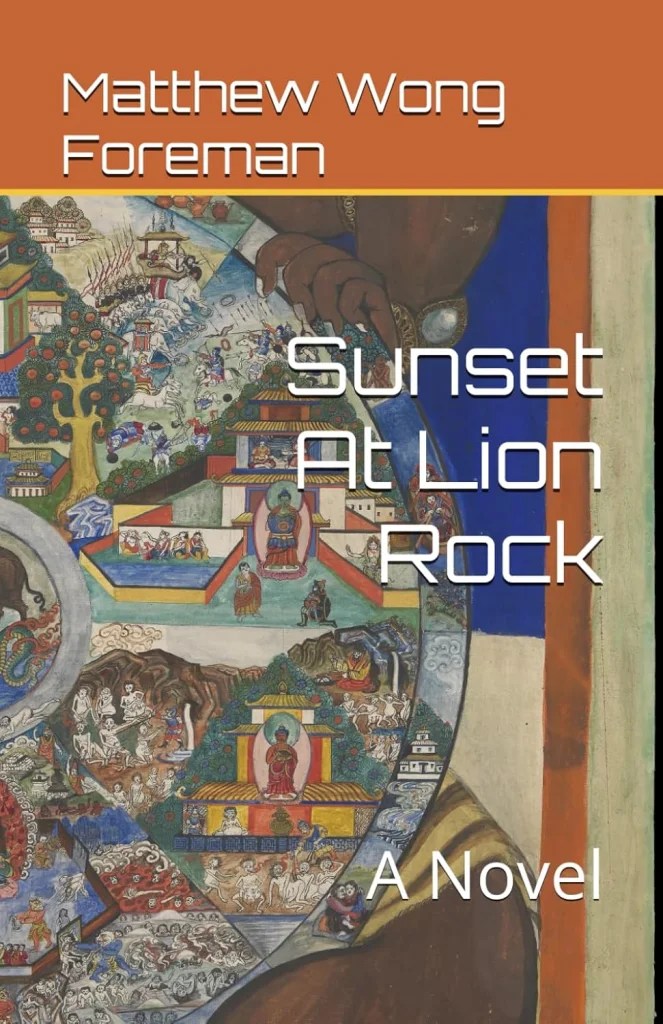
Matthew Wong Foreman, Sunset at Lion Rock, Proverse Press, 2024. 288 pgs.
{Read Jason S Polley’s review.}
For over 2,000 years, apocalyptic visions of doom—of the End Times, of destruction, death, decay, and disappearance—have formed part of the foundations upon which human societies were built. In Ancient Persia, Zoroastrians believed that the world would end after a final battle between good (Ahura Mazda) and evil (Angra Mainyu). During the 1100s, tens of thousands of European men, women, and children willingly marched to their deaths in search of Jerusalem, convinced that if Muslims continued to rule the Holy Land, God’s wrath would descend and destroy the earth. Seven hundred years later, Hong Xiuquan claimed to be the younger brother of Jesus Christ, sending millions to their graves in an effort to overthrow the Qing court—the supposed harbingers of apocalypse—and usher in a new era of righteousness. In 1995, followers of Aum Shinrikyo, a doomsday cult, sought to hasten the end of the world by releasing sarin—a deadly chemical agent—on three separate lines of the Tokyo Metro, killing thirteen and injuring over a thousand.
Thinking about the end of the world, and then getting on with life, is nothing new. Yet this was the question that plagued my mind on the morning of 1 September 2019. A black cloud thundered into my thoughts: it’s over, it’s all over, everything is going to shit.
I was sitting on the edge of my bed, hunched over my phone, scrolling furiously between news updates and Telegram messages. I was meant to fly into mainland China that afternoon, to begin a year-long fieldwork project for my PhD dissertation. Cancelling my flight seemed inconceivable, though it felt as if I had lost the ability to think, to plan, to move. Breakfast looked out of the question—I couldn’t stomach the idea of eating. Showering, getting dressed, going to the airport. Speaking to my mother, my grandmother. Friends from the night before—if I had any left. I couldn’t face any of it.
Yet what I did face, in the days, months, and years that followed: a shifting social, political, and economic landscape. Nationalist fervour. Ideological obsession. Lines drawn in the sand. Chastised for being too liberal, or not liberal enough; too white, too non-local, too self-involved—for simultaneously caring too much and not enough; for not being sufficiently Hong Konger—a phrase whose meaning shifted entirely depending on whom one asked. Climate change, the looming Interstellar-esque future—a world turned upside down, of droughts and famines, blizzards and floods. Governments more invested in silence than salvation, in power over people, prosperity over peace.
I didn’t know it at the time, but I was in shock—frozen, like so many others, in a tangled state of PTSD and survivor’s guilt that would take years to begin to unravel. The previous night, when everything had started to unfold, my girlfriend—who lived in Chicago, where I was attending graduate school—had messaged me to come home, and I had declined. “Home,” I responded, “is here.” But that false confidence didn’t last long. Within a month, I was on a plane to Harbin, preparing to spend ten weeks traversing the grey-green marshlands of idyllic Raohe, a county in Heilongjiang province, hoping to interview Russian-Chinese farmers while surrounded by tall trees, chirping birds, exotic fauna, and smiling clouds. I ended up travelling around China alone for most of it—and barely got anything done.
I clutched my phone, my thoughts a jumble. Facebook and Instagram were flooded with angry posts, cruel accusations, thoughtless takes.
What will you do? a friend posted.
What will I do? Why would anyone care? Yet the question, somehow, spurred me into action. I scratched my head, got out of bed. I put on a shirt. I brushed my teeth. I did not speak to my mother.
I made it all the way to Tsing Yi before telling the taxi driver to pull over. The day was beautiful—the sun a beaming face, the sky a cloudless, deep-blue hue, enveloping the city in its warm embrace. I wandered towards the promenade. It was curiously empty for a Sunday morning. I leaned against the railing and looked out over Victoria Harbour. Hong Kong’s sea and mountains usually offered comfort, but that morning all I could think about was the end of the world. A short while later, a young woman walked past with tears streaming down her face, eyes fixed on her phone. I considered whether to engage—then thought better of it.

On the walk home, I noticed a few more tear-streaked faces in scattered places. Alleyways, curbs, slumped on the benches at the pier facing the harbour. Eyes glued to their phones.
What will you do?
It felt as though a society had died—yet it was, undeniably, still alive. Schrödinger’s Hong Kong. Pandora’s box had been opened, and no matter how desperately we wished to force its contents back inside, our own trail of tears had begun. At home, I messaged a friend, a local journalist at an international English-language newspaper. I asked how they felt about going to work the next day. “I’m not going in,” they replied, two days later. “Why should I write anymore?”
On Sunday night, 28 September 2014, when the first tear gas canisters fell upon the crowds—the first since 1967—I was at home, seated in front of my laptop, writing furiously for a mid-term on John Rawls’ A Theory of Justice. I had begun taking my studies seriously several months earlier, while living in London as a poor and depressed exchange student, possessed by an overwhelming desire to pursue postgraduate studies in the UK.
As I watched the news segment showing clashes between students and police outside Admiralty, my grandmother told me that Ali—the Pakistani security guard who had worked in our building for almost thirty years and watched me grow from boy to man-child—had just got up and left the day before, without any notice or so much as a goodbye. I remember thinking how I knew absolutely nothing about him, or his wife, whose face I’d never seen beneath her burqa, or their son—a sullen man the same age as me—whom I’d never heard utter a word despite seeing him every weekend for almost two decades. One of my great-aunts later told me that Ali had had enough of the political instability and decided to move back home, where he had gradually built a decent life with his HKD 19,000 per month salary—a sum that, apparently, could get you a farm, livestock, and a few workers in Quetta.
I wondered how Ali felt amidst all the chaos. Did he feel as though he’d lost a home, or had he never considered Hong Kong home in the first place? And what of his son—born and raised here, schooled here, who had lived in Hong Kong his entire life—who now suddenly found himself on a farm in Quetta? What about their friends, who used to come over for tea and curry every weekend, speaking animatedly in Urdu? Did they too see the protests as harbingers of “deaths and injuries and other grave consequences,” as one official had angrily declared?
“Why should I write anymore?” Academic papers suddenly felt inadequate—useless. Like me, a 廢青 studying history and philosophy—worthless subjects in the grand scheme of economic status and power, the twin flames of Hong Kong culture. I left the dining table, where my family remained glued to the television screen, and sat in the lifeless dark of my room. I was facing something entirely new in my life—the crushing weight of futility. And I very much wanted it to lift.
My generation of writers—the writers who came of age in the ’90s and ’00s—live in the shadow of Ackbar Abbas’ famous deconstruction of Hong Kong identity as indelibly tied to disappearance. He wrote that Hong Kong “is not so much a place as a space of transit,” whose residents consider themselves transients and migrants en route from China (or elsewhere) to someplace else—or back to where they came from. As a humanities student, I had encountered this description so many times that I eventually went to the library and borrowed a copy of his book, Hong Kong: Culture and the Politics of Disappearance, to try and understand precisely what he meant. I knew it was time to confront this trope—if Hong Kong really were such a space of transience, why did millions care enough to march in the streets? Why did people call themselves Hong Kongers, or Hong Kongese? Why did I have British professors who came here in their twenties, only to choose to die here decades later?
Like many works of cultural theory, it was buried beneath layers of impenetrable abstraction, and it took me many years—and almost an entire PhD—before I fully grasped the brilliance of its insights. Abbas wrote the book in 1997, against the backdrop of the Handover, mass emigration, and a shrinking belief in Hong Kong’s future. To read his analyses of the city’s cultural production—its cinema, architecture, photography, and literature—is to understand what he meant by disappearance. It was not that Hong Kong lacked identity, or was incapable of forging one—a common misreading among scholars I’ve encountered—but that the driving force behind its cultural output was a continual struggle with the threat of erasure. The genius of Abbas lay not in excavating the (un)happy historical accidents that shaped Hong Kong into what it is today, but in articulating the possibility of identity without historical longevity, legacy, or cohesion. A city born of war and displacement, Hong Kong’s identity is one of perpetual presentism—a live-now-think-later rhythm, a deeply embedded pragmatism inseparable from apocalyptic imaginings of disappearance. These imaginings—that everything might collapse at any moment—are part of a cultural legacy inherited from centuries of geopolitical violence and intergenerational trauma.
As we face the unstoppable encroachment of an anti-progressivism that wields the notion of collective prosperity as a cudgel to crush dissent, the idea that Hong Kong is disappearing continues to affect every one of us who lives, has lived, or will live in this city. Critics, reviewers, and commentators repeat it constantly, albeit with varied phrasing. Hong Kong is changing, or dying, or decaying, or deteriorating—choose your adjective. Just another city now, no longer the glittering icon of its heyday.
I don’t believe Abbas interpreted disappearance as pessimistic, or eternal, or born of disillusionment. Having grown up in Kennedy Town as someone of Malay, Indian, and Chinese descent, I suspect he felt like an outsider among outsiders—observing people from across the globe arrive in Hong Kong to try to make a life, only to leave once their time felt up, just like Ali. But Hong Kong was, and still is, a young city, and Hong Kong culture a young, unfinished endeavour. It was easier to believe that Hong Kong had no history, that its people had no real attachment to it, than to believe what writers, historians, and activists around the world have long held true—that building identity takes time, effort, and hope. And that it is our responsibility to spend that time, commit that effort, and remain hopeful, in order to build and rebuild, ad infinitum.
When I was teaching at Northwestern, students often asked me why I chose to study Chinese history in the United States instead of “staying in China.” Indeed, I was asked this question almost every time I landed at O’Hare, where border agents would smirk when I told them why I was in America—as if they knew something I didn’t. I told them it was because America paid me—which wasn’t far from the truth. America paid me for a whole host of reasons, from the politics of language and the legacies of imperialism to the more nuanced political economy of cultural development. Shifts in cultural production have always been inextricably tied to the vicissitudes of politics and economics—be it the Harlem Renaissance in the wake of the Great Depression, or the Misty Poets following the Cultural Revolution.
Can Hong Kong have its own cultural renaissance? It’s not an easy question to answer. The uncertainties are many, even if the idea itself has ardent supporters. “When I was twelve, I watched a professor at Beida jump to his death, chased by his own students,” a professor once told me. “In that moment, I decided I would learn English. I decided to be rescued.” I remember, as a student, thinking: How could studying English literature possibly save you? And why would you ever come to Hong Kong just to make stuff up in English?
I began writing in earnest in 2021, at the height of COVID, while living in Western Massachusetts with my then-girlfriend and her lesbian parents. I mention her lesbian parents as if it matters—because it does. In my twenty-six years of earthly living, I had never encountered such levels of love, care, compassion, and empathy—and haven’t since. I owe much of my emotional growth and capacity for self-reflection to their constant challenges to my heteronormativity—a heteronormativity I hadn’t realised had been holding me back. It was there, in that cocoon of safety, that I first felt the confidence—what I now understand to be self-love—to write. For six months, I wrote incessantly, disillusioned by my academic work, which had ground to a halt as I could no longer conduct fieldwork. Deep down, I knew it would be the only period in my life where I’d be paid to write, and only write. And so I wrote—mostly rubbish, but also some good—which eventually culminated in my novel, Sunset at Lion Rock.
Being an untaught writer has its advantages—I was entirely free of expectation, and simply wrote whatever I wanted. Of course, I spent an unnecessary amount of money buying used books from ThriftBooks, studying them obsessively every day. But I cared little for the conventional markers of commercial publishing success. I didn’t focus on plot, or structure, or character arcs, or the methodical deployment of grammatical tense. I simply wrestled, in Orwell’s words, with the demon inside me—dissatisfied until it came out, eventually. And even if it’s nothing more than a plotless hodgepodge of navel-gazing narcissism, I take solace in the fact that I did it—that others saw enough merit in its flaws, and in mine, to help nurture it into the world. If I were to die tonight, I’d say with comfort that I have no regrets.
Writing that book also taught me the meaning of community. I wrote Sunset at Lion Rock secluded from family, friends, and the outside world (I lived in a forest for much of it), but I was never alone. Throughout the process, I was held by the quiet company of loving non-blood relations, of strangers and townsfolk, of nature. The privilege of having lived outside megalopolises like London and Hong Kong taught me to think beyond the logics of hypermodern commerce—and, perhaps more importantly, beyond self-commodification. Now that the book is out and I’ve returned to Hong Kong, I’ve found myself having to guard constantly against the ego. I don’t think she’s very good, why does she have such a big advance? He’s only famous because of his last name. I’m untaught—I deserve more recognition. A former close friend, a no-longer-writer who has since stopped speaking to me, once drunkenly blurted that if I ever found success as a writer, it would be because of my last name.
Perhaps. But why do writers stop writing? Usually, it’s futility. And where does futility come from? That depends. In my life—whether it’s writer’s block or giving up writing for long stretches—I’ve always traced that futility back to a broken belief. A loss of faith that writing mattered. It might be because of politics, or commercial failure, or a lack of recognition from friends, family, agents, publishers. Sometimes jealousy. One of the most painful emotions a writer can feel is the story of failure—a story that often prevents them from realising they are a writer in the first place.
I came to understand that I needed to write not merely to be seen or heard, but to cultivate a state of mind. One that embraces what it means to act creatively: faith. Faith matters more than talent, or a desire to be published, or even to be read. Faith is a way of life—a shameless confidence in the idea that literature matters, that it is sacred. That it is an endeavour worth pursuing, even if it is ultimately just a game. Because when you see literature through a more pious lens—as Benjamin Labatut has so beautifully described—you begin to see differently. Your relationship with your work changes; it is no longer about self-expression, but about teasing out from within something larger than yourself—delicate, yet overwhelming. When you create from that space, futility loses its grip.
And there is no place more suffocated by futility than Hong Kong.
I had many friends who confessed they had lost the will to write, to work, to care after 31 August. Although the world hadn’t ended, it continued to march through one apocalypse after another. Many of us—perhaps all of us—felt that God, or the gods, must have made a mistake, for They surely couldn’t be this cruel. But as a student of history, I knew this was not cruelty. Raised in a devout Buddhist family, I was familiar with the saṃsāric nature of humanity—the endless cycle of birth, death, and rebirth, not only of individuals but of entire societies. Between the ages of six and fourteen, I was sent to a monastery in central Taiwan every summer. I hated every minute of it, and while I utterly failed to fulfil my mother’s lifelong wish that her son become a monk, I did manage to memorise a fair amount of Mahāyāna Buddhist scripture. I didn’t know it then, but these texts would become my salvation. Avidyā 無明, anitya 無常, anatta 無我—to this day, for reasons I still don’t fully understand, despite no longer considering myself a Buddhist, I find myself returning to these concepts when confronting life’s crueler realities.
What is the point of despair? The same professor who once told me that English had saved them also said, on the day of my graduation, that there are only three ways to live: pessimistically, optimistically, and realistically. These states of mind determine the actions we choose to take. My therapist in Chicago insisted that, on the especially difficult days, I must remember that each day is a miracle. Where I came from, how I was raised, what I’ve endured—the familiar cliché of comparing oneself not with others but with one’s past self remains, perhaps, the only way forward. Especially as a writer in Hong Kong. As Ocean Vuong so poignantly asks: when the apocalypse comes, what will you place into the vessel for the future?
What will you do?
For me, the answer I’ve come to is that I choose to write. George Orwell once revealed that between the ages of seventeen and twenty-four, he tried to abandon the idea that he was, deep down, a writer. Since 2019, after I’d turned twenty-five, I too came to understand that some things are beyond one’s control. Sometimes these uncontrollable forces feel unbearable—at other times, they alter the entire course of your life for the better. In the endless dark of uncertainty, sometimes all one can do is write. Sometimes, they can take everything from you—but, though they’re trying, they can never take your thoughts. Doing is writing poetry so metaphorical it slips through the grip of censorship—the highest form of creativity. Doing is samizdat—when people met in secret across the Eastern Bloc to share forbidden books. It is ensuring that, in the midst of fear and in the face of terror, you choose to witness.
To become a writer in Hong Kong—or indeed any artist—is to participate in a failed enterprise. In a city where the average person reads five books a year—a statistic that is, incredibly, celebrated—it can feel dispiriting to find any significance in creative work. And yet creativity is not merely about being read. It is about preservation. A poem, a story, a novel, a painting—these are snapshots in time, artefacts that may one day become history, waiting to be found. And just because the chances of discovery are slim does not render the desire futile. We die trusting the living who follow us to make meaning of our lives. The same is true of art.
What do you want to leave behind, to say, to record, to keep from disappearing, when the apocalypse comes?
How to cite: Foreman, Matthew Wong. “On Becoming a Hong Kongese Writer” Cha: An Asian Literary Journal, 11 Api. 2025, chajournal.blog/2025/04/11/hong-kongese.


Matthew Wong Foreman is a Hong Kong-born writer. His debut novel, Sunset at Lion Rock, was awarded the 2023 International Proverse Prize and shortlisted for the 2022 Dzanc Books Prize for Fiction. A U.S. edition is forthcoming from 7.13 Books in 2026. His fiction and non-fiction have appeared in publications such as Pacific Historical Review, Asian Ethnicity, and The Oxford Review of Books. A graduate of both the University of Hong Kong and the University of Oxford, he completed a PhD in History at Northwestern University in 2023, where he also taught as an instructor. His work has been featured by RTHK and showcased at the Hong Kong International Literary Festival. Visit his website for more information. [All contributions by Matthew Wong Foreman.]
 Cha
Cha 