

📁 RETURN TO FIRST IMPRESSIONS
📁 RETURN TO CHA REVIEW OF BOOKS AND FILMS
Click HERE to read all entries in Cha on Cho Nam-joo.
Cho Nam-Joo (author), Jamie Chang (translator), Saha: A Novel, Liveright, 2023. 161 pgs.
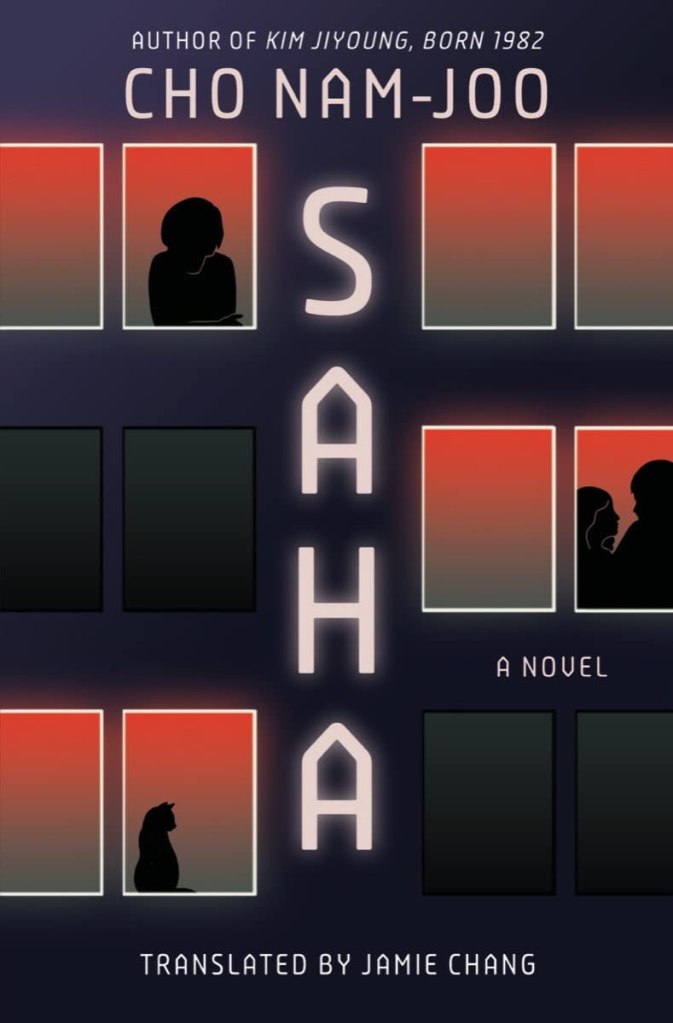
Cho Nam-Joo’s Saha: A Novel (《사하맨션》, 2019) presents a dystopian vision of refugees living in the Saha Estates. While the novel constructs a uniquely imagined world, readers may discern its subtle reflections on contemporary concerns such as immigration, declining birth rates, corporate hegemony, and the existential burdens of life in developed nations.
The story unfolds in Town, a once-thriving village sustained by fish farming. In time, a corporation seizes control, transforming the settlement into a closed, corporate-governed nation overseen by anonymous ministers. Under a “Special Law,” freedoms are severely curtailed and native residents are deported. Only the concealed Saha Estates offer sanctuary—where displaced individuals quietly build a functioning community over the course of decades. Town evolves into a powerful, insular country ruled by unseen authorities, impervious to the powerless and sealed off from the outside world. The Saha Estates remain its only clandestine gateway to an alternative way of life.
The inhabitants of the Saha Estates—referred to simply as “Saha”—are deemed the lowest social class. They are neither “Residents,” who are financially and socially recognised by the government, nor “L2s,” who possess residence permits allowing them to live in Town, albeit confined to difficult or low-paying occupations.
Saha does not centre on a singular protagonist; rather, the narrative continually shifts among characters, all of whom are linked to the Saha Estates. It moves, for example, from the siblings Jin-kyung and Do-kyung in Unit 701 to Sara, another resident in Unit 214. Yet these characters are not strangers to one another—Sara, for instance, has encountered Do-kyung and his girlfriend, Su, at the bar where she works.
It is perhaps through these narrative shifts that the narrator most effectively reveals the broader struggles faced by the residents of Saha. Before disclosing Su’s occupation as a medical worker, for instance, the narrator first draws attention to the injustices endured by Saha residents—how they are excluded from the medical insurance system and left to suffer when illness strikes. In another chapter, as the narrative turns to Granny Konnim, the same narrator addresses the issue of abortion through her encounter with her adopted child, Woomi, while also unveiling the circumstances that led to her becoming a Saha resident.
Alongside the direct depictions offered during these narrative transitions, the individual stories of each character resonate more profoundly with the reader. In one chapter, the narrator begins not only with Sara but also recounts the struggles of her mother, Yonhwa. Despite her relentless efforts, Yonhwa cannot alter her L2 status unless she marries a citizen—an older man for whom she feels no affection. In another section, the narrative reaches back three decades to the life of Eunjin, a Saha resident and orphan who strives tirelessly to improve her social standing, only to remain an L2. She ultimately dies while working as a caregiver, tending to sick children during the outbreak of a mysterious respiratory illness.
Although fictional, many of the novel’s plotlines closely mirror real-world concerns. The outbreak of a respiratory disease, for instance, may evoke memories of the COVID-19 pandemic from recent years. Meanwhile, the classification system of Citizens, L2s, and Saha reflects, in part, the visa categories assigned to foreign workers in numerous countries. In Japan, for example, the government has actively recruited foreign labour to address the challenges of a declining birthrate and an ageing population. The caregiving and hospitality sectors, in particular, have witnessed a marked increase in foreign workers. While the situation is not as extreme as that portrayed in the novel, reports of exploitation and poor working conditions—especially within technical intern training programmes—are not uncommon.
Therefore, the dystopian vision presented by Cho Nam-Joo is not only unsettling but also serves as a cautionary tale grounded in real-world events. Near the end of the novel, when Jin-kyung abruptly trespasses into the Parliament building, she is informed by the chief secretary that—contrary to media reports suggesting that seven ministers govern the country—he alone oversees the entire operation. Beyond its dramatic impact, this revelation underscores a central theme of the novel: the capacity of mass media to shape public perception by disseminating narratives that obscure the truth. It reflects the real-world peril of an ever-widening gap between reality and the selectively constructed version of it.
Although the book cover emphasises Cho Nam-Joo as the author of Kim Jiyoung, Born 1982 (《82년생 김지영》, 2016), readers of both works will find Saha stylistically distinct from her earlier publication. While Kim Jiyoung, Born 1982 explores the challenges of living as a woman in contemporary South Korean society, Saha envisions a world in which an entire class of people is marginalised, despised and exploited. To emphasise the lived reality of women like Kim Jiyoung, the narrator of that novel includes numerous footnotes referencing real articles and academic works that document gender inequality. In contrast, Cho’s later novel employs more complex language and nuanced expression to support its richly imagined dystopian world, whereas her earlier work adopts simpler, more direct diction in keeping with its documentary-style narrative.
Yet the connection between the two works is evident. Together, they reveal Cho Nam-Joo’s thematic shift from a microscopic focus—examining how an individual woman suffers under social repression—to a macroscopic one, investigating how an entire social class is systematically marginalised. Both works exemplify Cho’s broader literary project: to give voice to the often underrepresented and to raise public consciousness of systemic injustice.
As the translator of several of Cho Nam-Joo’s works, Jamie Chang delivers an English version of Saha that is both lucid and highly readable. With a keen awareness of the structural and cultural differences between Korean and English, Chang skilfully rearranges sentence order where necessary to ensure the translation reads naturally. In the original Korean text, free indirect speech appears frequently; in translation, Chang often employs italics to indicate a character’s inner thoughts or uses quotation marks to render them as direct speech. English, being less tolerant of ambiguity between thought and spoken dialogue, often necessitates interpretive choices—decisions that Chang navigates with care and precision.
One point worth noting is the translation of the term “Butterfly Riot”—a protest led by L2s and Saha residents against the new government. In its first instance, during a conversation between Jin-kyung and an elderly man, the original Korean reads 나비 혁명 (nabi hyeongmyeong), which might be more accurately rendered as “Butterfly Revolution.” Later in the novel, the narrator explains that the event is referred to by various terms—such as “protest” (시위, siwi), “riot” (폭동, pokdong), and “revolution” (혁명, hyeongmyeong)—depending on the speaker. That the old man uses hyeongmyeong (“revolution”) perhaps reflects a more sympathetic or idealistic interpretation of the incident. However, the translator may have chosen “Butterfly Riot” for the sake of terminological consistency throughout the English edition.
Overall, Saha is a thought-provoking work of fiction. Through its dystopian lens, readers can discern how various plotlines parallel contemporary issues and may interpret the novel as the author’s—or narrator’s—cautionary vision of a not-so-distant future.
Bibliography
▚ Cho, Nam-Joo. (2016). 82nyeonsaeng Kim Ji-young [Kim Jiyoung, Born 1982]. Minumsa.
▚ —. (2019). Saha maensyeon [Saha: A Novel]. Minumsa.
How to cite: Au, James Kin-Pong. “Narrating the Margins”of the Future: Cho Nam-Joo’s Saha.” Cha: An Asian Literary Journal, 9 Api. 2025, chajournal.blog/2025/04/09/saha.


James Kin-Pong Au is a Master’s graduate of both Hong Kong Baptist University and the School of Oriental and African Studies (SOAS) in London. He is currently a PhD candidate at the University of Tokyo, writing his dissertation about the relation between history and literature through close readings of East Asian historical narratives in the 1960s. His research interests include Asian literatures, comparative literature, historical narratives and modern poetry. During his leisure time, he writes poetry and learns Spanish, Korean and Polish. He teaches English at Salesio Polytechnic College and literature in English at Tama Art University. [All contributions by James Kin-Pong Au.]
 Cha
Cha 