
📁 RETURN TO FIRST IMPRESSIONS
📁 RETURN TO CHA REVIEW OF BOOKS AND FILMS
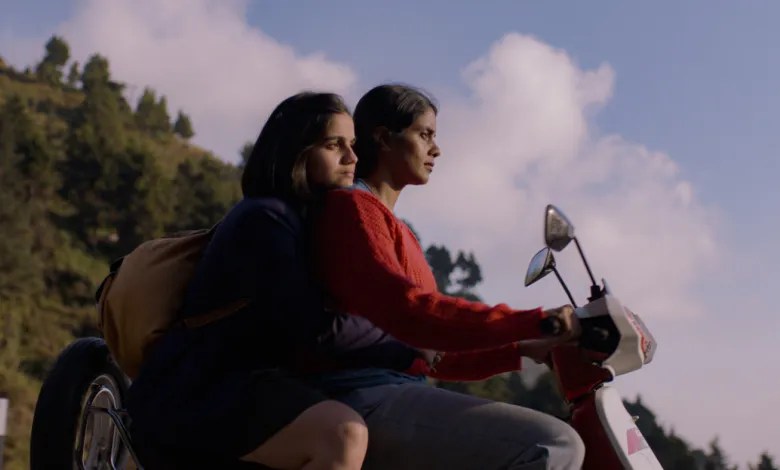
Shuchi Talati (director), Girls Will Be Girls, 2024. 118 min.

Female sexuality has long remained one of the most stringently policed and anxiously mediated territories. The erotic interiority of women—particularly young women—has been rendered either invisible or legible only through the codes of male desire, discipline, and denial. What Shuchi Talati undertakes in her audacious debut Girls Will Be Girls is a deliberate dismantling of this representational history. Mainstream Indian cinema has traditionally operated within a dual bind when representing young women: the girl must either remain asexual and therefore virtuous, or become sexual and thus dangerous, misguided, or punished. Talati refuses this dichotomy. Instead, she positions Mira within the affective space of becoming—neither wholly innocent nor fully transgressive, but suspended in the liminality of first desire, self-surveillance, and structural repression.
Set against the insular world of a conservative boarding school nestled in the Indian Himalayas, Talati’s Girls Will Be Girls explores the friction between institutional conformity and adolescent yearning. Mira, played by Preeti Panigrahi, is not merely a school topper. She is the institution’s ideal product—a head prefect, academic overachiever, and, perhaps most tragically, the internalised enforcer of the school’s oppressive moral codes. Yet beneath all this lies the combustible rawness of a girl on the verge of becoming. The arrival of Sri (Kesav Binoy Kiran) introduces not just a romantic distraction but a direct threat to Mira’s carefully curated sense of self. Talati peels back the stifling veneer of institutional respectability to reveal the tender, tumultuous, and often contradictory interior life of a young girl standing at the edge of womanhood.
Mira exists in a world calibrated for excellence and obedience, carefully constructed by both the institution and her own mother—a brilliant Kani Kusruti—herself an alumna of the same school, whose ideas of success are rooted in fear and personal regret. Her mother, a homemaker with no economic autonomy, funnels all her latent ambitions into her daughter’s grades, tightly holding the reins of Mira’s life in hopes of crafting a future that does not resemble her own. What begins as distraction slowly blossoms into longing—an emotional and physical attraction that Mira neither understands nor knows how to articulate. Anila forbids her from romantic entanglements not out of prudishness alone, but because she lives under the weight of a patriarchal arrangement that leaves her economically and emotionally dependent on a husband who holds her accountable for their daughter’s choices. “If Mira’s grades fall,” she warns, “he will blame me.” It is not just the fear of failure, but the fear of being punished for it.
Mira’s adolescence is, thus, shadowed by a generational legacy of female compromise—Anila’s own lost girlhood reverberates through her overbearing concern. Talati threads the narrative with those small, awkward, half-formed rituals through which adolescent girls first begin to encounter their bodies, their desires, their power, and their “shame”. There is the thrill of wielding authority—however minor—as Mira patrols the hallways as head prefect, penalising students for painted nails or incorrect socks. There is the queasy panic of being humiliated by a teacher for the length of one’s skirt—an early lesson in how modesty becomes currency in the economy of “good girlhood”. One minute, Mira is chiding her peers for lip gloss, the next she is sneaking glances at Sri across the classroom, uncertain whether she wants to look or to be seen. Her sexual awakening is not a dramatic metamorphosis, but a slow, unfolding awkwardness—marked by confusion, elation, guilt, and fleeting euphoria.
The film’s title poses a provocatively subversive question: what does it truly mean for girls to be girls? Both Preeti Panigrahi and Kani Kusruti deliver performances of astonishing restraint, infusing even the simplest gestures. Their shared scenes possess the weight of unpractised intimacy—the ache of two people who coexist under the same roof but lack a common language for tenderness.
But it is in Talati’s handling of female sexuality that the film reigns supreme—particularly within the broader context of Indian cinema, where girlhood is so often sanitised, moralised, or diminished. Girls Will Be Girls insists, instead, on bodily truth. Mira’s sexuality is neither idealised nor exploited—it is rendered in its full spectrum of awkwardness, hesitancy, curiosity, and joy. We see her practising how to kiss on her wrist, inspecting her cleavage in the mirror with mingled embarrassment and delight, dancing alone in her room, and masturbating for the first time. Her romance with Sri is equally nuanced, alive with the tentative smirks and hesitant touches that define adolescent love. Talati captures the fumbling, fragmented nature of desire—its capacity to exhilarate and confound in equal measure. The scenes between Mira and Sri shimmer with vulnerability: their longing is half-expressed, perpetually interrupted, eternally cautious. As their relationship deepens, so too does the pressure to balance—between love and academics, secrecy and selfhood, between Mira’s yearning for freedom and the institutional gaze intent on disciplining her into docility. Mira is expected to be exceptional, obedient, desexualised—the perfect daughter, the model student, the vessel of a mother’s aspirations and a school’s reputation.
Anila is not simply a mother figure in the traditional narrative sense. Most of what we come to understand about her—her compromises, her regrets, her longings—is revealed not through exposition but through the subtle ways she reacts to Mira’s burgeoning confidence. There is, undeniably, motherly love in her gaze—but braided into that affection is a murky blend of fear, envy, and bewilderment. She watches her daughter move through the world with a clarity and self-assurance she herself never possessed, and though she wishes Mira a life of independence, she also cannot help but mourn the version of herself who never got to want so freely. In watching Mira’s ascent into selfhood, we also witness Anila’s descent into reflection—not only on who she has become, but on the parts of herself that have long since fossilised. Her frustration with Mira is not rooted in cruelty but in displacement—a slow, aching realisation that the future she once longed for now belongs to her daughter, and that in trying to guide her, she might also be reaching—perhaps for the first time—for her own agency.
One of the most enduring undercurrents of Girls Will Be Girls is its confrontation with the way institutions—particularly schools—become complicit in scripting the first chapters of a girl’s shame. The boarding school in the Himalayan foothills, where the film is primarily set, becomes a pressure cooker for both the policing of female desire and the casual entitlement of boys. Mira is punished not for breaking the rules per se, but for refusing to perform the quiet deference expected of girls. Meanwhile, her male classmates—vulgar, voyeuristic, emboldened by the impunity the school affords them—are allowed to operate with near-total invisibility.
Ms Bansal, a teacher who embodies the institution’s genteel cruelty, responds to Mira’s complaints with polite dismissal. “You’re getting older. You need to be careful,” she warns—a phrase that could belong in any auntie’s moral lexicon. In one of the film’s most gutting sequences, Mira, now Head Prefect, attempts to report the predatory behaviour of her classmates. The response is almost farcical in its inversion of responsibility: the length of the girls’ skirts is up for discussion; the boys’ behaviour is not.
On Teacher’s Day—when the seniors traditionally role-play as members of the faculty—those same suspended boys are reinstated in a mock position of authority equal to Mira’s. In theory, it is a day of parody; in practice, it exposes the rot. Power, even as pantomime, is too easily returned to the boys, and Mira’s status as principal-for-a-day is revealed to be symbolic—hollow. When they see her walking alone near the terrace—a private space she may have intended to share with Sri, her romantic interest—they descend. The camera pulls back to reveal a chilling tableau: a young woman in a saree, surrounded by boys.
Anila sits beside her daughter as she is quietly chastised by the school authorities. Not one of the boys who had heckled her is present. Not one is asked to explain. The burden of accountability, once again, is laid at the feet of a girl who refused to be small.
The final act of parental solidarity is the film’s subtle coda. Anila, once a girl herself, now watches her daughter be punished for the very freedoms she was denied. In Anila’s attempts to guide, interfere, and protect, we witness not control but a desperate act of self-redemption—a woman trying to rewrite her own story through the unwritten pages of her daughter’s. What Girls Will Be Girls ultimately lays bare is the cyclical nature of gendered expectation—how women, even as they attempt to break free, often find themselves entangled in the very webs they once sought to escape. In the acts of looking, wanting, touching, being seen—Mira reclaims the autonomy that was denied to generations before her, including Anila, who now watches her daughter move through a landscape she was forced to cross blindfolded.
What the film captures with rare precision is the way female sexuality is pathologised from the very beginning—not merely by men, but by the institutions and women conditioned to do so. Anila’s surveillance of Mira is not borne of malice but of a deeply internalised fear that desire will destroy a girl’s worth. The mother is not merely a character, but a living embodiment of what becomes of women who were told, from girlhood, that they could want nothing. This is the anatomy of how patriarchy reproduces itself—not only through the actions of men, but through the fearful complicity it cultivates in women. The school that warns girls to be “careful” around boys while excusing the boys’ violence is not simply a corrupt institution—it is a microcosm of society itself.
We try not to become our mothers, only to discover that we are, in ways both tender and terrifying, already them. We do not merely inherit our mothers’ faces—we inherit their unfinished stories. What complicates this further is that our mothers were often punished for being who they were—for wanting, for feeling, for resisting—and so their love arrives laced with warnings. They offer care threaded with caution, support shadowed by sorrow. Girls Will Be Girls understands this with painful clarity. It recognises that female relationships are often forged in the fire of double standards and silences—where daughters seek liberation and mothers seek protection, and neither realises how alike their wounds truly are.
What Talati ultimately captures is a paradox that feels achingly true: that mothers and daughters often ache for one another, even as they fail to understand each other. That a mother might see her own buried self in her daughter’s boldness—and feel both pride and pain. That a daughter might glimpse the cost of compromise in her mother’s eyes—and both resent it and fear becoming it.
Mira is not the infallible emblem of the “new” woman, nor is Anila merely a bitter casualty of the old order. Instead, they are—simultaneously—women caught in the slow churn of generational evolution, full of longing and contradiction. One is trying to forge a path unburdened by shame; the other carries the weight of shame so heavily she mistakes it for duty.
How to cite: Singh, Ananya. “Shuchi Talati’s Girls Will Be Girls Charts Female Sexuality With Unusual Subtlety.” Cha: An Asian Literary Journal, 9 Apr. 2025, chajournal.blog/2025/04/09/be-girls.



Ananya Singh is a writer. Her work has been published in FirstPost, Deccan Herald, Madras Courier, and elsewhere. She can be contacted via ananyadhiraj7@gmail.com and @anannnya_s on Instagram and X. [Read all contributions by Ananya Singh.]
 Cha
Cha 