
茶 FIRST IMPRESSIONS
茶 REVIEW OF BOOKS & FILMS
[REVIEW] “Samrat Upadhyay’s Mad Country: To Adapt and Thrive in the Chaos” by Abhinav Tulachan
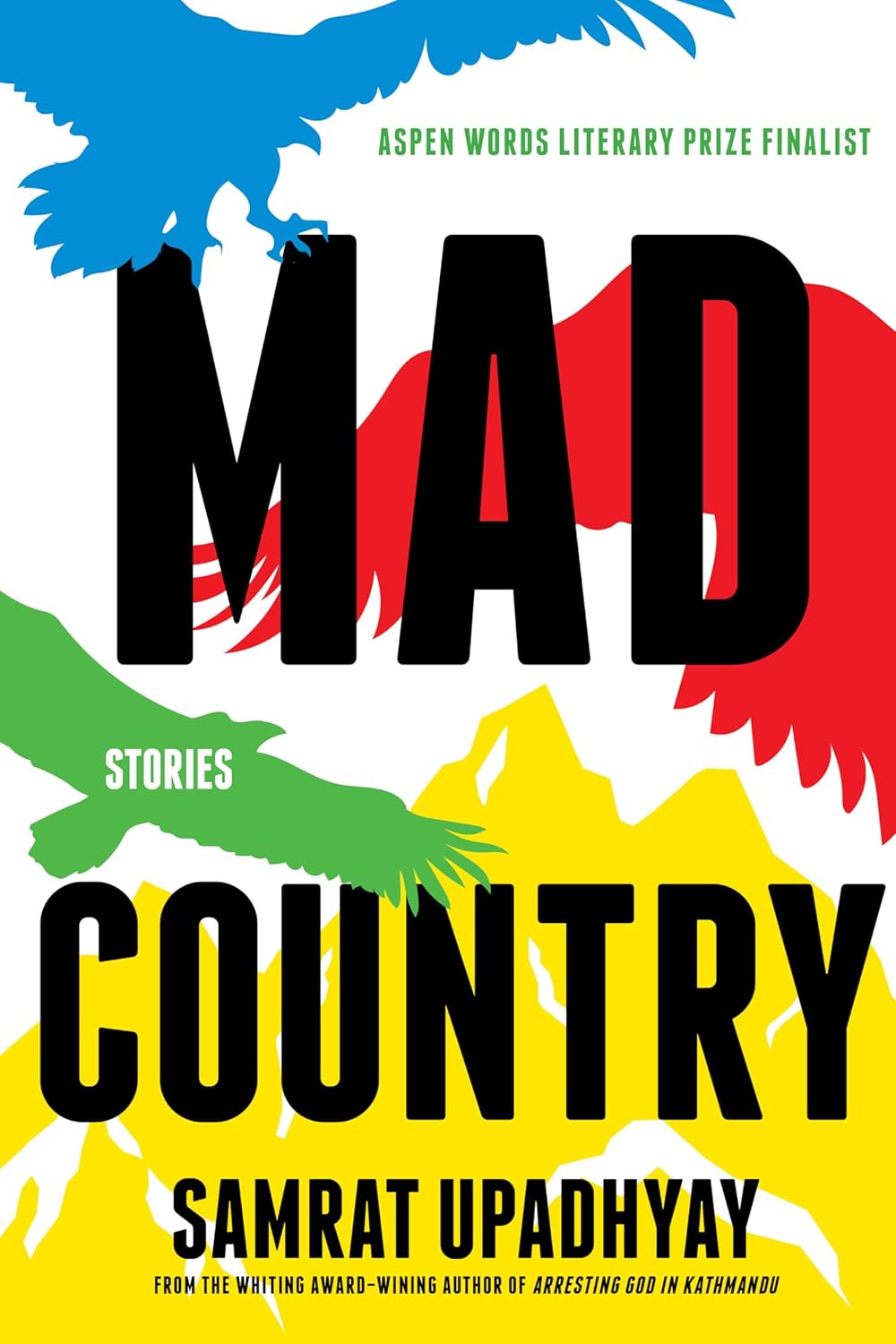
Samrat Upadhyay, Mad Country, Soho Press, 2017. 304 pgs.

Abhinav Tulachan’s copy of Mad Country
Following my previous review of Prajwal Parajuly’s The Gurkha’s Daughter, my father handed me yet another literary treasure to read before my departure to Hong Kong, where I was to complete my undergraduate studies. He insisted that the tales within were akin to Parajuly’s own narratives.
With those expectations in mind, I waited until I had settled back into my dormitory in Kowloon before finally cracking open Samrat Upadhyay’s Mad Country—and I was, admittedly, surprised. While the stylistic execution bears conceptual similarities, the stories—and especially the themes—diverge sharply from anything I had previously encountered.
There is a remarkable degree of thought and sophistication imbued in Mad Country; each tale vividly encapsulates the essence of the book’s title—the chaotic character of the Nepali landscape, a reality widely acknowledged yet rarely explored or thoughtfully reflected upon. What the collection does so powerfully is to show how this very landscape reshapes the identities of its people, whether through personal turmoil or social conflict encountered by the cast. Samrat Upadhyay presents eight stories from a world that feels at once deeply familiar and strikingly alien.
The story that most powerfully embodies these ideas is “Beggar Boy”—a tale of Ramesh, a wealthy yet impressionable teenager who indulges—no, drowns—in fantasies of adopting an entirely new identity, in a desperate attempt to salve the wound of abandonment carved into his soul by his mother. The emotional void she leaves behind gradually consumes him, as we witness his sense of self-worth unravel with each passing page.
And how does he cope with such turmoil, you may ask? By masquerading as a street beggar—still a common sight in present-day Kathmandu—joining them on the streets (!!!) by going to varied lengths to acquire and wear filthy, foul-smelling rags (purchased from an actual beggar).
People like Ramesh are dealt a cruel hand—one that, unfortunately (or perhaps fortunately, in his own view), compels him to reshape the very foundations of his identity and social standing. For he was never taught any alternative means of making peace with his pain.
A similar pattern emerges in “Dreaming of Ghana”—the longest story in the collection—which follows a young man named Aakash, disillusioned with his life in Kathmandu, who begins to yearn for a country he has never known. Ghana becomes, for him, a symbol of possibility—a distant land untainted by his current despair, yet one he longs to experience.
These yearnings take physical form in the figure of a young, dark-skinned woman whom Aakash encounters on the street and names “Ghana”—as he gradually falls in love both with her and with the very idea of his imagined paradise. Yet by the story’s end, he watches helplessly as the fragile “dream palace” he has constructed crumbles before his eyes.
These are but a few of the many ways in which Samrat Upadhyay challenges his characters’ perceptions of “Who I am” versus “Who I might actually be”—questions that resonate far beyond the borders of Nepal.
“America the Great Equalizer”, as the title aptly suggests, centres on a Nepali student living in Illinois who begins to find a sense of community and identity among African Americans, after witnessing the pervasive racial injustices on foreign soil. “‘Will they shoot me because I’m a Black n***** or because I’m a Nepali n*****?’” the young man, Biks, asks—just days before joining a protest rally against the police in Ferguson.
However, this is not to say that all the tales are centred exclusively on the Nepali people or the Nepali diaspora. Perhaps my favourite story in the collection is the one set in the 1970s. “Freak Street” (Jhochhen Tole—a former “hippie nirvana” in Kathmandu due to its once-thriving hashish trade) follows the journey of a foreigner who finds a sense of belonging through a found family in Nepal, yet struggles to maintain this feeling as she desperately clings to the life she has built on foreign soil.
The young American “hippie” Sofi—or Sukumari (सुकुमारी, meaning “virgin girl”) as she begins calling herself—is mocked by locals for wearing traditional Nepali clothing and for her desire to adopt aspects of Nepali culture as part of her own identity. No matter how earnestly she tries to escape her past, or how deeply she wishes to preserve her relationship with the landlady she affectionately calls “Ma” (short for Ama, meaning “mother” in Nepali), she cannot transcend her origins as a kuiriney (white woman). Ultimately, she is left to wander the streets of Freak Street—just another “uncombed, unwashed, and dazed hippie”, another story swallowed by the chaos of the landscape.
Of course, tragedy—or some form of ill-fortune—seems to befall the central figures of each narrative, whether as a gradual descent or a sudden fall. The latter is exemplified in the titular story, Mad Country (likely set during the revolutionary era), which follows a mother who is arrested and held in police detention for months after seeking information on her wayward son.
This sudden change in her fortune compels her to adapt to her new reality—within which she finds companionship among other female political prisoners and, by the end, undergoes a complete transformation in both identity and worldview.
What surprised me most, however, was the near-exact reversal of this fate depicted in “What Will Happen to the Sharma Family” (which, admittedly, I had to read twice). It was a particularly engaging narrative in which the so-called black sheep—the most “dim-witted” member of the family—rises to success and ultimately finds peace and comfort. The distinctiveness of each story, while orbiting a shared thematic concern with what it means to live in Nepal, is what kept me fully engaged—propelling me from one tale to the next without pause.
Yet what I’ve offered here are but mere glimpses—surface reflections, so to speak—of the depth each narrative offers, regardless of its length. These are stories of the unheard—stories that demand to be told, yet are so often left in the shadows, consumed by silence.
The endings are often abrupt, yet this seems true to Nepal’s broader nature—a labyrinth of histories buried deep, obscured over time as layer upon layer accumulates.
Upadhyay grants these stories the spotlight they deserve, and I would strongly encourage readers to immerse themselves in these depths—to discover, for themselves, why for those living in Nepal, existence is indeed life in a “Mad Country”.
How to cite: Tulachan, Abhinav. “Samrat Upadhyay’s Mad Country: To Adapt and Thrive in the Chaos.” Cha: An Asian Literary Journal, 8 Apr. 2025, chajournal.blog/2025/04/08/mad-country.



Abhinav Tulachan is an undergraduate student in the Department of English Language and Literature at Hong Kong Baptist University. He loves reading, writing, and sharing the knowledge he has gained through his academic journey. [All contributions by Abhinav Tulachan.]
 Cha
Cha 