

◉ I Made Sure It Had Nothing Whatsoever To Do With Hong Kong: A Confession
◉ The Ballad of Billy Lopez: An Excerpt

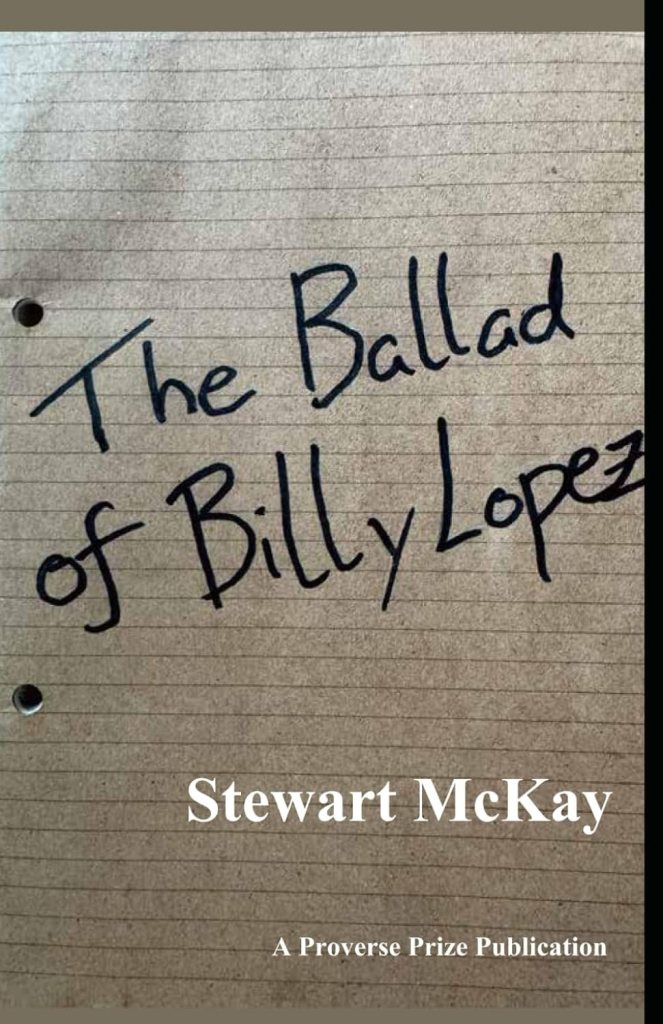
Stewart McKay, The Ballad of Billy Lopez, Proverse Publishing, 2024. 208 pgs.
You have lived in Hong Kong since March 2012. You rent a walk-up in Yau Ma Tei. You have adopted a Sai Kung street cat. You have hiked every stage of the Big Four trails. You know precisely what you want to order in a cha chaan teng. You can tell a minibus driver, with confidence, exactly where to let you off.
You are a writer—one who writes about Hong Kong. Not because you find it any more inspiring than the other places you have lived—after all, inspiration should arise from the mundane as much as the extraordinary—but because you could no sooner resist writing about the city where you have spent nearly fifteen years than you could command its summer rain to cease.
Speaking of which—how does one write about Hong Kong without slipping into clichés as well trodden as the pavements of Nathan Road? The humidity and the neon, the concrete jungle and the summer rain… These are the first pitfalls a Hong Kong writer encounters on their journey—and the easiest to sidestep. The clichés? Simply abandon them.
There is more to Hong Kong than the well-worn imagery of its skyline and streets. Set your story on the quiet plains of Kam Tin, where no building rises above three storeys, and velvet mountains, their dusty paths winding like ancient veins, call to mind the distant landscape of Nepal. Or let it unfold abroad a sampan moored off Sai Kung, its wooden frame swaying with the tide. Or in a public housing estate in Tuen Mun, where the rhythm of daily life hums in a language beyond words. Each of these places is more Hong Kong than the clichés ever dared to be.
On the other hand, how does one write about Hong Kong without the humidity and the neon—without the elements that have seeped into the world’s collective imagination—and still capture widespread appeal? After all, people believe they know Hong Kong. They have glimpsed its streets through the lens of cinema, watched its skyline flicker past from the deck of a cruise ship, or perhaps even lived here briefly in the eighties, when the city was something else entirely.
People want the skyscrapers, the sweltering heat, the carts piled high with dim sum baskets. Strip these away, and what remains? Set a story in Hong Kong without them, and you risk losing its sense of place—blurring its edges until it could be anywhere. Europe? America? Some wistful, impossible land where people still read for pleasure…?
There’s an elusive line, isn’t there? A fine, shifting boundary between authenticity and expectation. Write with an eye too keenly fixed on widespread appeal—focus-grouped, box-ticked, sanded down to fit a marketable mould—and the reader will sense it within the first few paragraphs. No one likes to be written down to.
Better, then, to remain steadfast in your vision—to set your story in a Band Three school in Kwun Tong and trust in the deeper truth within it. The way through to the reader is not through concession but through universality. Strip away the specifics, and what remains? We have all been schoolchildren once, after all—whether in a struggling secondary school in Kowloon, a red-bricked American elementary, or the hallowed halls of Eton.
Right. You’ve navigated those thorny dilemmas, making steady progress along the trail—but the ascent is far from over. Further questions begin to rise before you, steep and unrelenting as the slopes of Lantau Peak. How do you write about Hong Kong as an expat? And yes, even after all these years, you are still an expat. You shop at Marks & Spencer. Your skin is pale, your hair light. You are a literal gweilo. So, what then? Do you write about others like you—expats propping up bars in Wan Chai, slipping off to Mid-Levels for their discreet afternoon rendezvous? God, no. Readers would sooner hear about the humidity.
Writing about Hong Kong as an expat is no mere pebble to be kicked aside—it is a boulder, immovable and weighty, demanding to be reckoned with. Compared to this, the challenges of cliché and widespread appeal are trifles, obstacles easily skirted. Of course, you can write about expats without indulging in the well-worn tropes of Lockhart Road. Place your expat in a public housing estate in Tuen Mun. How did he find himself there? How will he leave? Does he even want to? Yet, even in sidestepping one set of clichés, another looms large. The expat himself—his very existence—is already a cliché.
If you choose not to write about expats, then what remains? Do you write about local Hong Kongers?
You are not one—neither by ethnicity nor by citizenship. So, can you? (Well, no one is stopping you.) Should you? (That’s a far trickier question.) If you do, tread lightly. Approach with sensitivity, with meticulous thought and research. Be prepared for scrutiny, for criticism if you falter—or if you slip, yet again, into well-worn clichés. Wet markets, incense-laden temples, the weight of familial expectation… All relevant, all real, but each no more than a sliver of the intricate, shifting mosaic that is daily life in Hong Kong.
One final landmark stands before you in your trek towards the elusive perfect Hong Kong story. How do you avoid writing the wrong thing about this city—something that might be seen by the wrong eyes, read in the wrong way? This is the newest and most insidious obstacle on the course—no mere stone underfoot but a hidden snare, a pit veiled in leaves, waiting to catch the unwary. It is the question that now looms largest over anyone daring to write about Hong Kong—and perhaps the most pressing of them all.
In my writing, I have often—consciously or otherwise—circumvented this final, thorny question by setting my stories in alternate versions of Hong Kong. Post-apocalyptic landscapes, half-submerged and fractured by gang warfare; dystopian futures where laughter is outlawed and leaders rule for a single week before facing execution. There is, in some ways, a strange comfort in these imagined cataclysms—a kind of catharsis in surrendering to a future where we are all, inevitably, doomed. But even here, the illusion of escape is fleeting. Any dystopian vision of Hong Kong—of Asia, of the world—is still, unavoidably, political. It cannot be otherwise. Politics, like cliché, seeps in whether we invite it or not. (Is politics itself a cliché?)
And so, when it came to writing my first novel, I took the only path that remained—I ensured it had nothing whatsoever to do with Hong Kong. Yes, I wrote the bulk of it here—in cafés, in libraries, in the solitude of my walk-up flat. Yes, I redrafted it, edited it, had it critiqued, all while Hong Kong pulsed and shifted around me in its endless, kaleidoscopic guises. But the story itself? It belongs elsewhere. It is a coming-of-age tale, a romance between two teenage boys, set in the American South in the late nineteen-eighties. Its characters know nothing of Hong Kong; if asked, they would conjure only hazy impressions—kung fu films, Bruce Lee, and perhaps, inevitably, the neon. Always the neon.
But I have no doubt that Hong Kong seeped in—how could it not? The city that bore witness to the birth of my first full-length novel, the backdrop to every draft, every revision. Even now, as I reread the opening paragraphs—my narrator walking along a busy street towards his school—I find myself wondering: is it not, in its rhythm and energy, utterly redolent of this gloriously chaotic city?
How to cite: McKay, Stewart. “I Made Sure It Had Nothing Whatsoever To Do With Hong Kong: A Confession.” Cha: An Asian Literary Journal, 16 Mar. 2025, chajournal.blog/2025/03/16/whatsoever.



Stewart McKay is a British-born writer based in Hong Kong. He graduated from the University of Stirling in 2007 with an honours degree in English Literature and History. After living in Thailand, he moved to Hong Kong in 2012, working as an ESL teacher, tutor, and examiner. An active member of the Hong Kong Writers Circle, he has contributed to several of their anthologies and edited HK24 (2017) and Lost in Transition (2023). His flash fiction and short stories have appeared in Grindstone Literary, Raconteur, Fiction Factory, and Free Flash Fiction, with several pieces shortlisted for literary prizes. His debut novel, The Ballad of Billy Lopez, was a finalist for the 2023 Proverse Prize. McKay’s fiction explores the complexities of human nature—its desires, contradictions, and failings. While he believes literature should interrogate the human condition, he insists it must also entertain. A dark seam of humour often runs through his work, which spans sexuality, aging, speculative futures, and post-apocalyptic nightmares. https://chajournal.blog/category/stewart-mckay/
 Cha
Cha 