
📁 RETURN TO FIRST IMPRESSIONS
📁 RETURN TO CHA REVIEW OF BOOKS AND FILMS

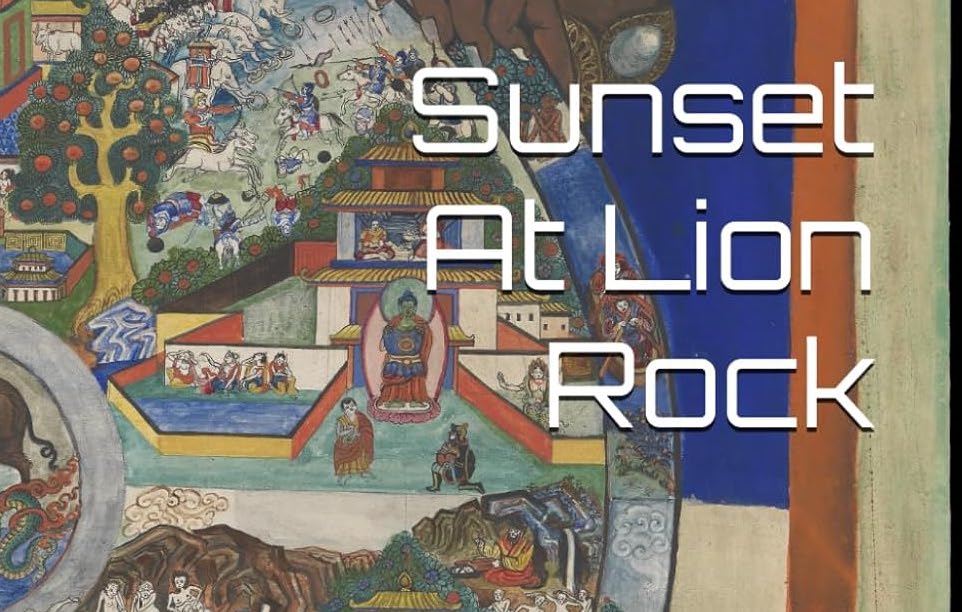
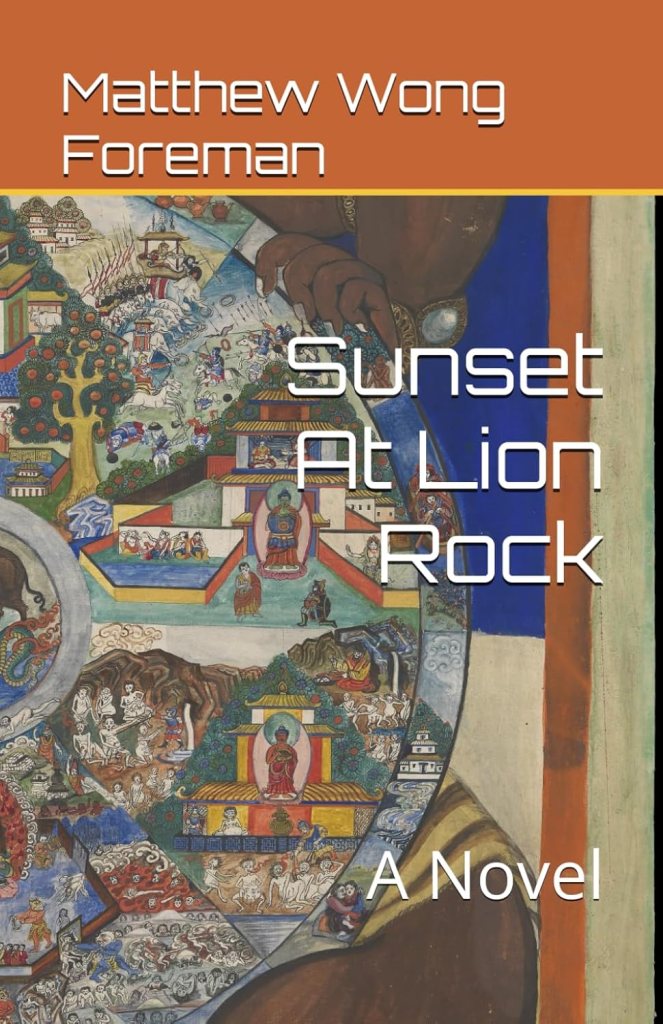
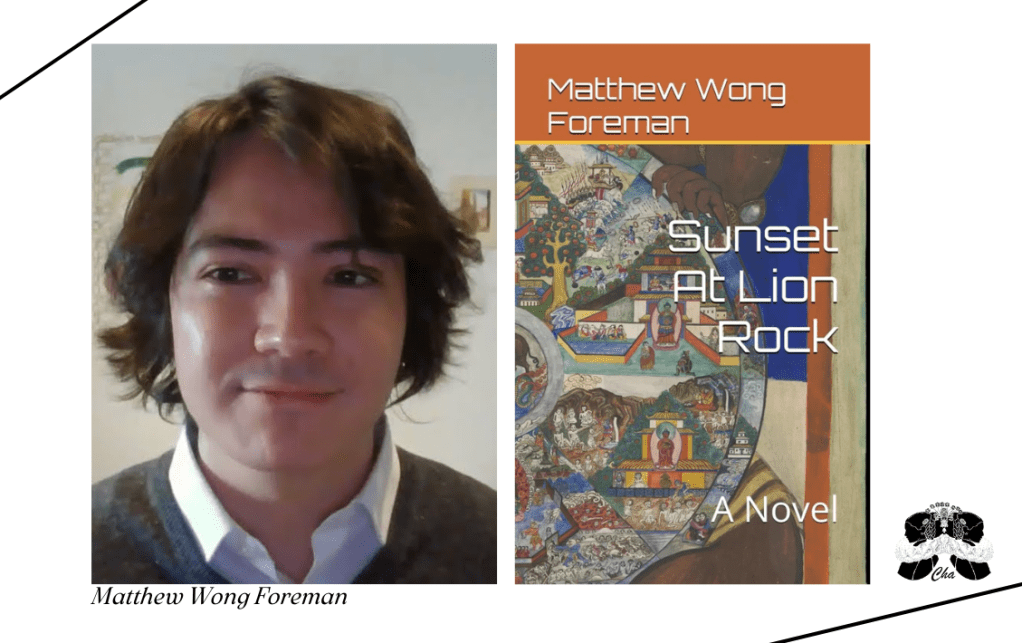
Matthew Wong Foreman, Sunset at Lion Rock, Proverse Press, 2024. 288 pgs.
………I’ve no strength left to stop the contradiction
………My heart is tired and my eyes blurry you know
………—Leslie Chung, “Echo, is that You”.
Not unlike some of the stories in Masking the City: Hong Kong in Allegory (2020)—such as Vaughan Rapatahana’s “The Sickness” and “Winnie el Chingón”’s “Sheep”—Matthew Wong Foreman makes a virtue of existentialism (among many, many other things) in his debut novel, Sunset at Lion Rock. Wong Foreman’s 2024 work opens with two epigrams: one from Rilke, the other from Camus. This invocation of self-willed, authentic agency—expressed through poetry in the face of quiet desperation—is hardly surprising, given the political upheavals that have reshaped Hong Kong over the past decade: the peaceful Umbrella Movement in 2014, the vehement anti-extradition law protests in 2019, the allegedly Orwellian implementation of the National Security Law (NSL) in 2020, and the draconian Covid mandates that inhumanely dragged on until March 2023.
In Hong Kong, quarantine measures, universal masking—both indoors and out!—and vaccination checkpoint charlies persisted for nearly a year longer than in regional neighbours Thailand and Malaysia, and more than two years beyond their abandonment in “the West.” In this pharmakon instance, “the West” includes regional rival Singapore, where the series of so-called “circuit-breaker lockdowns”—three attenuated civic shutdowns between April 2020 and August 2021—lasted a mere 14 weeks in total. It is worth noting that Covid fatalities in Singapore—a city-state with statistically comparable population demographics to those of Hong Kong—were approximately one-sixth of the toll suffered in the latter. As Worldometer last reported on 13 April 2024—before officially closing the book on Covid, though the virus continues to circulate and remains lethal to the elderly and those with comorbidities—Hong Kong (population ~7.4 million) recorded “14,924” deaths, reflecting a mortality rate of 0.202%. In contrast, Singapore (population ~5.8 million) reported “2,024” fatalities, with a markedly lower lethality rate of 0.035%.
Despite near-total surgical mask compliance and widespread “vaccination,” Hong Kong recorded one of the highest per capita death rates in the post-“vaccine” era. This is the consequence of confining people indoors during an ostensibly airborne “plague.” Consider Israel, where studies indicated that no individual under the age of 50 succumbed to Covid unless burdened with at least five comorbidities. Look to the United States, where the average Covid-related death occurred at age 82—six years beyond the nation’s life expectancy of 76. Or take Canada, where the truckers’ protests of January 2021—effectively precipitating the end of lingering lockdowns across the West a full 25 months before a beleaguered Hong Kong fully reopened—were dismissed with banal accusations of Nazism before their bank accounts were unconstitutionally frozen. This, in a federation where, two years later, the entire parliament delivered a standing ovation to a Waffen-SS veteran simply because he had fought against the Russians—who, lest it be forgotten, were Allied forces in the Second World War. Sickness. Sheep. And the largest upward transfer of wealth in modern history.
Thus, the existentialism gaining gravitas in the literary imaginary of our beloved Hong Kong—and in what certain social scientists, with characteristic redundancy, might term the “lived experience” of everyday Hongkongers. Yet, to sustain this counterbalancing of caveats—complementing those already woven into Wong Foreman’s de facto political Sunset at Lion Rock—we would do well to recall the West’s current à la mode penchant to brand almost any dissenting voice as “stochastic terror” and any disagreeable figure as an “existential threat.” A classic top-down stratagem. Imagine: In-group dogma eclipses fact. Perceived threats supersede actual atrocities. Panic, both internal and external, is stoked. Fear becomes the instrument of mass acquiescence, precipitating popular demands for expanded state control. And voilà—the inchoate autocracy emerges. Individuality, once the hallmark of originality and thus of difference, is eradicated. Difference mutates into indifference—a failure of commitment to the collective. Doubt enters: the ultimate treason, both against faith and against the surveillance state. Sheep. Sickness. Anguish.
All of this, CNN would brazenly—or rather, be dutifully trained—to reiterate ad nauseam, constitutes the stuff of “conspiracy” … if applied to the United States rather than to China, of course. Yet, in the wake of the American presidential debate this past June—where nearly half of North America found itself stunned by the realisation that “President” Joe Biden was drifting ever deeper into cognitive decline—the Pfizer-funded “democratic” legacy media found itself, in turn, unmasked as the true purveyor of disinformation. For years, they had lied—blatantly, unrepentantly—to viewers cum voters about Biden’s accelerating senescence, a decline perceptible to any resolute news consumer since at least the shallower depths of summer 2021. Meanwhile, the guileless subscribers of CNN and its ideological twin, MSNBC, had been inhabiting an alternate reality—one in which, for instance, Biden was tirelessly lauded as at the top of his game behind closed doors. [And—to add caveat to caveat—we must recall that at Fox News, which is also Pfizer-captured legacy media, the hypocritical, albeit courageous, Tucker Carlson, who was America’s most popular news anchor by a longshot at the time, was fired for telling the actual truth!] Who needs honesty and wellness, to coin a phrase, when state propaganda will suffice? And the crowning irony—in this one-hundred-miles-an-hour interim thus far? A palace coup! The self-proclaimed guardians of “democracy” installing a new presidential candidate who had not received so much as a single vote. Selection masquerading as election. A political figurehead installed by decree. This Sinophobic irony, one hopes, is not lost on my fellow Hongkongers.
Now, all of this—to return, for a moment, to myself, a self who, for three years post-NSL, lectured on “Existentialism” in a fourth-year university seminar—all of this post-Covid red-pill awakening, this dawning recognition that the so-called “legacy media” is wholly subjugated to corporate interests, where profit trumps well-being, all of this is not, in any literal sense, integrated into Wong Foreman’s protracted and not unflawed Sunset at Lion Rock. The novel concludes in the midst of the tumult of Hong Kong’s 2019 riots—a term that our protagonist Eric’s Popo (grandmother) would no doubt find apt, though where Eric’s Gonggong (grandfather)—the novel’s secret hero—stands politically in that fateful year is left unspoken. Yet—and “Yet, yet our lives add up to yet”—we cannot but read late-2024’s Sunset at Lion Rock in the shadow of the West’s now-exposed programmatic witlessness. Its Eurasian protagonist, Eric, who at the age of seven was already suicidal, exhibits from the outset a healthy scepticism toward official narratives—particularly those peddled by TVB Pearl, one of Hong Kong’s four free-to-air stations. It is he who tells us as much, early on.
All the narration in Sunset at Lion Rock, styled as an epistolary novel, is ostensibly addressed to the absent Mikey—Eric’s dissident oncle manqué. Mikey vanished in mainland China in 1989 (!!!), at the age of 19, long before Eric was born to Mikey’s sister, Eva Wong, and a paradigmatically imperious (and all-but-absent) gweilo from England. That man, John Phillips—a mercurial figure by definition—never realises his lofty ambitions of becoming a writer “of the same ilk as Orwell, Keats, Blake, Byron, Maugham,” a nomadic “Kerouac of the decaying British Empire.” Meanwhile, Mikey—his antithesis in almost every conceivable way—was, as a precociously sharp engineering student at Hong Kong Polytechnic (before its rechristening as PolyU), improbably radicalised by “Chinese translations of Bakunin, Kropotkin, Marx, Heidegger, Foucault, Girard, Barthes, Lenin, Stalin, Mao.” Eric, the ostensible biracial reincarnation of Mikey within the Buddhist Wong family, claims by the age of 27—when he sets down his recollective epistle—to have “read them all,” including Mikey’s “own pencilled annotations in the margins.”
Even Eddie—Eric’s affluent, dipsomaniacal adolescent friend—manifests as a precocious literato. In one of several inebriated colloquies, Eddie derides Eric as “some genius big-shot,” “a wannabe writer,” “[t]he next Orwell, the Hong Kong Junot Díaz, or some other self-absorbed schmuck.” In the same tête-à-tête, Eddie corrects Eric’s malapropism—deus ex machina for creatio ex nihilo—delivers a scathing précis of Houellebecq’s Huxleyan peroration in Atomized, alludes to Taleb’s “black swan conundrum,” and, with characteristic theatricality, declaims Eric’s self-conception as (sic erat scriptum) “so weak it needs to be determined by the people around you, be they Buddhist, a fool, drunk, doctor, lesbian, blonde, Chinese, Indian, dog, cat, whatever.” Heady stuff.
And brimming with epic lists. Here’s another: “Like Ocean Vuong. Like Lê Thi Diem Thúy, Maxine Hong Kingston, Amy Tan. Like all those who came before me—Han Suyin, Lu Xun, Zhang Ailing, Bei Dao, Mo Yan, Yu Hua, Qiu Miaojin, George Orwell.” And another: “The faces of my youth—Shijia Moni, Guanyin, Wenshu, Dizang, Xukongzang, Dashizhi, Puxian, Jingangshou—the only ones I recognise, the only names I know.”
Cosmopolitan, cross-disciplinary matter indeed—this, in a novel that blends Epicurean matérial with Derridean supplément, offering a veritable grab-bag of ideas. Chapter 11 of its 17 devotes pages, seemingly inconsequentially, to an eclectic array of subjects, including (i) an exposition on Buddhist sutras and Lamrim elaborations, (ii) a historical survey of Kowloon’s Pui Ching Middle School and King George V School, (iii) an assortment of wholly inappreciable dog meat recipes, (iv) an explication of the Japanese classics Kojiki and Nihon Shoki, and—among still many other digressions—(v) a portrait of the bisexual Hong Kong virtuoso Leslie Cheung, an über-talented depressive who, at 46, took his own life on April Fool’s Day, 2003.
And now, as I begin to draw this review to a close—a review of a debut I came to commend only upon sustained reflection after a second reading—let me clarify my deliberate use of the qualifiers not unflawed, nominally, improbably, and inconsequentially. I invoke these terms with intention, not with animadversion. This is not hedging. There is no covert critique smuggled within overt praise.
Wong Foreman’s partly fictionalised novel is, at its core, also a memoir. How else could one sustain, with such reflexive intensity, the sheer weight of suffering, passion, and sympathy in an encyclopaedic work—one that opens with a family tree and unfolds, through fragments, mirages, and flashbacks, across four generations, tracing a lineage of skiving, scars, and scandals? Like Kit Fan’s Diamond Hill (2021)—another debut in which the first-person, notionally Buddhist narrator concedes that “one does not devote oneself seriously to any religion without being damaged”—Wong Foreman masterfully entwines Cantonese into his English-language Hong Kong novel, a fusion that mirrors the hybridity of the city itself.
How to cite: Polley, Jason S. “Keep the Aspidistra Flying, Among Many, Many Other Things: Matthew Wong Foreman’s Sunset at Lion Rock.” Cha: An Asian Literary Journal, 14 Mar. 2025, chajournal.blog/2025/03/14/sunset.


Jason S Polley is an Associate Professor of English at Hong Kong Baptist University, where he teaches modern fiction. His passions extend beyond literature—to South Asian writing, long-distance running, motorcycling, and the works of Daniel Defoe, Flaubert, and Stendhal. Yet his truest love is his blue-eyed daughter, Jacynthe Milagros Lloy—Jacyn the Miracle Joy (alias Jacyn Jr!)—who, at not yet two, is already at home in English, Cantonese, French, and Hok Lo, a northeastern Guangdong dialect that, as Popo tells him, drifts somewhere between Cantonese, Hakka, and Min Nan Hua. Jason (Sr.) has published articles on John Banville, District 9, Jane Smiley, Watchmen, Wong Kar-wai, House of Leaves, Bombay Fever, Joel Thomas Hynes, R. Crumb, critical pedagogy, and David Foster Wallace, alongside encyclopaedia entries on a range of Indian authors. He is also co-editor of the essay collections Everyday Evil in Stephen King’s America (2024), Poetry in Pedagogy (2021), and Cultural Conflict in Hong Kong (2018). [All contributions by Jason S Polley.]
 Cha
Cha 