
茶 FIRST IMPRESSIONS
茶 REVIEW OF BOOKS & FILMS
[REVIEW] “Freedom from Time and Space: On James Shea’s Last Day of My Face” by Jonathan Han
Click HERE to read all entries in Cha
on Last Day of My Face.
James Shea, The Last Day of My Face, University of Iowa Press, 2025. 76 pgs.
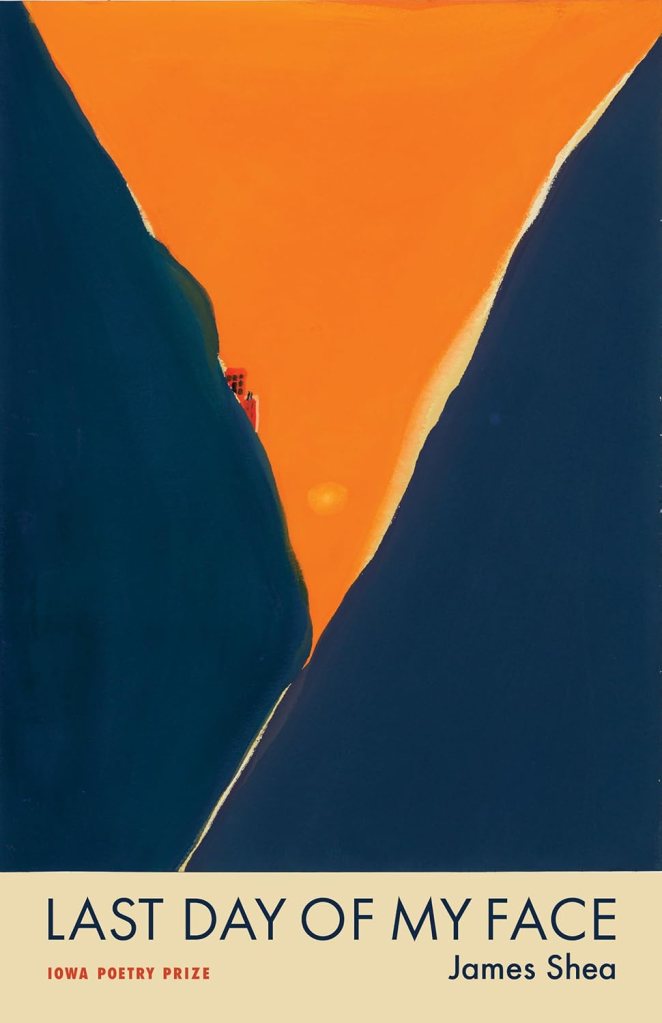
I have come to this book rather late. James Shea’s Last Day of My Face won the Iowa Poetry Prize in 2024 and was published in 2025, so I have the advantage of writing, at the beginning of 2026, in dialogue with what has already been said.
I confess that I am grateful for this circumstance. Shea’s poems do not readily yield to explanation. They entice with wit and draw the reader in with apparent lucidity, yet the crux of the poetry often remains elusive. That very elusiveness generates the charge within Shea’s cerebral collection, apprehension as a tantalising reward.
Challenging, certainly, but the book is not inaccessible. There are points of entry from which the lines may be navigated. Consider, for instance, the poem, “After Ma Zhiyuan”:
Electric valley, a little wind, indefinite clouds.
An old snail, two monkeys, 6-inch moth on the balcony,
coral-green trees, a bus down the mountain, AC.
Traveler without teeth in the middle of a private street.
The title offers a generous clue. The poem makes clear that it situates itself within the tradition of the sanqu 散曲 form, a lyric genre that flourished during the Yuan dynasty and is marked by its sequence of discrete, juxtaposed images. Sanqu poems tend to assemble compressed scenes that accrue resonance through accumulation and tonal modulation. The most celebrated example is Ma Zhiyuan’s “Autumn Thoughts.”
Withered vine, aged tree, evening crows,
Small bridge, flowing water, human habitation,
Old road, westerly wind, thin horse
Evening sunlight falls west,
Broken hearted, a man exists, at Heaven’s edge1
If one takes “Autumn Thoughts” as a secondary point of reference, the form presents a tightly packed sequence of ten images. It would be tempting, though likely futile, to chart precise correspondences between Shea’s images and those of Ma Zhiyuan. The broken-hearted man may well find his descendant in a toothless traveller. What truly binds “After Ma Zhiyuan” to its precursor is the manner in which Shea suspends action through imagery, achieving what Ezra Pound described as “that sense of freedom from time limits and space limits.” The traveller appears aged, adrift in the mountains, wandering beneath a hot sun. By the poem’s close, these possibilities coalesce into a genuine narrative of sympathy.
One image from Ma Zhiyuan’s poem that may be carried forward is that of the “evening crows.” The bird becomes the central presence in the poem “Finish Line”:
What are they whispering along the telephone lines?
Whose names are they calling among themselves?
There was no subtlety to their departure.
It was to the point: the point of their departure.
One of them left in the wake of the others,
and in leaving, left a map of its wake.
The overlapping repetition in these opening lines, and in those that follow, exemplifies the musicality of Shea’s poetry. There is no readily discernible rhyme scheme in the book, yet when a word recurs its meaning pivots, and the poem turns with it. The effect is especially apt, given that crows are often imagined to caw twice. The dark birds’ association with mortality accords with other poems in the volume. “Wake” lends its title to a poem that catalogues garments mourning the naked death of their wearer. In a similar vein, “Two-Body Problem” meditates on the notion that the toes are the last to apprehend the poet’s death. Death without morbidity, humour without grotesquerie, Shea maintains a careful balance in his treatment of the theme.
Last Day of My Face is neither constrained by its themes nor circumscribed by its influences. One poem, “That’s That,” meditates on the versatility of the word “that.” “Motion” depicts a couple riding the tram and is one of a handful of poems set in Hong Kong. “The Womb I Knew” offers a comic retelling of the tale of the Trojan Horse, in which the cowardly speaker “stayed back,” remaining “in the ass of the ass.” The pun is coupled with a Homeric quality in the decisive action and the spare imagery.
“The Station of Prince Edward” turns to more recent events closer to home. The violence in the station is mediated through footage viewed on a device. As in “The Womb I Knew,” the poem interrogates what it means to bear witness, though here the act is inflected with irony.
Reporters held their cameras in the scrum
and I could have been anywhere but there—
streaming felt like a strange act of love….
I’m a witness to all this, I told no one.
I’d watch a live-feed of the Crucifixion.
The final line unsettles the ostensibly noble notion of bearing witness by conceding a measure of gratification. There is something intoxicating in observing martyrdom as it unfolds. Set against the scuffle is the spectator’s relative inaction, and the moral authority of the witness is thereby called into question.
The closing poem of the book, “Failed Self-Portrait,” differs markedly from what precedes it. Its greater length permits a more fully developed narrative, and a relationship may be traced across its sections. The lines are looser, yet they retain the sharp imagery and coy humour that characterise the earlier poems. Here is a selection of couplets:
I mount a mirror to my front bumper
so I’m always driving into myself.
They say when you die, your life
flashes before your eyes,
so you can’t see where you’re going.
Ah, the loyalty of my breaths,
one following upon another.
Small tufts of snow blowing
in circles, mostly leftward
with the wind, also downward.
More than the shorter poems, which often crystallise around a sharply defined vision, “Failed Self-Portrait” draws the space between its images ever tighter, until their interrelation becomes resistant to paraphrase. It is among Shea’s more demanding works. Rather than lingering over the lines and constructing abstract frameworks that confine the poem within strictly logical terms, one finds greater pleasure in simply attending to the poem on its own terms.
The same approach may be extended to the entirety of Last Day of My Face. Each poem may capture a fleeting aspect of the poet, yet it is the reader’s act of turning the page that renders these faces whole, and in so doing confirms their impermanence. That sentiment finds its most eloquent expression in two couplets from “Failed Self-Portrait”:
I want to set life apart
and examine it, consider its particulars,
but I am swept up. Your turning
of these pages blows a wind upon me.
- The translation of “Autumn Thoughts” is found in Stephen H. West’s 2021 essay “‘Autumn Thoughts’: Shared Images, Shifting Phrases, and Promiscuous Poetics.” Early Medieval China 27:101–120. ↩︎
How to cite, Han, Jonathan. “Freedom from Time and Space: On James Shea’s Last Day of My Face.” Cha: An Asian Literary Journal, 2 Mar. 2026. chajournal.com/2026/03/02/day-of-my-face.

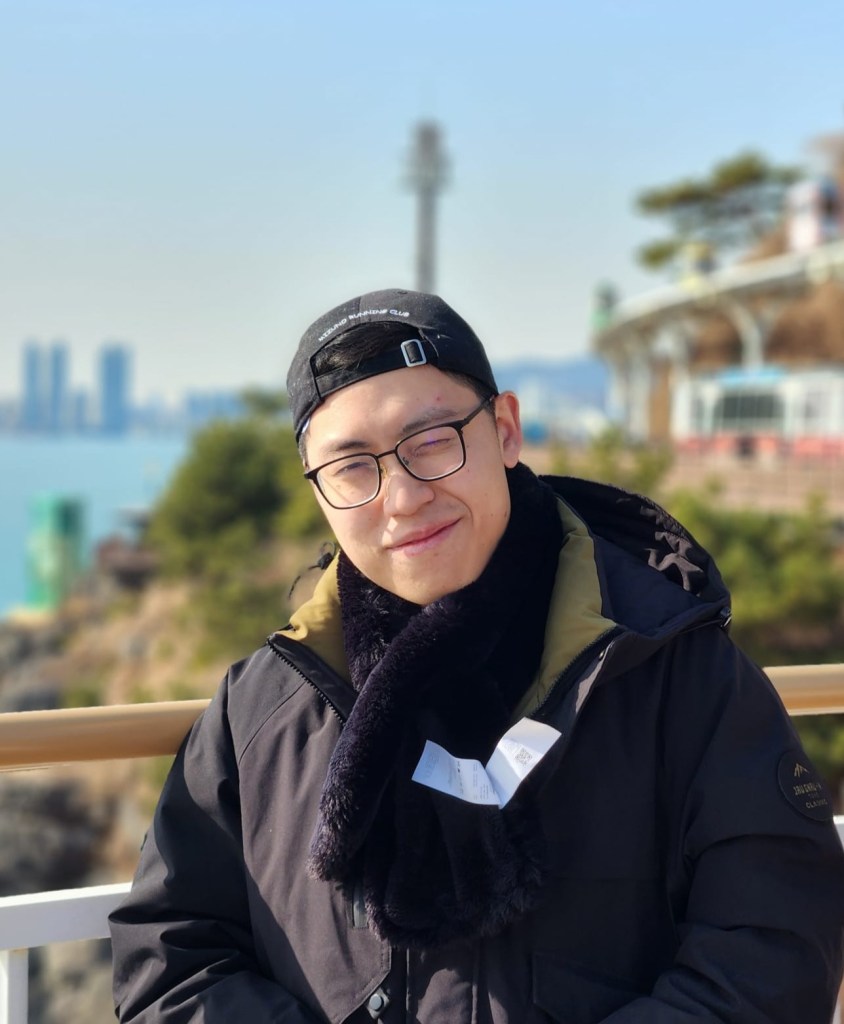
Jonathan Han is a Hong Kong-based writer. His work has appeared in Essays in Criticism, Hong Kong Review of Books, and Asian Review of Books. His chapbook Quinquennial was published by Pen and Anvil Press. Follow his Substack @jhantheman. [All contributions by Jonathan Han.]
 Cha
Cha 