

茶 FIRST IMPRESSIONS
茶 REVIEW OF BOOKS & FILMS
[REVIEW] “Before TSMC and Same-Sex Marriage: Qiu Miaojin’s Notes of a Crocodile” by Glen Loveland
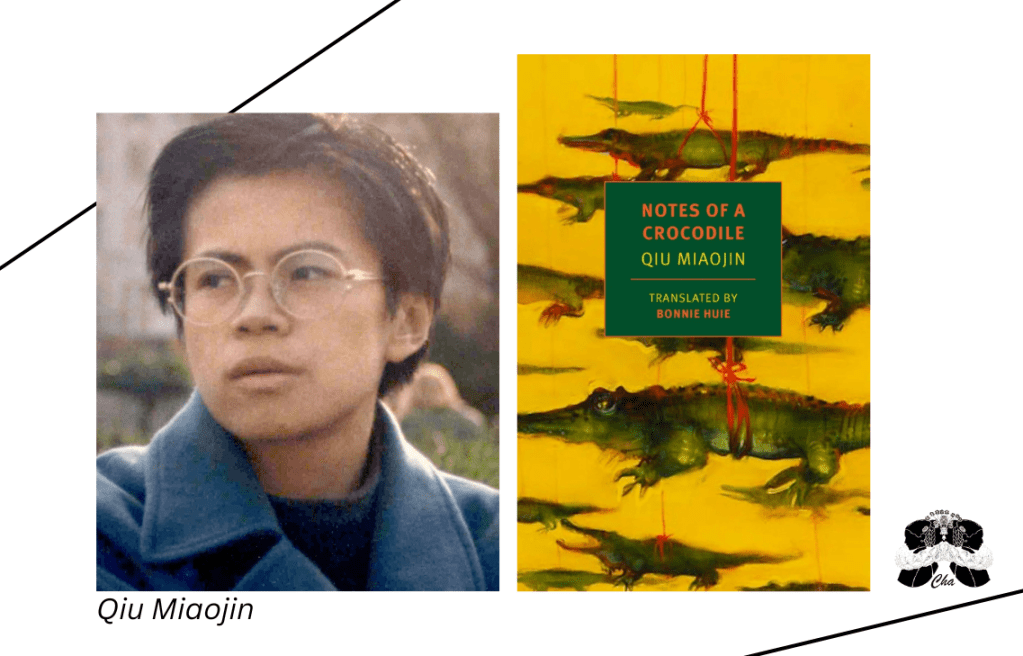
Qiu Miaojin (author), Bonnie Huie (translator), Notes of a Crocodile, NYRB Classics, 2017, 256 pgs.

To reflect on Taiwan in the late 1980s is to witness a nation in the throes of profound transformation. Decades of martial law—a period defined by the suppression of civil liberties and political dissent—had set the stage for an era of democratic awakening. Amid this societal upheaval, Qiu Miaojin’s Notes of a Crocodile emerged not merely as a novel but as an incisive meditation on the island’s impending metamorphosis. Now available in Bonnie Huie’s luminous English translation—recipient of the Lucien Stryk Asian Translation Prize and longlisted for the PEN Translation Prize—this seminal work transcends its historical moment, offering a visionary blueprint for the progressive society Taiwan would one day become.

Qiu Miaojin (1969–1995) was a revolutionary literary voice, whose incisive explorations of queer identity, desire, and alienation have cemented her as a defining figure in LGBTQ+ literature. Born in Changhua, Taiwan, she developed a literary style that defied convention—blending autofiction, epistolary form, and surrealist allegory to illuminate the complexities of marginalised existence. Her seminal works, including Notes of a Crocodile (1994) and the posthumously published Last Words from Montmartre (1996), blur the boundaries between confession and fiction, their fragmented narratives pulsating with raw emotional intensity.
A psychology graduate from National Taiwan University, Qiu relocated to Paris in 1994, where her struggles with isolation and self-discovery profoundly shaped her writing. Last Words from Montmartre, composed as a series of haunting, introspective letters, reflects her fraught relationship with society, art, and love, culminating in her tragic suicide at the age of twenty-six. Yet beyond the biographical, her work endures as a radical critique of heteronormativity and an unflinching testament to queer resilience.
Though overlooked in her lifetime, Qiu’s oeuvre has since garnered international acclaim for its stylistic innovation and fearless honesty. Her writing, now translated into multiple languages, resonates across cultures, influencing feminist and queer diasporic literary movements. Critics have lauded her intertextual richness—drawing from philosophy, film, and myth—and her extraordinary ability to transmute personal anguish into universal poetics. Today, her legacy persists as a beacon for those navigating the intersections of identity, art, and defiance, ensuring her place in the canon of world literature.
Set against the backdrop of National Taiwan University, Notes of a Crocodile chronicles the life of Lazi, a lesbian undergraduate whose introspective diary entries form the novel’s beating heart. Through Lazi’s lens, readers traverse a landscape where entrenched traditions collide with emerging ideologies, capturing both the exhilaration and the disorientation of a society in flux. The university serves as an ideal crucible for Qiu’s exploration—a space where intellectual emancipation confronts societal conservatism, and the allure of new ideas strains against the weight of convention.
At the core of the novel lies the evocative metaphor of crocodiles masquerading as humans—a motif that operates on multiple levels. For LGBTQ+ individuals, it serves as a poignant reflection of the struggle to conceal one’s true self within an unforgiving environment. In 1980s Taiwan, this allegory resonated deeply, mirroring the populace’s experience under the Kuomintang (KMT) regime. Following their retreat to Taiwan post-1949, the KMT imposed policies that promoted a homogenised Chinese identity, often at the expense of local languages and customs. Consequently, many Taiwanese navigated a dual existence: one persona tailored to official expectations, another—a more authentic self—hidden from public view.
Qiu masterfully wields this imagery through surreal vignettes interspersed throughout the text, including mock newspaper reports about “crocodile sightings” and public hysteria over these creatures living among humans—a trenchant critique of moral panic and society’s fear of the “other.”
Qiu’s avant-garde narrative structure—a mosaic of diary entries, fictitious media excerpts, and surreal vignettes—mirrors the fractured reality of individuals grappling with marginalisation. This unconventional form not only challenges literary convention but also embodies the disjointed yet interconnected experiences of those existing on the fringes of society. The novel’s composition becomes a literary corollary to the multifaceted identities its characters inhabit, drawing readers into the raw intricacies of self-discovery and societal estrangement.
The temporal setting of Notes of a Crocodile coincides with Taiwan’s twin revolutions: its ascent as a technological powerhouse and its nascent strides toward LGBTQ+ recognition. By the late 1980s, Taiwan was shedding its identity as the “plastic kingdom”—a hub for low-cost manufacturing—and emerging as “Silicon Island,” a global leader in semiconductor innovation. Simultaneously, the era witnessed the clandestine rise of underground LGBTQ+ publications, often produced in the same covert print shops that disseminated pro-democracy literature. This convergence underscores a symbiotic relationship between technological progress and social change, each fuelling the other in a dance of modernity and liberation.
Notes of a Crocodile stands as a literary harbinger, anticipating Taiwan’s evolution into a society celebrated for both its technological ingenuity and progressive social policies. The novel’s interrogation of identity, love, and resistance against societal constraints encapsulates the broader national trajectory toward inclusivity and innovation. Qiu’s work not only captures the zeitgeist of a transformative epoch but also serves as an enduring testament to literature’s power to inspire and reflect social change.
As Taiwan continues to navigate its complex position on the global stage, Notes of a Crocodile reverberates with renewed urgency. The nation’s leadership in semiconductor manufacturing, epitomised by companies like TSMC, and its groundbreaking legalisation of same-sex marriage in 2019 underscore the realisation of the transformations Qiu’s narrative envisioned. The novel compels reflection on the intricate interplay between personal identity and collective progress, illuminating the courage required to embrace authenticity in the face of societal adversity.
Qiu Miaojin’s Notes of a Crocodile transcends its temporal and geographical origins, offering a universal meditation on the struggles and triumphs inherent in the quest for selfhood within a shifting society. Through its innovative form, potent metaphors, and profound thematic resonance, the novel endures as a testament to resilience, vision, and the indomitable spirit of those who dare to imagine a more inclusive and equitable world.
How to cite: Loveland, Glen. “Before TSMC and Same-Sex Marriage: Qiu Miaojin’s Notes of a Crocodile.” Cha: An Asian Literary Journal. 17 Feb. 2025, chajournal.com/2025/02/17/crocodile.



Glen Loveland is a memoirist and global HR executive whose thirteen-year tenure in Beijing coincided with China’s rapid modernisation and global integration. A former press secretary in the U.S. Congress during the George W. Bush administration, he relocated to Beijing in 2007, immersing himself in the city’s dynamic sociopolitical and professional landscape. His career with multinational corporations—including The Walt Disney Company and CGTN—granted him a front-row seat to China’s evolving corporate culture and the intricate nuances of cross-cultural leadership. These experiences form the foundation of his critically acclaimed memoir, Beijing Bound: A Foreigner Discovers China, which interweaves sharp business analysis with an intimate portrayal of Beijing’s LGBTQ+ community amid shifting societal tides. Now based in Arizona at the Thunderbird School of Global Management, Loveland mentors the next generation of international leaders, seamlessly blending academic rigour with invaluable insights from his extensive experience in East-West relations. His work remains an essential resource for those seeking a nuanced understanding of Asia’s contemporary identity through the lens of a discerning outsider. Visit his website for more information.
 Cha
Cha 