

📁 RETURN TO FIRST IMPRESSIONS
📁 RETURN TO CHA REVIEW OF BOOKS AND FILMS
Fang Li (director), The Sinking of the Lisbon Maru, 2023. 123 min.
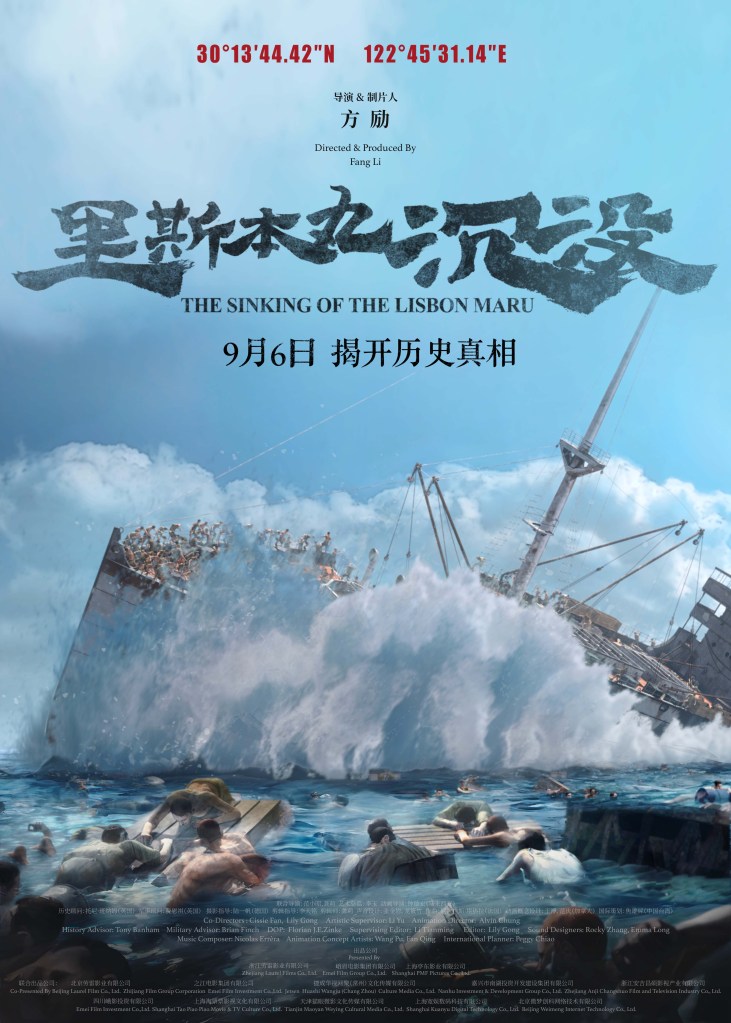
The Sinking of the Lisbon Maru is a documentary film recounting the torpedoing of the Japanese cargo ship—repurposed as a troop and POW transport—by the USS Grouper off the Chinese coast in 1942. As the captives in the ship’s three main holds attempt to escape the sinking vessel, they are mercilessly shot at in the water by their captors. Salvation only arrives when Chinese fishermen intervene, forcing the Japanese naval commander to retreat and evade culpability. Seven decades later, documentary filmmaker Fang Li uncovers this tragic history, locating and interviewing the two remaining survivors, along with relatives of countless others, and the daughter of the U.S. submarine’s commander.
This is a weighty and sobering film—one that demands contemplation more than critique. As both a document and a documentary, The Sinking of the Lisbon Maru compels viewers to consider what it means to bear witness to history. In doing so, it also prompts reflections on cinema itself and the role of historical narrative.
Moviegoers, especially in China, have been deeply moved by this story. Director Fang Li is a constant on-screen presence. An oceanographer by training, the story begins off the Zhoushan coast, where sonar imaging unveils the enormous hulk of the Lisbon Maru for the first time. His research takes him to Hong Kong, the UK, and Canada, where he meets and interviews survivors and their families, each carrying their own distinct memories and trauma. In Japan, he puts the burning question to military historian Kurosawa Fumiki—why did the Japanese forces attempt to drown their prisoners and even shoot those who survived the sinking? One reviewer scoffs at Fang’s “desire to make the very construction of his documentary the framework of said history,” but the film’s weight also derives from how the director must navigate this complex process. This recalls broader questions about how historical events are remembered, and there is no indication that Fang Li and his team have treated this endeavour with anything less than the utmost seriousness. The very existence of the film is an achievement—one that has moved many and garnered significant acclaim. I was likely not alone in shedding tears throughout its duration.
Beyond its immediate historical subject, The Sinking of the Lisbon Maru carries a layered emotional weight—whether or not Fang consciously plays upon it. The re-evaluation of Republican-era events in modern China remains a sensitive topic. Official attitudes towards films and documentaries addressing this period have shifted in recent years, as seen with the success of The Eight Hundred. Such shifts echo broader changes in state-sanctioned historical research. As Tim Luard notes in his study of the joint Sino-British escape from Japanese-occupied Hong Kong, his obsessive research coincided with an officially sanctioned push to study the period. Interest in this chapter of history opened up as China further integrated into the global stage, bringing what Luard calls Interest in this chapter of history opened up as China further integrated into the global stage, bringing what Luard calls “a small and forgotten piece of China’s glorious history in for reappraisal” (xvii)[1] into reappraisal. What The Sinking of the Lisbon Maru represents, so late in the day for the surviving POWs interviewed by Fang Li, is partly the visual manifestation of this complex process. The tears and tragedy of the event may be felt as much in the sadness for a history unexplored as in the slow realisation of such official permission. One cries for a story only now being told, through an act of sympathy that was both politically and historically delayed.
Then there is the censorship, or a kind of amnesia, that Western societies are partly complicit in, which Fang Li and his interviewees also make much of. One irrevocable fact is mentioned constantly by Fang’s former POW subjects and/or their families. British and Canadian survivors and their relatives mention the lack of interest within their own societies in the story of the Lisbon Maru. The tragedy took place in a geography beyond the general narrative of World War II, almost like an Asian problem that just happened to involve Western victims. They have found it hard to assimilate their experience with others. An island off the coast of modern Zhoushan, en route to Hong Kong and Japan, is hardly to be imagined as a heartland of conflict. There is a logic of remembrance here, as much as there is with the politicised manner of memory in China. Tragedies took place here, and by being overlooked, they fall out of the main narrative; they may eventually be recovered, or they fall into oblivion. Other examples exist of victims falling between the geographical and ethnic fault lines of the war and its aftermath. One thinks, for example, of those Dutch commandeered as “comfort women”—though in this case, restitution was made (sadly, far quicker than for Chinese or Korean comfort women) efficiently and quietly in the 1950s. The scars of this war may only fade with the last tragedies, and by their logic, these take place beyond the present geography of our imagination. By that same logic, the last stories may take place on these borders, and through means such as those found in Fang Li’s work.
Perhaps it is not how or why we see history that matters, but the acknowledgement that one day, each strand of it will be seen for the last time. The Sinking of the Lisbon Maru ends on that poignant note, as families of survivors—Fang’s two POW interviewees having since passed on—travel from the UK and Canada to China. There, they sail out from Dongji Island towards a patch of ocean where Fang’s sonar reveals the Lisbon Maru resting beneath their feet. We are brought full circle to the film’s beginning. There is an embrace between director and family, and once again, tears are shed. These are bittersweet. They carry a sense of finality. The audience stands outside this intimate moment—it is simply too personal. And yet, we are, at the same time, drawn into this collective act of remembrance, here for the final time. In his own way, Fang Li has also brought us this far. A memory has been completed. Forgetting can begin.
At least, it feels like the film gets at how memory should begin. As a document, a tragedy with global meaning has been restored. A remarkable endeavor, it is only ironic how at odds this globalizing of a Chinese and Western tragedy is with the vilification of wartime Japan in state-run media in China. This movie actually helps us do something—forgetting Japanese war crimes—which is not in the Chinese state interests. Perhaps The Sinking of the Lisbon Maru is actually prescient, looking to the future rather than the past. As China seems inevitably to be brought into the world, now more than ever with its own homegrown AI catapulting her, willingly or not, further towards a global narrative, she finds herself engulfed in something new, speaking a new language even to her own people. Works like Fang’s show that historical trauma may simply redesign itself in the process.
[1] Escape from Hong Kong: Admiral Chan Chak’s Christmas Day Dash, 1941.
How to cite: Allen, Edward. “Crying in the Cinema, Chinese Style: Fang Li’s The Sinking of the Lisbon Maru.” Cha: An Asian Literary Journal, 11 Feb. 2025, chajournal.blog/2025/02/11/lisbon-maru.


Edward Allen earned a PhD in archaeology from Fudan University in 2024 and is currently authoring a book on prehistoric China and Eurasia. His creative work seeks to merge his interests in archaeology and storytelling as well living between China and the UK. He writing a trilogy centred on Fu Hao, the legendary female general and royal consort of the Shang Dynasty. [All contributions by Edward Allen.]
 Cha
Cha 