

📁 RETURN TO FIRST IMPRESSIONS
📁 RETURN TO CHA REVIEW OF BOOKS AND FILMS
Marcus Fedder, My Shanghai Neighbours, Black Spring Press, 2023. 130 pgs.

Having spent four years living in a Shanghai lane between 2012 and 2016 (when I left China), I couldn’t resist the allure of a book set in a similar milieu, featuring characters that evoked vivid memories of my own neighbours behind the rusty green gates on Taiyuan Lu in the Former French Concession.
That part of the city—with its arcs of dusty phoenix trees filtering sunlight over the streets, elegantly curved Art Deco apartment blocks in pastel hues, and hidden lanes thrumming with life—may not be the image that immediately springs to mind when thinking of Shanghai. Most striking is the modern skyline with its bristle of towers, as Fedder remarks in his “Instead of a Preface”, or perhaps the imposing colonial grandeur of the Bund. But it is in the longtang lanes and xincun (compounds) of the old French quarter that I truly fell for Shanghai. Visiting a friend in the spring of 2008, as the city was gearing up for the Expo with an omnipresence of bubblegum-blue Haibao mascots, I saw Shanghai (as many have) as an enticing alternative to the somewhat dreary life I had found myself leading in London. An evening spent in the then-nascent Tianzifang lane complex on the last night of my visit convinced me to move there permanently, which I did later that year.
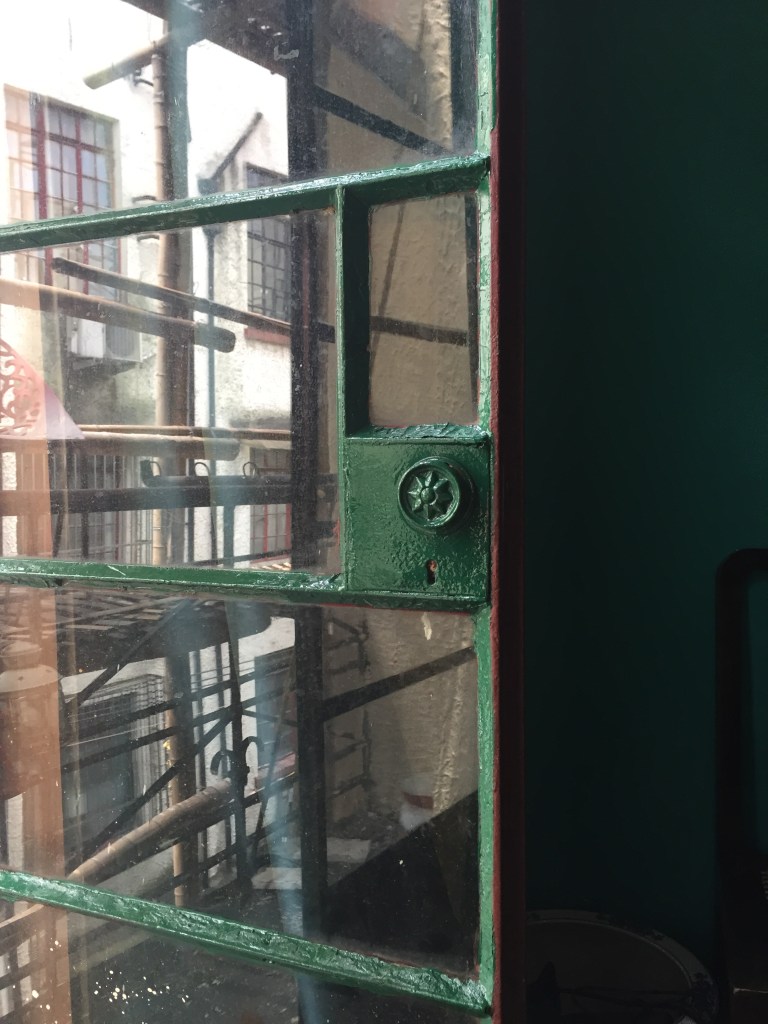
View from the balcony of my lane house
The portraits in Marcus Fedder’s book brought back vivid recollections of my friends and acquaintances from the lane. I read them with a mix of amused delight and the sharp pang of nostalgia that still strikes me almost a decade after leaving. Fedder’s cast of characters includes former generals, Party officials, musicians, a precocious teenager, and a perceptive kindergartener. The vignettes are briskly paced and compelling, transforming the book into a subtle page-turner. One of my favourite segments features a cat named Jing Zhang, who observes that “[a]ll the cats in the xincun were fervent Maoists. Mao had made China great again and had ensured that their status was restored. Mao, in Mandarin, means cat. Well, with a slightly different intonation, but that’s a minor detail.”
In November 2012, midway through my time in China, I moved into the top floor of House 3, down a lane off Taiyuan Lu in the serene southern reaches of the Former French Concession. Reeling from the loss of someone close to me and grappling with a reshuffling of priorities—as is often the case after a profound bereavement—I found myself in a new world. My neighbours introduced themselves one by one, their tentative knocks betraying a mix of curiosity and nosiness. I welcomed them, apologising for my rudimentary Mandarin (which improved, albeit coloured by the charmingly swampy vowels and chattering consonants of the Sanhae-eiwu, the local dialect). There was Mr Wu on the ground floor, a retired mechanic whose musty MacGyver-like workshop I had to pass through to reach the staircase, and his wife, who inexplicably called herself “Candice”. On the second floor lived a three-generation family: grandparents, parents, and a spirited five-year-old boy. Across the hallway-kitchen on my own floor were a widow and her college-age son. Over four years, we developed a comfortable rapport—distant due to my foreignness but always courteous and mutually respectful. For me, those years were simultaneously the hardest and most fulfilling of my life: enduring friendships were forged, a book deal for my second poetry collection was signed, and my rooms gradually filled with Old Shanghai haipai furniture.
Sometimes, the passage of time folds in on itself, striking like a foot through thin ice. It will soon be ten years since I left. Ten years since Candice stopped me in the hallway to press into my hand a parting gift: a metal bookmark with a porcelain stamp, because she knew I was a writer. Sometimes, the memories surface unbidden; other times, they are jolted into life by something evocative—most recently, My Shanghai Neighbours. Marcus Fedder has done an exceptional job of capturing the essence of longtang life. His characters shimmer on the page, crafting a fictional world so authentic to my own experience that it felt like being physically transported back there. That, to me, is the hallmark of a truly remarkable talent.
How to cite: Gordon, S. C. “Resurrecting Longtang Memories: Marcus Fedder’s My Shanghai Neighbours.” Cha: An Asian Literary Journal, 17 Jan. 2025, chajournal.blog/2025/01/17/shanghai-neighbours.


Born in the northwest of England in 1981, S. C. Gordon is a Liverpool-based writer, translator, and editor. Her first poetry collection, Peckham Blue, was published in London by Penned in the Margins in 2006; her second collection, Harbouring, was released in November 2015 under Math Paper Press in Singapore. Her poetry, fiction, and non-fiction have been featured in anthologies and journals such as United Verses, Unsavoury Elements, Middle Kingdom Underground, Unshod Quills, Junoesq, Jewish Women of Words, 96th October, and the May Anthologies 10th Anniversary edition. She participated in the Royal Court Theatre’s young writers’ programme in 2007–2008 and was a finalist and runner-up in British Vogue’s young writers’ competition in 2004 and 2005. She holds a PhD in Comparative Literature from the University of Liverpool and a BA in English from the University of Oxford. She is the founder of the independent press and journal OfTheBook. Her debut novel, A Monster in the Ash, is forthcoming from Claret Press in 2025.
 Cha
Cha 