

📁 RETURN TO FIRST IMPRESSIONS
📁 RETURN TO CHA REVIEW OF BOOKS AND FILMS
Click HERE to read all entries in Cha on Idol, Burning.
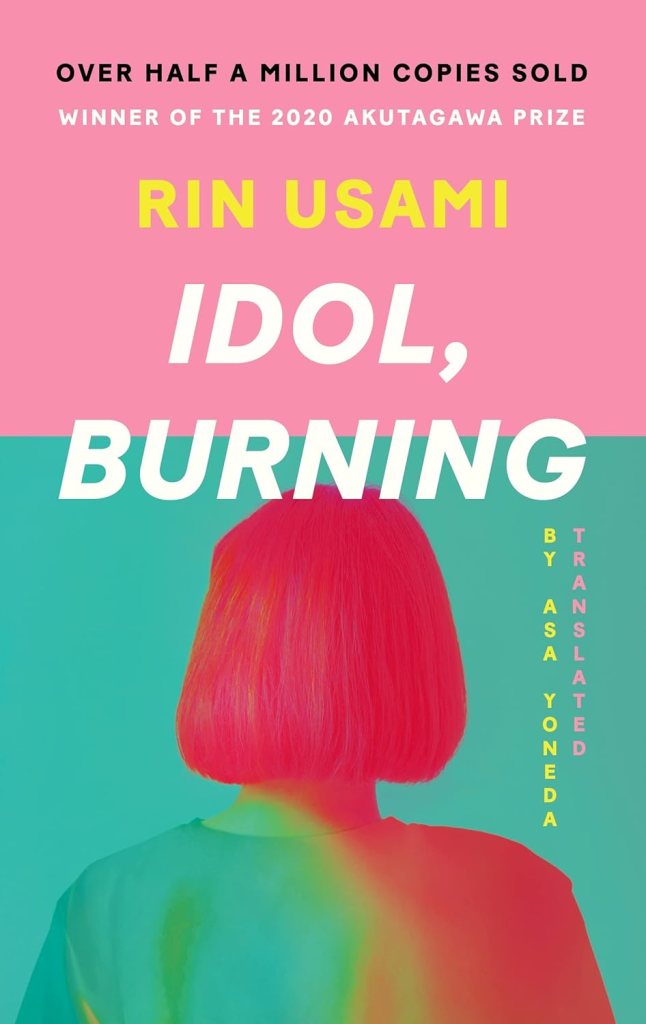
Rin Usami (author), Asa Yoneda (translator), Idol, Burning, HarperVia, 2022.144 pgs.
Japan, for me, has long been a pop music paradise. On my first trip there in 1980, I was a finalist for a songwriting contest sponsored by a major record label and performed my song in concert at Nakano Sun Plaza. When I moved to Tokyo a few years later for music and other ambitions, I encountered the golden age of J-pop idols, which included luminaries like Seiko Matsuda, Akina Nakamori, Masahiko “Matchy” Kondo, and many others. You could hear the latest pop hits everywhere—not just on the ubiquitous television music shows (The Best Ten, Yoru no Hit Studio, etc.), but also on the bustling streets of Harajuku and Shibuya, blasting from boutiques and enormous video screens mounted on skyscrapers. They even permeated TV commercials, a lucrative collaboration between advertising and the music industry—a practice almost unheard of at the time in the United States, where I am from.
Later, I came to understand that idol culture, in one form or another, has been a monumental force in Japan for decades. Mega-idols ranged from Misora Hibari in the 1950s to Momoe Yamaguchi in the 1970s—the singer and actress who famously turned her back on show business to retire at the tender age of 21, never to perform again. Then came Pink Lady, the duo who dominated the late 1970s and early 1980s, achieving not only immense popularity in Japan but also a peculiar attempt at international success with a short-lived TV show in the United States. By the 1990s, it was Namie Amuro who reigned supreme over Japan’s idol industry.
Fans have always shared a unique connection with their idols, but with the rise of blogging and social media, these relationships have evolved dramatically. Fans are now much more entwined in their idols’ lives. This cultural shift brings us to Idol, Burning, a brief yet profound and captivating novel (or novella) by Rin Usami. At just 21 years old, Usami won the prestigious 2020 Akutagawa Prize for this incisive work, now available in an absorbing English translation by Asa Yoneda.
Our protagonist, Akari Yamashita, a high school junior, articulates the nuances of idol worship as follows:
There were as many styles of fandom as there were fans. Some people worshipped every move their oshi made, while others thought discernment made the true fan. There were those who had a romantic interest in their oshi but no interest in their oshi’s work; others who had no such feelings but sought a direct connection through engaging on social media; people who enjoyed their oshi’s output but didn’t care about the gossip; those who found fulfillment in supporting the oshi financially; others who valued being part of a fan community.
My angle was simply to keep trying to understand him as a person and as an artist. I wanted to see the world through his eyes.
When had I first started feeling this way? I looked back through my blog posts, and the answer seemed to be about a month after my first Maza Maza concert last year. I’d written up a radio appearance, and there was a certain level of demand for content, maybe because it had only been broadcast regionally, so it was the fifth or sixth most-read post on my blog.
Notice that Akari refers to Masaki Ueno, a member of the superstar J-pop group Maza Maza, not as her “idol” but as her oshi. A departure from earlier terminology, this word is derived from a verb meaning “to push.” It suggests a level of fandom that extends beyond mere admiration from afar. For Akari, it embodies an intense empathy and devotion—an obsession that compels her to purchase Maza Maza CDs that include voting tokens, which allow her to influence whether the record company grants Masaki the opportunity to perform solo on specific tracks.
Akari’s journey begins when she first sees Masaki performing in a live production of Peter Pan. Indeed, a distinctly Peter Pan motif runs throughout this novel, with its focus on a teenage girl who resists—or perhaps is incapable of—growing up. Akari exhibits a form of avoidance, though not to the extreme of a hikikomori. Rather, she appears trapped in a downward spiral, clinging to an adolescent dreamscape fuelled by social media, which numbs her to the harsh realities of her daily life.
My very first memory is of looking directly up at a figure in green. My oshi, at twelve years old, is playing the role of Peter Pan. I am four. You could say my life started when I saw my oshi fly past overhead, suspended on wires.
But it wasn’t until a lot later that he became my oshi. I’d just started high school and had stayed home from a rehearsal for the sports day in May. My hands and feet were sticking out from under a terry blanket. Rough, papery tiredness caught on my overgrown toenails. From outside, the faint sounds of baseball practice landed in my ears. I sensed my awareness lift half an inch into the air at each impact.
The PE clothes I’d washed two days ago in readiness for the rehearsal were nowhere to be found. At six a.m., half-dressed in my school blouse, I’d searched my room, turning it upside down, then given up and fled back to sleep. The next thing I knew, it was noon. Nothing had changed. My ransacked room was like the dishwashing sink at the restaurant I worked at—totally unmanageable.
Akari’s struggles extend beyond her fandom. At school, she grapples with kanji, possibly due to dyslexia. Her home life is fractured: her father works overseas, her older sister offers little sympathy, and her mother harbours resentment over caring for a domineering mother-in-law. Akari works part-time at an izakaya, but solely to support her devotion to her oshi.
An hour of work paid for a photo, two hours was a CD, and when I earned ten thousand yen that was a ticket to a live event. I was paying the price for just trying to get through work doing the bare minimum. I could see the wrinkles carving themselves into Chef’s face as he wiped down a table with a self-conscious smile.
Toward the novel’s end, Akari reaches her nadir:
I found out I’d failed junior year a month before graduation. After the meeting, Mom and I walked back to the train station together. I felt the same way I did when I went to the infirmary or went home early—like time had been ripped off and was suspended in midair—except even more strongly, and the feeling seemed to have infected her, too. Although we hadn’t cried, we both looked tearstained as we walked. Things felt bizarre. We’d decided I would quit, since repeating the year probably wouldn’t make any difference.
Although the novel’s “inciting incident” is a rumour that Masaki Ueno punched a fan, this event serves less as a pivotal plot point and more as a springboard for exploring Akari’s backstory, her obsession with her oshi, and the broader phenomenon of modern idol culture.
By the conclusion, readers are left with a sense of resolution, as Akari glimpses a path out of her toxic fandom while her oshi appears to attain a semblance of freedom. Yet, Masaki’s perspective remains elusive. What does he truly think of the extreme devotion of his fans and the obligations it entails? Is it grounded in reality, or is it merely another product of the geinokai (entertainment industry) machine?
The novel concludes with several poignant afternotes. In an Afterword and Acknowledgements section, Usami reflects on her creative process and candidly shares her motivations for writing this story—a rare insight that not all authors provide. Particularly moving is her heartfelt address to her brother, who inspired certain aspects of Akari’s character, and to whom she offers a touching apology. Contributions from the translator, cover artist, and interior illustrator further enrich the text, lending it a manga-like aesthetic.
These thoughtful additions mirror the dynamic explored in the novel: the yearning to understand an artist’s world. Just as Akari initially seeks to grasp her oshi’s essence, readers are invited to witness her struggles and triumphs, ultimately viewing the world through her eyes.
How to cite: Tokunaga, Wendy. “When a Passion Turns Toxic: Rin Usami’s Idol, Burning.” Cha: An Asian Literary Journal, 13 Jan. 2025, chajournal.blog/2025/01/13/idol-burning.



Wendy Tokunaga is a novelist, developmental editor, writing teacher, and devoted cat servant. She is the author of the novels Midori by Moonlight and Love in Translation (St. Martin’s Press), as well as several others. Her latest novel, Brenda Barker’s Next Chapter, is forthcoming from Blydyn Square Books in 2027. Wendy holds an MFA from the University of San Francisco and teaches in Stanford’s Novel Writing Certificate Program. When she’s not writing, editing, or teaching, she enjoys singing jazz and bossa nova standards alongside her keyboardist husband. They live in the San Francisco Bay Area with their feline roommate. You can connect with Wendy on Twitter (@Wendy_Tokunaga), Bluesky (@wendytokunaga.bsky.social), and her website.
 Cha
Cha 