

📁 RETURN TO FIRST IMPRESSIONS
📁 RETURN TO CHA REVIEW OF BOOKS AND FILMS
Annie Zaidi, Bread, Cement, Cactus: A Memoir of Belonging and Dislocation, Cambridge University Press, 2020. 166 pgs.
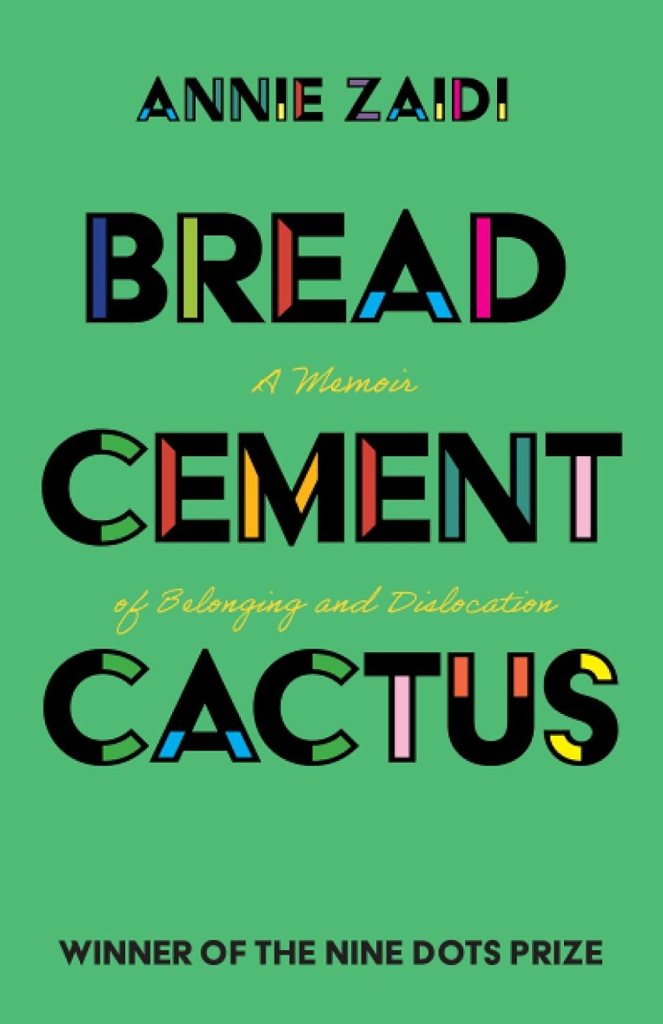
Annie Zaidi’s memoir Bread, Cement, Cactus: A Memoir of Belonging and Dislocation explores the multifaceted meanings of “home” in post-colonial India, a country still entangled in many vestiges of its colonial past. While the concept of home is deeply personal, Zaidi’s work transcends individual memory to reflect the broader political realities of contemporary India.
Zaidi examines the exploitation and displacement of indigenous inhabitants in the small town in Rajasthan where she spent her childhood. She reflects on her identity as a Muslim woman in India and the complexities of feeling “at home” in a society that often perceives her as an outsider. The paradox of inhabiting multiple homes while simultaneously being unwelcome in the broader national imagination encapsulates the everyday dilemmas faced by Muslims in India since Partition in 1947. While this “othering” of Muslims may not be uniform across all spaces, it remains a pervasive issue in a nation that paradoxically celebrates its diversity while harbouring exclusionary tendencies. Through personal anecdotes, Zaidi delves into the intersecting influences of family, history, religion, employment, and longing that shape her conception of home. Among the most poignant connections she draws is the association of death with homecoming, as articulated in Sufi traditions, which she invokes to situate home in a spiritual and religious context.
For those without strong territorial ties, the idea of home often takes on a metaphorical dimension, shaped by lived experiences and political realities. In India, the Muslim identity has been subjected to systemic marginalisation, with political and social forces working to silence their voices and curtail representation. This dynamic transforms the concept of home into a nebulous and contested space. Zaidi traces her upper-caste Muslim roots to eastern Uttar Pradesh, a region she nominally considers home. However, historical and political upheavals in places like Allahabad and Lucknow have not only precipitated cultural decay but have also fostered erasure of historical narratives under the shadow of majoritarian politics.
The violent Partition of India and Pakistan wrought untold bloodshed and dislocation, leaving a lasting void in the identities of countless individuals. This void, compounded by state repression, renders home a fraught and hostile space. A hostile home may still be a home, but the connotations of belonging become intricate and clouded. Zaidi, in unravelling the idea of home for herself, interrogates the notion of belonging for single Muslim women (in her case, Shia) within a society where patriarchy, hyper-nationalism, and state oppression intersect. Her familial ties to Pakistan further complicate her relationship with the concept of a homeland that transcends national boundaries.
The plurality inherent in the experience of belonging necessitates a perspective that moves beyond national constructs. While borders impose physical limitations, the sense of belonging is irreducible to a singular or monolithic national identity. The persistent enmity between India and Pakistan has repeatedly forced individuals to define their sense of home in terms of national affiliation, leading to existential questioning of their identities. National belonging, however, cannot supplant the deeper sense of belonging, which transcends borders and walls. Before asking “Where is home?”, one must first grapple with the preceding question: “Where do I belong?” The search for home, in and of itself, signifies dislocation—a condition that has become increasingly acute in contemporary India.
Each essay in the book addresses distinct issues, problematising various aspects of life in modern India. Zaidi’s narrative traverses timescapes, weaving historical contexts with contemporary realities. Rather than offering a definitive answer to what home means, her memoir questions what it means to live in today’s India, a reality that proves more daunting than the book’s length might suggest. Another commendable aspect of the work is its brevity, a stark contrast to the trend of overly lengthy memoirs that often lose focus. Zaidi avoids falling into unproductive digressions, instead delivering a concentrated exploration of longing and memory.
A profound and troubling question that lingers after reading this book is the notion of home for second-class citizens. While some may deny the existence of this category or dismiss claims of systemic subjugation, the lived realities of marginalisation in India remain undeniable for many.
Bread, Cement, Cactus stands as a compelling meditation on belonging and dislocation. Zaidi’s prose illuminates the complexities of identity and home, offering readers a lens through which to understand the struggles of those relegated to society’s margins. It is a memoir that invites reflection on the enduring quest for a place of belonging in a fractured world.
How to cite: M, Fathima. “Lived Reality: Annie Zaidi’s Memoir Bread, Cement, Cactus.” Cha: An Asian Literary Journal, 12 Jan. 2025, chajournal.blog/2025/01/12/bread.


Fathima M teaches English literature in a women’s college in Bangalore, India. She likes hoarding books and visiting empty parks. [Read all contributions by Fathima M.]
 Cha
Cha 