

📁 RETURN TO FIRST IMPRESSIONS
📁 RETURN TO CHA REVIEW OF BOOKS AND FILMS
Click HERE to read all entries in Cha on Half Sound, Half Philosophy.
Jing Wang, Half Sound, Half Philosophy: Aesthetics, Politics, and History of China’s Sound Art, Bloomsbury, 2021. 232 pgs.
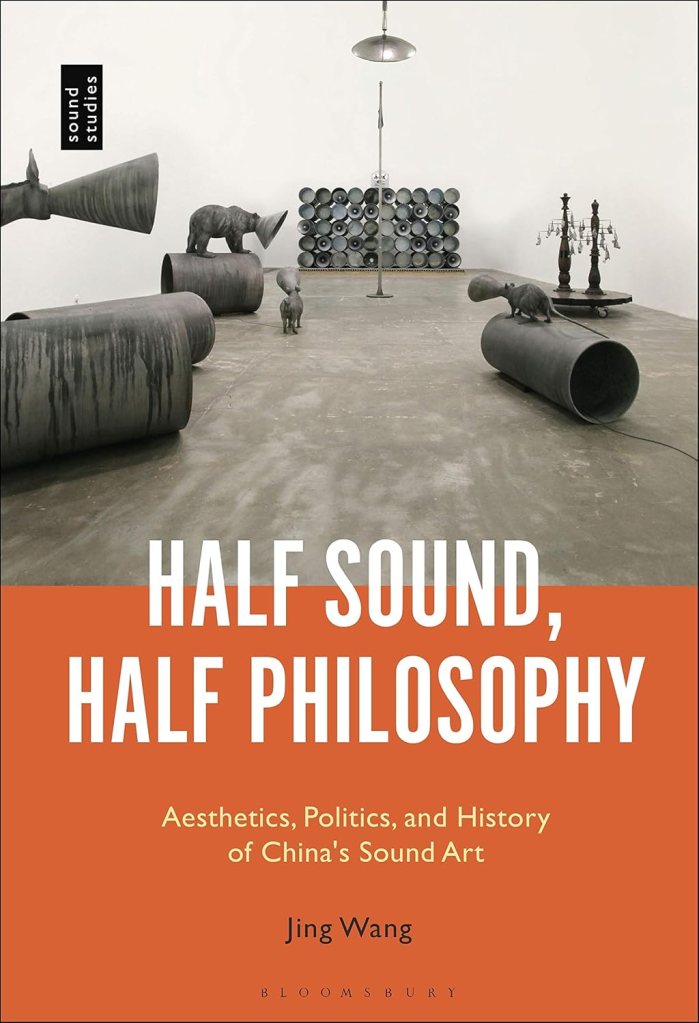
Jing Wang’s Half Sound, Half Philosophy: Aesthetics, Politics, and History of China’s Sound Art represents a significant addition to the history of sound art, traditionally framed through American, European, and Japanese narratives. Alongside chronicling Chinese artworks that incorporate sound or focus on auditory culture, Jing interprets these works using philosophical concepts. This is a familiar practice within the discipline of Sound Studies, but whereas most scholars adopt Western philosophical systems (typically from the continental tradition), Jing turns to Chinese thought, specifically the ancient concept of qi.
A central tenet in Chinese philosophy since at least the Zhou dynasty, qi appears in many foundational Confucian, Daoist, and Buddhist texts. The term is often translated as “life-breath” and described as a vital force or energy that unites humans with both heaven and earth. Qi is neither merely a material force, like physical vibration, nor an ethereal spirit; instead, it is a process of becoming that encompasses both matter and spirit—a dynamic fluctuation of opposing forces, of contraction and expansion, inhalation and exhalation, yin-qi and yang-qi.
Qi was most explicitly related to sound by the Ming dynasty scientist Song Yingxing, who defined sound as qi imbued with shi—another distinct concept, often translated as force, power, disposition, or potential. In Jing’s opening chapter, she delineates how qi was connected to cheng (creativity) and how both were linked to sonic resonance in the writings of the Confucian philosopher Zhang Zai. Cheng is understood here as a kind of “sixth sense,” the capacity to attune oneself to the resonance (gan) that unites us with the myriad things and is sourced in qi. Consequently, sonic creation becomes an act of reciprocation with the universal qi, a means of amplifying cosmic resonance through art.
Jing’s second and third chapters trace the origins of Chinese sound art to two interconnected but distinct fields: the Chinese art world and experimental electronic music. Following China’s economic reforms in the late 1970s and early 1980s, many artists began rejecting socialist realism’s figurative style, embracing new media, including sound. A standout example is Zhang Peili’s 1991 video piece, Water: Standard Version from the Chihai Dictionary, featuring CCTV television broadcaster Xing Zhibin repetitively reciting the word shui (water) in the “official” Mandarin accent made ubiquitous by state-sponsored media. The repetition estranges Xing’s pronunciation, and as Jing elucidates, this “making strange” resonates with political undertones in a nation where linguistic unification has historically discouraged regional dialects.
As artists like Zhang moved away from socialist realism, attitudes toward electronic music were also shifting. The invention of synthesisers was elevated to a national science project, prompting the emergence of autodidactic instrument makers such as Tian Jinqin, who invented the XK-1 Ribbon-Controlled Analogue Synthesiser, designed to emulate traditional Chinese instruments. This burgeoning fascination with synthesisers marked a profound shift from the Maoist era’s dismissal of electronic music as “bourgeois decadence.” By the 1980s, electronic and computer music studios had been established at several Chinese universities.
By the early 2000s, contemporary art styles, methodologies, and media relevant to sound art had been thoroughly integrated into Mainland China’s art and music education systems. Yet, the flourishing of sound art cannot be solely attributed to institutionalisation. Simultaneously, Western popular styles—including rock, jazz, and electronica—were gaining traction in China, with vernacular avant-gardes emerging in local punk, free improvisation, and ambient music scenes. These movements enriched sound art in its broadest sense. Jing’s attention to these underground scenes throughout her book is a notable scholarly contribution, as prior studies of Chinese sound art have predominantly focused on academic electroacoustic music. Her exploration of the Chinese underground further reveals how sociopolitical changes since 2012—escalating rents and heightened cultural censorship—have displaced musicians from bars and galleries into private spaces (e.g., living rooms) or impromptu public venues, such as deserted underpasses or secluded nature reserves.
The distinction between academic institutions and local undergrounds is particularly evident in Jing’s fifth chapter, where she examines the enduring relevance of shamanic practices in Chinese sound art. Shamanism in China continues through two pathways: its preservation as a cultural artefact by state-supported programmes and its continuation through everyday cultural and religious practices among inheritors of shamanic traditions. Jing identifies two artistic responses to shamanism in Chinese sound art. The first, “representing the shaman,” is exemplified by Tan Dun’s incorporation of ideas and sounds from Nuo opera and ba gua stone drumming in works such as Ghost Opera and The Map. Here, instruments and melodies function as cultural symbols, “preserved” within notated or prerecorded compositions. The second response, “becoming shaman,” is reflected in the work of artists like Xu Cheng, Wang Fan, Sheng Jie, and Lin Chi-Wei, who enact performative rituals akin to those of shamans. This latter approach prioritises the processual aspects of shamanistic practice over its resemblance to traditional Chinese music.
Jing’s fifth chapter also delivers her most lucid application of qi philosophy to contemporary sound art. Following Zhang Zai’s writings, she interprets shamanic rituals—and the sound art that emulates them—as channelling gui-shen: the “ghosts-spirits” corresponding to the contraction-expansion cycles of qi. Similarly, she employs qi to analyse works of sound art in the fourth and sixth chapters, examining them through the painterly aesthetic of shanshui and contemporary concepts of an “ambience of control.” However, the proliferation of concepts in these chapters—including both Chinese terms (xiang zha, hsu, huanghu) and non-Chinese notions of noise and “immanent control”—renders them challenging to navigate. Indeed, as the book progresses, qi risks becoming overextended, applied so broadly that its conceptual precision and interpretative value diminish.
To her credit, Jing acknowledges early in her book that she approaches qi as a cultural construct rather than a metaphysical truth, intending it as a lens to differentiate Chinese sound art from its international counterparts. However, a tension persists between her assertions of the aesthetic specificity of Chinese sound art and her recognition of the influences of European, American, and other Asian traditions (e.g., Chinese-American composer Chou Wen-Chung’s modernist music lectures, Jean-Michel Jarre’s concerts in Beijing and Shanghai, and the Young British Artists’ impact on the Post-Sense Sensibility Movement). While it is entirely feasible for an artistic culture to possess unique attributes while remaining receptive to external influences, Jing’s insistence on interpreting all Chinese sound art through qi, even when unrelated to the artists’ intentions, occasionally veers toward an ethno-aesthetic essentialism. Her concluding comparison of qi with cybernetics further complicates its supposed cultural specificity.
Despite these contradictions and an unusual number of distracting typographical errors, Jing’s book offers an insightful account of qi as it pertains to sound and an invaluable chronicle of Chinese sound art. It is hoped that this work will inspire further discussions on both subjects and introduce a broader English-speaking audience to the rich and diverse history of Chinese sound art.
How to cite: Windleburn, Maurice. “Overhearing Qi: Jing Wang’s Half Sound, Half Philosophy.” Cha: An Asian Literary Journal, 10 Jan. 2025, chajournal.blog/2025/01/09/half-philosophy.


Maurice Windleburn is a Research Assistant Professor with the Society of Fellows in the Humanities at The University of Hong Kong. His current work examines the sonic ontologies of philosophers, occultists, scientists and critics in modernist France (1880–1940), and their effects on the arts in this period. Additionally, he has written on late-twentieth-century avant-garde music, music philosophy, and intermedia, and published his first book, John Zorn’s File Card Works: Hypertextual Intermediality in Composition and Analysis, with Routledge.
 Cha
Cha 