
📁RETURN TO FIRST IMPRESSIONS
📁RETURN TO CHA REVIEW OF BOOKS AND FILMS
John Wells (director), August: Osage County, 2013. 116 min.

As Christmas draws near in the West, the East prepares for the arrival of Lunar New Year. To those unfamiliar with the holiday, it might seem like a colourful festival filled with red decorations and extravagant feasts. But for those of us who grew up celebrating it, the holiday often brings a more complicated reality—family drama. And while the details may vary across cultures, the tensions and emotions are strikingly universal, as depicted in the film August: Osage County.
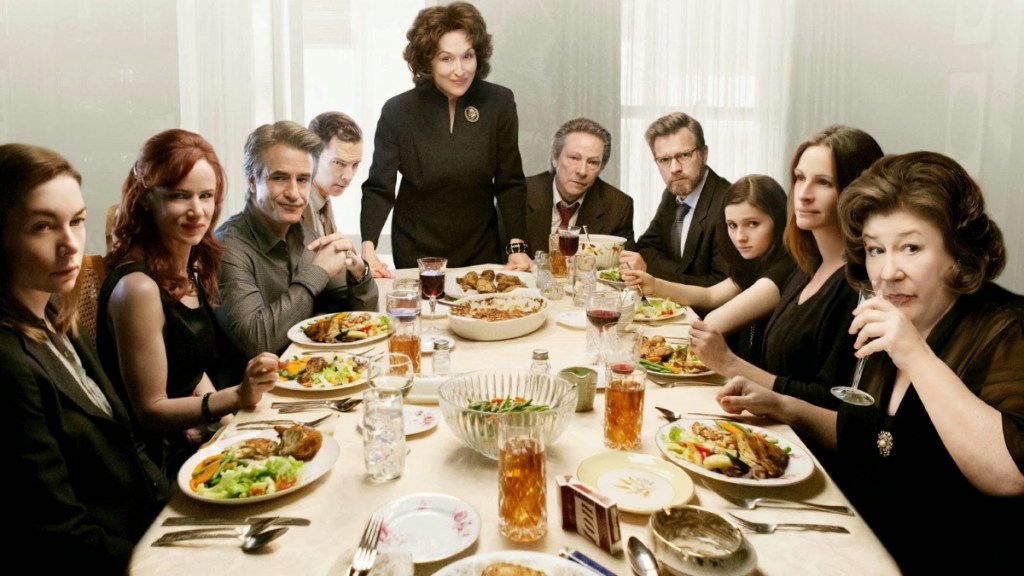
Rather than relying on stereotypes or cultural tropes, August: Osage County captures something more relatable: the way families clash, bond, and unravel in times of stress. The film gathers a familiar cast of characters: the overbearing, sharp-tongued mother; the eldest daughter who inherits her personality; the loyal sibling who stayed behind to shoulder the family’s burdens; the youngest daughter trying to find her place; the philandering husband; the rebellious teenager; and a host of other relatives with their own quirks and struggles. They come together ostensibly for a funeral, but the gathering inevitably becomes an airing of grievances, a chance to vent pent-up frustrations and grudges.
I first watched August: Osage County over a decade ago, largely drawn in by the powerhouse performances of Meryl Streep and Benedict Cumberbatch. At the time, I admired it but didn’t fully connect with its story. Now, having weathered my own share of family gatherings, I find it resonates in ways it never could before. The awkward teasing of a teenager’s principles, the careless revelation of family secrets, the strained attempts to brighten the mood after a solemn event—these are all scenes I’ve lived through in one form or another.
One moment from the film that has stayed with me is the dinner scene following the funeral. Everyone sits together at the table, bound by the meal yet divided by their differences. It instantly brought me back to a Lunar New Year dinner years ago, when I had just learnt I hadn’t been accepted to my dream university in Taiwan. I don’t blame my parents for letting loose the secret because everyone on the table was asking. It was my uncle’s wife who lit my anger. She chimed in, “It’s okay. Like me, you can marry someone who graduated from there!” I remember swallowing both my anger and a mouthful of rice, resisting the urge to say something equally cutting.
In hindsight, moments like these help me appreciate the layers of tension and emotion in the film. Take Jean, the teenager in August: Osage County, who openly calls her mother a liar and rolls her eyes at the adults who tease her. I could never have acted that way at a family gathering; I was raised to show respect to elders, even when I didn’t agree with them.
There are other cultural differences as well, like how funerals are handled. In my family, which practises Taiwanese Buddhism, funerals are nothing like the Western traditions shown in the film. When my grandfather passed away, my grandmother prepared wooden tablets bearing his name and placed them in several temples. In the days before the funeral, we visited these temples with offerings of fruit and chanted scriptures with the monks. The funeral itself involved a series of solemn rituals—bowing, kneeling, chanting—but no dinner. We shared only simple snacks while waiting for the cremation.
Despite these differences, the emotional undercurrent is the same. I remember the tension at my grandfather’s funeral: my uncle’s family arriving late, my aunt sobbing theatrically in front of his body but remaining stoic before and after, my grandmother snapping at my mum much like Violet lashes out at her daughters in the film. Watching August: Osage County, I couldn’t help but see my own family reflected back at me.
David Ansen once wrote, “We are the movies, and the movies are us.” Through Tracy Letts’s sharp writing and the extraordinary performances of Meryl Streep and the rest of the cast, August: Osage County captures something universal about families: the love and frustration, the history and hurt, the push and pull of belonging. It’s a film I’d recommend watching with family—not because it’s “wholesome”, but because it’s honest. There are no explosions or elaborate plot twists; the drama comes from the characters themselves, in all their messy humanity.
As the holidays approach—Christmas in the West, Lunar New Year in the East—we’re reminded of the unique challenges and joys of family. Whether we’re travelling home from afar or living with family year-round, this season brings relationships into sharp focus. Like the characters in August: Osage County, we argue, compromise, reconcile, and, if we’re lucky, grow. Out of those moments of tension and vulnerability, we might find a deeper connection—or at least a better understanding of who we are and where we come from.
So here’s to family drama, in all its universality—whether it unfolds over a Christmas dinner or a Lunar New Year feast.
How to cite: Hu, Hai-Mo. “Here’s To Family Drama, In All Its Universality—August: Osage County.” Cha: An Asian Literary Journal, 9 Dec. 2024, chajournal.blog/2024/12/09/osage-county.



Hai-Mo Hu is a Creative Writing graduate whose fiction spans a variety of genres, including realism, romance, magical realism, and dystopian literature. She holds an Associate of Arts degree in General Theatre from the College of the Canyons and a Bachelor of Fine Arts in Creative Writing from Full Sail University. Her flash fiction pieces have been featured in CafeLit Magazine (“Private Funeral”), The Raven Review (“Force to Chocolate”), and CC&D Magazine (“Ten Tea Bags”). Growing up by the coast has profoundly influenced her storytelling, inspiring her to weave elements of the ocean into her work. Ever since childhood, she has dreamed of becoming a mermaid—a whimsical aspiration that continues to spark her imagination.
 Cha
Cha 