
📁RETURN TO FIRST IMPRESSIONS
📁RETURN TO CHA REVIEW OF BOOKS AND FILMS
Matthew Meyer (author and illustrator), The Night Parade of One Hundred Demons: A Field Guide to Japanese Yokai, Hardcover Collector’s Edition, 2015. 224 pgs. Images copyright 2015-2025 © Matthew Meyer, used with permission of the author.

Winter has arrived. As long shadows creep into mid-afternoon and the long, damp nights of winter descend, Matthew Meyer’s book of classic Japanese folkloric creatures is a great reading choice. The Night Parade of One Hundred Demons narrates tales of Japanese monsters, ghosts, and spirits found throughout Japan in all seasons. Even so, winter’s darkness lends an ominous thrill to such supernatural storytelling.
The Night Parade of One Hundred Demons (Hyakku Yagyō) describes an event that has been rumoured to take place in Japanese cities for many centuries, at night. Thousands of supernatural creatures gather on a street to form an orderly procession, or conversely flock together as chaotic revellers, and march through a city. These parades were dangerous events for humans who, if they chose to leave their homes without proper spiritual protections, risked being spirited away, or even death.
Today, in a city like Kyoto, for example, the night parade has become a benign but boisterous reenactment, a costumed event celebrating folklore, and a reason for evening street parties. In both a historical and contemporary sense, Meyer’s book provides a written and visual guide to the legends one might encounter in today’s Japan.
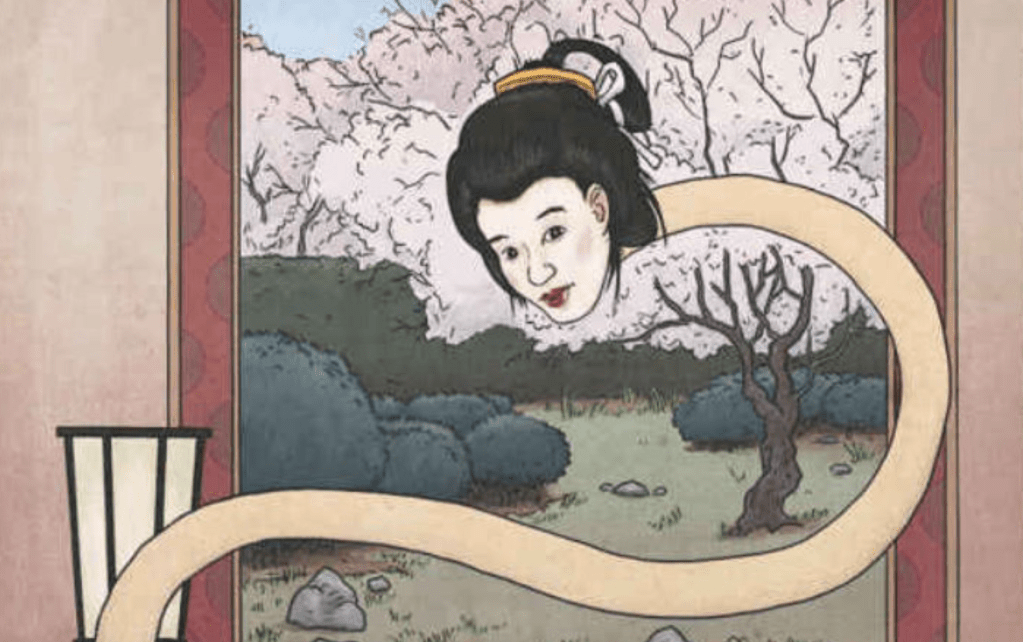
Meyer was trained as an illustrator. His beautifully rendered, colourful, and often humorous pictures complement and enhance the text. These images reference Nihonga painting and mokuhanga printing styles. While certainly imitative, they retain Meyer’s own hand and do not feel like forced or rote copies. Each image serves as an inviting threshold through which one can enter fantastic supernatural worlds, worlds coexisting and superimposed upon our own.
The book is divided into five chapters by place: Into the Wilds, Out at Sea, On the Town, At a Festival, and In the House. A full-colour map is also included. It further specifies the locations of yokai sightings and their habitats, reminding readers that a sense of local geography remains vital to these tales. The tales are presented like entries in a naturalist’s field guide. Each entry organises yokai information under seven headings—Translation, Alternate names, Habitat, Diet, Appearance, Behaviour, and Interactions.
Will some readers be tempted to venture out into targeted locations, this book in hand, searching for these illusive creatures?
Meyer’s prose style is clear, direct, and spare, with limited use of common English idioms. The entries relay “factual” information and often include reported incidents, short and anecdotal. I think this stylistic choice enhances the subject matter. The outlandish and otherworldly appear even stranger when described in a field guide’s simple, plain language.

Hyōsube
Take, for instance, this description of the behaviour of Hyōsube:
BEHAVIOUR: Hyōsube live near rivers, where they catch wild fish and generally keep away from humans. Their favorite food is eggplant—they are capable of devouring whole patches in the blink of an eye. Like kappa, hyōsube love mischief and hate horses. They are generally more violent and malicious than their cousins, but they retain a strong sense of honour.
Eggplants? How many monsters are known to adore eggplant? This is, of course, comical, but presented in a manner used to denote a certain animal preference for, say, acorns. Language and organisational form are well-used here. Identifying extraordinary creatures and using a surprisingly familiar structure is practical and amusing.

Nozuchi
This is a description of the strange and ancient yokai, Nozuchi:
TRANSLATION: wild mallet (named for its mallet-like shape)
APPEARANCE: Nozuchi are one of the earliest recorded yōkai in Japan. They are powerful and ancient snake-like spirits of the fields, known for their bizarre shape and habits. Short, fat creatures shaped like mallets, Nozuchi are about fifteen centimetres in diameter and just over one metre long. They have no eyes, nose, or any other facial features save for a large mouth located on the tops of their heads, pointing towards the sky. Their bodies are covered in a bristly fur, much like a hairy caterpillar.
It is indeed odd to encounter the exact measurements of such a strange creature! How has this information been handed down? Who has measured a Nozuchi?

Aosagibi
Even the cautionary advice given for interactions between a yokai, the Aosagibi, and humans resembles an ornithological, not supernatural, observation:
INTERACTIONS: Like most wild birds, night herons are shy and flee from humans. Even after transforming into yōkai, they retain their shyness. While the sight of a colony of wild birds breathing blue flames and making strange calls on a cool autumn night can be rather disconcerting, aosagibi does not pose any threat. However, because their fireball breath appears similar to other phenomena, caution should be taken to avoid confusing aosagibi with onibi or other supernatural lights.
It is difficult to imagine a more integrated description of an encounter between humans and yokai, one that normalises contact and anticipates it, an inclusively constructed worldview.
I haven’t the expertise to comment on the veracity of this work as a field guide to yokai, I. But as an avid reader of fiction, fairytales, and folklore, I encourage readers to discover Japan’s richly complex history of spirits, demons, monsters, and myths. Meyer’s book is a wonderful introduction
The Night Parade of One Hundred Demons is the first of four books—The Hour of Meeting Evil Spirits: An Encyclopaedia of Mononoke and Magic (2015), The Book of the Hakutaku: A Bestiary of Japanese Monsters (2019), and The Fox’s Wedding: A Compendium of Japanese Folklore (2022) that Meyer has written and illustrated. Kyoto’s Yokai Festival 2024 (14 September–8 December) continues. Yokai parades are scheduled for Saturdays, Sundays, and public holidays. On 26 October and 8 December, Grand Parades of 100 Yokai take place.
How to cite: McDonald, Marsha. “Tales of Japanese monsters, ghosts, and spirits: Matthew Meyer’s The Night Parade of One Hundred Demons.” Cha: An Asian Literary Journal, 1 Dec. 2024, chajournal.blog/2024/12/01/night-parade.


Marsha McDonald lives in Vilar de Andorinho, Portugal. An artist and writer, she works and exhibits between North America, Europe, and Asia. She has received grants from the Pollock-Krasner, Puffin, Mary Nohl (travel), Lynden Sculpture Garden, Gallery 224 Artservancy (artist working within conserved land in Wisconsin USA), and a New York Fellowship. Her writing has appeared in Otoliths (Australia), The Drum and The Cantabrigian (Cambridge MA), Voice & Verse Poetry Magazine, Cha (Hong Kong), and La Piccioleta Barca (Milan). She has collaborated with artists and writers in the UK, France, Spain, Germany, Portugal, North America, and Japan. In 2024, she will be an arts resident at the Tyrone Guthrie Centre in Ireland and Studio Kura in Kyushu, Japan. Visit her website for more information. [All contributions by Marsha McDonald.]
 Cha
Cha 