
📁 RETURN TO FIRST IMPRESSIONS
📁 RETURN TO CHA REVIEW OF BOOKS AND FILMS
Click HERE to read all entries in Cha on All We Imagine as Light.
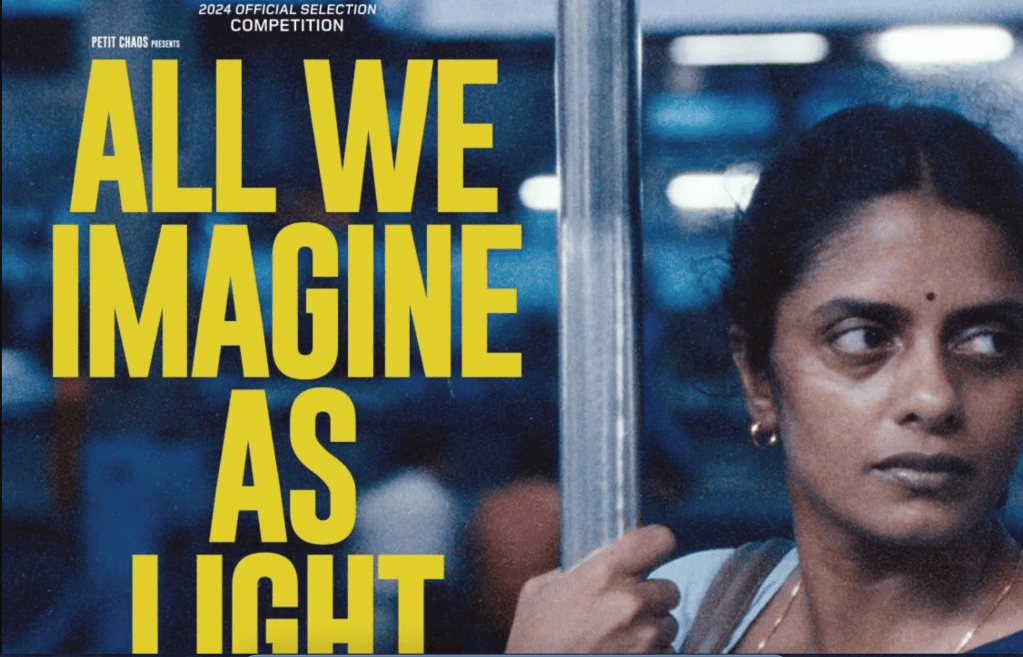
Payal Kapadia (director), All We Imagine as Light, 2024. 118 min.

Payal Kapadia’s debut feature All We Imagine as Light is a poetic film, endowed with a poeticism that is announced in its very title. So lyrical and elegiac it is throughout you are constantly fearful it will tip over into an overwrought aestheticisation at the expense of its characters and their respective plights. It is to Kapadia’s skill as both screenwriter and director that this never comes to pass and underneath its handsome surface the film has a steely resolve.
It would be glib in the extreme to call All We Imagine as Last a “love letter” to Mumbai—there is far too much pain and dejection accompanying its protagonists for that—but affectionate it certainly is. We hear this in the voiceovers during the film’s opening. They sound like outtakes from Kapadia’s work as a documentarian—accounts by migrants, in a cacophony of India’s languages, of their experience in Mumbai (which many of them continue to call “Bombay”). These are the sort of gold dust documentary makers dream of finding in their interlocutors—homespun wisdom, honed no doubt over years of telling and retelling, delivered in voices at once weary and cheerful. They might well be scripted but there is a frisson of truth there that makes you suspect they are pulled from the heart of the “Maximum City”, to use Suketu Mehta’s expression.
Kapadia’s film is a nocturnal one—nearly all of it takes place after dark. Not surprisingly, given in Mumbai, like in many parts of Asia, there is a lot of night. Even in summer, the sun rarely hangs around much later than 7pm. Shiaz (Hridhu Haroon), the secret Muslim boyfriend of Anu (Divya Prabha), tells her that sundown is his favourite time of the day, a memory of his childhood when he and his friends would finish playing football and head home. Shiaz and Anu’s courtship plays out in the evenings, and the free time of the two other main characters—Anu’s flatmate and nursing superior Prabha (Kani Kasruti) and their friend, the hospital cook Parvaty (Chhaya Kadam)—is also nocturnal.
Anu, Prabha and Parvaty are all Mayalali migrants from Kerala, each representing a different generation, and referred to throughout by what are presumably different honorifics. Though they are far from the worst off of Mumbai’s millions of residents, they are all hamstrung by circumstance and social expectations—Anu by her family’s likely non-acceptance of her love for Shiaz, Parvaty by the unrecompensed eviction from her home of 22 years to make way for a luxury development, and Prabha by the marital limbo she is left in by her husband, who emigrated to Germany shortly after their marriage years before. Each of these predicaments seems doomed, even in the case of the youngest, Anu, who has a more independent streak and who surreptitiously dispenses contraception to impecunious young women. Nonetheless, Kapadia does not succumb to fatalism and the film is a touching portrait of solidarity and generosity that is distinguished by characters that are, despite all that befalls them, genuinely good people.
Indian audiences will, naturally, glean more from this fine film than viewers further afield will but All We Imagine as Light’s international success, winning the Grand Prix at Cannes this year, will give it a deserved wider audience. And also a wider audience for Indian cinema, one of the world’s most linguistically diverse national cinemas, which has some of the most linguistically adept actors, such as the cast of this film.
How to cite: Farry, Oliver. “A Poetic, Nocturnal Film: Payal Kapadia’s All We Imagine as Light.” Cha: An Asian Literary Journal, 13 Nov. 2024, chajournal.blog/2024/11/13/as-light.


Oliver Farry is from Sligo, Ireland. He works as a writer, journalist, translator and photographer. His writing has appeared in The Guardian, The New Statesman, The New Republic, The Irish Times, Winter Papers, The Dublin Review, The Stinging Fly and gorse, among other publications. Visit his website for more information. [All texts by Oliver Farry.] [Oliver Farry and chajournal.blog.]
 Cha
Cha 