

On my way to the prison, I heard a teaser on the radio about bananas. Something to the effect that bananas were in trouble. I didn’t hear the actual story, but I’ve been thinking of bananas ever since.

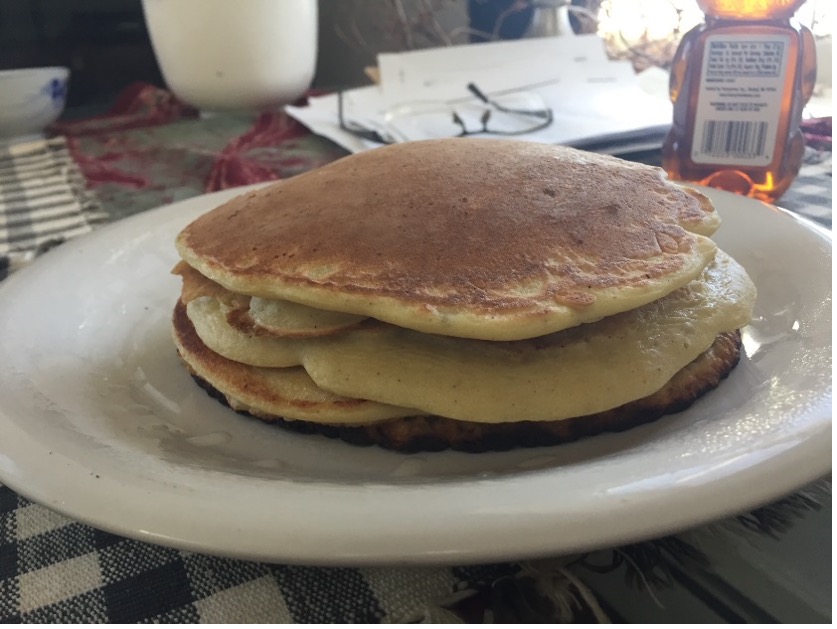
For several years now, on Sundays, I have made banana pancakes for brunch. Often there’s a football game on, and either I bring my iPad over to the stove and mix up the ingredients, or sometimes I get lucky and the match ends, so I can make my pancakes without the distraction of the beautiful game.
When I went to Thailand many years ago, I was surprised to find out that there were seventeen varieties of bananas. I don’t remember how many I tried, but each one zinged with flavour. It was like learning of the best-kept secrets of Southeast Asia, one banana at a time.
Travellers said bananas were good for gut health so there was that too.
When I finally got out of Bangkok, I arrived at Nita’s Guesthouse in Kanchanaburi, on the River Kwai. It was a sprawling houseboat that was moored by the river bank. Nita was not to be found, but his father, wizened like the old crone in Pather Panchali, took a break from babysitting Nita’s two-year-old and showed me my room, how to order food, and the guestbook. Once I got settled, I leafed through the guestbook. Many travellers complained about the nefarious Disco Duck, a floating karaoke bar, which sat directly across the river. Some gave tips for the area: Erawan Falls, Sai Yok, Hellfire Pass, the war cemeteries, renting bikes. One warned against asking to see The Bridge on the River Kwai on the VCR. Everyone raved about the food at Nita’s, especially the banana pancakes.

One traveller wrote: “The banana pancakes are amazing!!!!” I took note of the several exclamation points.
On the radio, someone said that though she loved bananas, she didn’t like banana flavouring. I thought of my very first batch of baked cookies, made during the pandemic. The ingredients were just oats, bananas, chocolate chips and an egg or two, if I recall. And I remember thinking: easy, but too much banana.
To say the banana pancake I ordered was “amazing” would be redundant. Plate-sized, with the banana slices baked right in, topped with a thin glaze of honey, and flavour that was a glimpse of nirvana. When I told the two other travellers who arrived just after me about it, Pete, the German, immediately called out to his god, and Dan, the Englishman, said we should laze around on the cushions, read novels, and eat banana pancakes all day.
I’m sure we would have if the Disco Duck had not fired up its sound system right then. An unwelcome blast that scattered the morning calm. We took off to go sightseeing but over the three days we stayed at Nita’s, we had our fill of banana pancakes and their abundant exclamation points.
In Victorian England, bananas were considered immoral, and it was taboo for a lady to touch or hold one.
Before the Boston Fruit Company—which became the United Fruit Company, which became known as “El Pulpo” (“The Octopus”) because over the first half of the 20th century they amassed so much land in Central America that their tentacles corrupted governments to such an extent that thanks to a story by O. Henry the countries were called “banana republics”. All the major Latin American writers, including Costa Rica’s Carlos Luis Fallas, Guatemala’s Augusto Monterroso, Colombia’s Gabriel Garcia Márquez and Chile’s Pablo Neruda denounced the company in their writings; its interests were protected when the Colombian army opened fire on a crowd of striking workers in 1928, killing up to two thousand people, though the official death toll was forty-seven. These interests were also protected when Guatemala’s reform-minded president was overthrown in a CIA-led coup in 1954, which instigated thirty years of civil war. The United Fruit Company later became Chiquita Brands International, which pled guilty in 2007 to funding paramilitary groups in Colombia whose death squads murdered thousands of people, including trade unionists and social activists; along with the other major banana companies, it has successfully fought or stalled lawsuits by workers who became sterile after using their pesticides. For the company to market the suggestive-meaning-phallic fruit, they had to find a way to break the taboo. So it issued postcards showing Victorian ladies sitting under trees picnicking, holding and eating bananas.
A fictionalised account of the 1928 “Banana Massacre” is depicted in Marquez’ novel One Hundred Years of Solitude.
Fallas’s novel Mamita Yunai is less mother united and more mother boss.
In “The United Fruit Co.,” Neruda refers to the dictatorships as flies and writes:
Among the blood-thirsty flies
the Fruit Company lands its ships,
taking off the coffee and the fruit;
the treasure of our submerged
territories flow as though
on plates into the ships.
Monterroso brilliantly satirises American imperialism in his short story, “Mr Taylor”, in which the eponymous character, from Boston, acquires a curious trinket in the Amazon: a palm-sized shrunken head. He gets the idea to mass-market the ghoulish products back home. Demand soon exceeds supply, and capitalism becomes entwined with the corpse trade. Suffice to say the tale ends badly for our Bostonian.
Monterroso fled Guatemala to Mexico in 1944 to escape persecution by Guatemala’s ruling generals. But one cannot mention Monterroso without also mentioning his celebrated short story, “The Dinosaur”, known as the shortest story in literature, which reads, in its entirety, “When I awoke, the dinosaur was still there.”
Late one night after my Spanish class in Panajachel, Guatemala, I had a lively discussion with Eddie, a computer specialist who lived in Guatemala City and had come to a conference for half a dozen local mayors at my hotel. He spoke in broken English, and I in broken Spanish and together we wondered how best to make change in Guatemala. He related a story about visiting Washington, D.C. for a conference on aid to his country and described feeling squeezed by the conditions necessary to secure loans. I tried to make him understand that unfortunately, Washington, the U.S., and the West couldn’t care less about Guatemala. He told me to read the book, Bitter Fruit: The Story of the American Coup in Guatemala to better understand the country’s troubles.Long after the lights in the hotel foyer were turned off, Eddie and I were still using our hands, throwing in words in our own tongues, straining to communicate. I remember the rosebud of Eddie’s cigarette blazing like a comet as it swung to and from his face in the dark.

The trouble bananas are in isn’t the difficulty in finding fair-trade bananas, which would pay the small farmer rather than a giant corporation, or the abundance of pesticides needed to help them grow, troublesome as they are. It’s their complete lack of genetic diversity. Practically every banana consumed today in the Western world is a clone directly descended from a plant grown in a Derbyshire estate hothouse 188 years ago. Known as the Cavendish, it is in danger of being wiped out by a strain of a fungus that killed off the previously most popular cultivar, known as Gros Michel, in the 1950s.
When the fungus, known as Panama disease or banana wilt, devastated the Gros Michel, growers switched to the Cavendish, a less tasty breed that was able to grow in infected soils. But the fungus evolved, and the new strain kills both the Cavendish and local breeds. Now the fungus again needs to be contained, and the race is on to develop a new cultivar.
Because the Gros Michel was under constant siege from the Panama disease between 1910 and 1960, when it disappeared altogether, the song, “Yes! We Have No Bananas”, from 1922, primarily about a jovial Greek shopkeeper who never liked to say no, is also a response to the banana shortage from the blight.
One of the happiest days of my life involves banana pancakes. I was at my friend Raymond’s “shack” in Nova Scotia on a sunny summer morning. He had been to Thailand so he knew how good a banana pancake could be. He lived on a hilltop overlooking the Avon, which was a tidal river that came and went all day, like a slow heartbeat. We had the weekend newspaper, and a big pot of coffee and were sitting out in front of the shack at a picnic table. He had a portable stove and brought it outside to cook the pancakes. We had nowhere else to be, so we stretched that Sunday morning into the early afternoon. We sat out there, savouring our coffee, reading the paper, chatting, enjoying the big sky, the pulse of the river, enjoying each other’s company, and cooking up pancake after pancake. Each served with a light drizzle of honey.
Back when Humans of New York was a thing on Facebook, one of my favourites was the widower who told the story that his greatest day was when he was on a cruise to Antarctica and he said so, aloud, at the time. When she heard it, his wife of many years agreed that this was the greatest day. The weather was fine, he said, calm seas, little wind, warm, so the captain took them deeper than he usually went; they were floating among icebergs and wherever they looked seals were laying out in the sun. He added that he was taking continuing-ed classes to keep his Alzheimer’s at bay. Today was Genetics, tomorrow French New Wave film.
I love everything about that story. How it dawned on him that he was enjoying his greatest day, how his wife agreed, what that meant for them together, the calm, the icebergs, the seals. And then his efforts to keep his mind and memories together.
In the film, “After Life”, heaven is a sort of way station where counsellors interview you about your favourite memory. Once you come up with one, they recreate it for you in a film so that you can relive that blissful time for all eternity.
It turns out that the counsellors were people who were unable to come up with a happiest memory, so they transitioned to a role at the way station. Their task was to interview the new arrivals.

I remember hearing the film’s Japanese director, Hirokazu Kore-eda, speak after a screening of it at the Toronto International Film Festival. He said he interviewed hundreds of people in the street to collect material for the film. But instead of asking for their happiest memory, he asked for their favourite memory, and was surprised at how often it was from an unhappy time in the person’s life.
One of my favourite memories happened when I was in India, the same trip that began in Thailand a few months before. I had just spent a week in Manikaran, a mountain village at the end of the road in the Parvati Valley, known for its hot pools and Sikh temple. I passed my days going hiking, reading, hanging around the hot pools and also hanging out with a sadhu named Baba. When it came time to leave, rather than wait for the bus, I decided to walk back to the next town. where I had left my backpack. Baba said he would come part of the way to see me off. Upon parting, in a surprise gesture, he asked if we could trade watches. He liked mine—a digital—because it had a light that allowed you to read the time in the dark. When he gave me his he said, “It just tells the time.” I walked down the mountain road, getting used to the feel of my new watch, and listening to the roar of the Parvati River far below. A truck with some Sikhs came down the road towards me and the driver offered me a ride. I declined because I was going the other way. He smiled and wished me good travels. We waved to each other as he drove off. I resumed my journey down the road. Rarely had I felt so unencumbered, as if I was walking into the rest of my life, free.
How to cite: Hudon. Daniel. “Memories of Bananas.” Cha: An Asian Literary Journal, 26 Oct. 2024, chajournal.blog/2024/10/26/bananas.


Daniel Hudon, originally from Canada, teaches physics, astronomy and math at the college level in Boston, Mass., where he also lives. He is the author of “Brief Eulogies for Lost Animals: An Extinction Reader,” named a Must Read in the 2019 Massachusetts Book Awards. He has recent essays in The Smart Set, The Revelator, Hidden Compass and Appalachia Journal and can be found at danielhudon.com.
 Cha
Cha 