
TIFF 2024
▞ Introduction
▞ 8. Band of Outsiders: On Neo Sora’s Happyend
▞ 7. The Soul of an Artist: On Hong Sang-soo’s By The Stream
▞ 6. The Two Maidens: On Trương Minh Quý’s Viet and Nam
▞ 5. The Master and Her Muse: On Jia Zhang-ke’s Caught by the Tides
▞ 4. Self-Studies: On Sook-Yin Lee’s Paying for It
▞ 3. The Inheritance: On All Shall Be Well and The Paradise of Thorns
▞ 2. A World of Pain: On Kiyoshi Kurosawa’s Cloud
▞ 1. Mise en abyme: On Lou Ye’s An Unfinished Film

Lou Ye (director), An Unfinished Film, 2024. 106 min.

Resurrection is a punishing feat, but no matter.
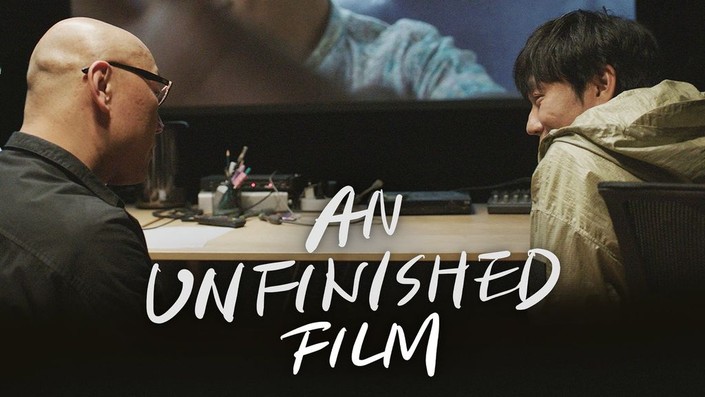
In Lou Ye’s An Unfinished Film—a metafictional mockumentary about the making of a film at the very onset of COVID—the director, Xiaorui, played by real-life producer and director Mao Xiaorui, turns on a computer with the help of his crew, and discovers the dailies for a half-finished film about a love triangle between three men, which was abandoned after they ran out of funding a decade earlier. With nothing else to do but his desire to propel him, Xiaorui decides they should pick up where they left off and finish the film. But he runs into an obstacle: so much time has passed, and everyone has changed, including the actor Jiang Cheng, played by Qin Hao: who, in Ye’s 2009 hit film Spring Fever, also played a character named Jiang Cheng.
“I’ve got mouths to feed,” Jiang tells him: “Now we’ve go to the finish this film, not for money, but for the obligation you feel. That’s not realistic…if nobody can see the film in theatres, then what’s the point? Just for our own simple pleasure? Tell me, what’s the point?”
But neither director—the one in the film nor the one of the film—care about the point of the endeavour: what they do want to do is work with a group of people, so they can create a work of art together, to recover the not-so-distant past from obsolescence and breathe new life into it.
A film-within-a-film; an actor playing an actor; the crew behind the crew; An Unfinished Film’s metafictional dimensions are dizzying—and exciting.
That the footage from the “unfinished film” of the title derives from extended or deleted scenes from Spring Fever only deepens its dimensions.
It is in Spring Fever that one glimpses Lou’s mastery as a director, for what has always set him apart is his ideas of how the camera should behave: that film began with a shot of the camera shaking itself in the air, abstracted trees falling in and out of the frame before stabilising itself, latching onto the central pair; but every now and then, as the state of affairs in the lives of characters change, and the cinematic language—the cinematographer for both films is Zeng Jian—follows suit and fluctuates accordingly.
Lou’s dirty realism make his films seem like documents, though ones that are orderly structured and highly stylised, and they always unfold in such an organic seamless way that it takes you some time and effort to realise your perception is intentionally being manipulated.

During a lockdown, the actor Jiang Cheng (Hao Qin) uses his phone to film footage for his director.
First there’s masks and traffic. Then there’s videos and messages. A hairdresser, who was born in Wuhan, is asked to leave because the hotel demands it be so. All the cabs are booked up and flight seats are going fast. Someone coughs, then collapses. People appear in white hazmat suits. Punches are thrown. The doors are locked, roads blocked. They’re trapped.
Being a process film with a postmodern bent, this is not the kind of film where the object of desire is of any importance, rather it is within the constraints of a conceit that Lou can stage something else entirely: set in early 2020—just a few days shy of Chinese New Year—the film becomes about the reality of experiencing a pandemic, which happened, in the words of Hemingway, “gradually, then suddenly,” in a country with strict measures to boot.
“Also use your phone to film when you have some time,” Xiaorui directs his crew: “Record your daily life. Take selfies and save videos from the internet. It might be interesting to look back at them.” They heed his request, but the state of things takes a toll on them, and Jiang Cheng steps to the fore: he spends his days smoking and eating, calling various people and watching videos from netizens, and from time to time, outside his bedroom window, he records what he witnesses, whether it’s man being dragged into an ambulance or a woman mourning her mother.
The most profound material in this film comes not from the cast or crew, but from the citizens of China. We re-encounter the image of Dr Li Wenliang, the ophthalmologist at Wuhan Central Hospital who was deemed a fear-mongering spreader of rumours but, who after his death, has been seen as a heroic whistleblower. We watch doctors and patients dancing tougher in mobile cabin hospitals on New Year’s and children singing “ting wo shuo xie xie ni” to frontline workers. There’s the footage of a residential block on Urumqi Road in Shanghai that catches fire, and then the public protest and revolt in the streets, which was met with violent attacks from the authorities.
Perhaps the most moving of all these inclusions is of a woman who ran onto Wuhan Avenue on 4 April 2020 so that she can observe three minutes of silence for all those lost—the streetlights were red for three minutes and everyone froze in the street—and her wheezy weeping teeters on the edge of elation, not having the words to express how she feels, just guttural sounds.

The director, played by real-life director Mao Xiaorui, convinces his main actor to help him finish his film.
The city of Wuhan was under lockdown for 76 days in 2020; this film is nowhere near exhaustive, in fact what it does is scratch the surface and not dig any deeper, which, in Robert Scholes’s words “reaches the limits of tolerable complexity”, letting the record of the public take over, and which lends the film some authenticity. The ending comes abruptly too—as though Lou was tepid about doing the work to get there—giving the impression that there was never really a story in mind, that an event like the pandemic happened in real time, with its own unique form, and that to go over the material and shape it so that it tells a more coherent story—for films need not tell stories—would be an offence.
“What happened afterwards,” Xiaorui concludes, “was something we never expected.”
What came after: a present with an uncertain future that is more engaging than that half-done product of the past, an idea that never came to fruition. To circle an idea instead of penetrating it can be a fruitful mode of creation. Lou Ye manages to pull off the risky nature of a film like this, a solid time capsule whose current timeliness and digital immediacy do not necessarily date it.
How to cite: Nagendrarajah, Nirris. “Mise en abyme: On Lou Ye’s An Unfinished Film.” Cha: An Asian Literary Journal, 22 Oct. 2024, chajournal.blog/2024/10/22/unfinished-film.


Nirris Nagendrarajah (he/him) is a Toronto-based writer whose work has appeared in paloma, Polyester, Fête Chinoise, In the Mood Magazine, Tamil Culture, in addition to Substack. He is currently at work on a novel about waiting. [All contributions by Nirris Nagendrarajah.]
 Cha
Cha 