
TIFF 2024
▞ Introduction
▞ 8. Band of Outsiders: On Neo Sora’s Happyend
▞ 7. The Soul of an Artist: On Hong Sang-soo’s By The Stream
▞ 6. The Two Maidens: On Trương Minh Quý’s Viet and Nam
▞ 5. The Master and Her Muse: On Jia Zhang-ke’s Caught by the Tides
▞ 4. Self-Studies: On Sook-Yin Lee’s Paying for It
▞ 3. The Inheritance: On All Shall Be Well and The Paradise of Thorns
▞ 2. A World of Pain: On Kiyoshi Kurosawa’s Cloud
▞ 1. Mise en abyme: On Lou Ye’s An Unfinished Film

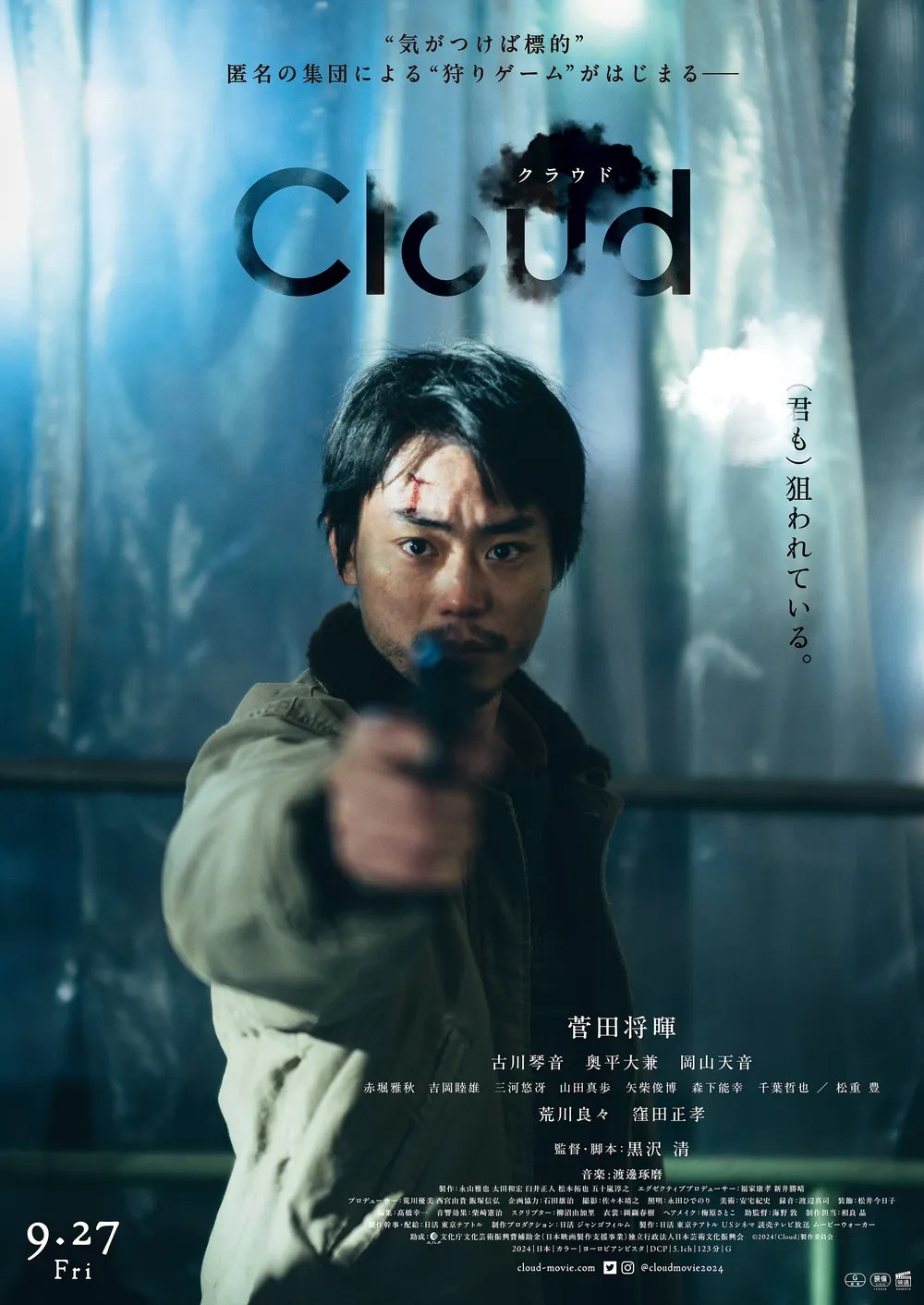
Kiyoshi Kurosawa (director), Cloud, 2024. 123 min.

Kiyoshi Kurosawa wastes no time inviting us into his cryptic filmic visions.
His newest film, Cloud, begins in medias res: near the tail end of a transaction.
Our protagonist, Ryosuke Yoshii, played by Masaki Suda—who was the voice of the Grey Heron in Miyazaki’s The Boy and the Heron—cheats a manufacturer out of a bulk purchase of “miraculous therapy devices”, which he then attempts to flip for a profit on a resale site.
What follows is a sequence that acts and feels like a sex scene of sorts: as soon as Yoshii puts the merchandise up for sale, he sits back and watches as the grey squares on his computer turn red each time they’re sold. When the grid is complete—he’s completely flummoxed—he lets out a sigh of relief, his eyes moist. It’s the ultimate release; orgasmic and depleting.
Because Cloud is a film interested in exploring human nature, the nature of men to be exact—where, it will appear, there is no place for a woman with desires to exist—and the implications of greed, selfishness and immorality, Yoshii spends most of the rest of the film never being able to achieve the height of that initial release: the items, if he can secure them, don’t always sell; or they do but at a lowered price; or, unfortunately, not at all. It’s only later in the film, when he’s given a gun for protection, that Yoshii re-encounters that state of arousal with the potential to become addictive. He has difficulty firing the first shot, but then the gears get lubricated and soon he becomes trigger-happy, a fast learner and over-achiever, to the point of comic exaggeration. In trying to pursue a return to an elusive state of being by all means, entirely obsessed with it, he stays the winding course, unsteadily so.
One of Yoshii’s primary motivations to succeed is being able to provide a certain lifestyle for him and his high-maintenance girlfriend Akiko—played by Kotone Furukawa—and to set him apart from the people of his life—a possessive boss, a former mentor—whom he deems inferior to him and who live for “conventional happiness”, as though he is the only one who figured out how to be independent: a self-made man.

Acclaimed actor Masaki Suda plays Ryosuke Yoshii, a man whose luck as an online reseller gradually runs out.
“It doesn’t matter if it’s real or fake,” he says to his assistant about a designer handbag that proves to be a miscalculated investment, the last block pulled before the tower comes tumbling down.
Yoshii’s ego and the indifference to the products he sells—like the “miraculous therapy device” at the beginning, which is flung through his window after he and Akiko move into their new place, and which, burnt to a crisp as it is, he claims not to recognise—is the catalyst for his downfall, not that we can do anything about it.
Kurosawa likes to stretch his ideas as thin as possible, to the point of translucency, so that we can view the world through this mediation, this visual filter that, in taking away from the purity, consequently, brings other things into the frame, from the realm of paranoia. What makes his signature style as remarkable as he was when he made Cure—his 1997 masterpiece—is his way of briefly calling attention to things that go unexplained that make sense later on, when they all come together: in the best work is a puzzle—often labyrinthine—nested within the narratives.
In Cloud, for instance, the audience can sense something is awry early on: as when a decayed corpse of a rat, wrapped in a newspaper, appears on Yoshii’s doorstep; or a taut wire on the road that causes him to fall off his motorcycle; or the figure on the bus—who appears to be a woman—who causes all the sound of the film to drop out. You await a revelation, hoping it will be good.
Then the film switches registers, introduces us to new characters, inhabiting an outsiders perspective, so that Yoshii—whom we know so well—temporarily becomes a secondary character, only intermittently available to us, meaning that the film must re-establish its tone, which it never really quite does, scattered it is, and also less restrained.

In the film’s second half, Miyake (Amane Okayama) joins a troupe of terrifying revenge seekers.
The second part of Cloud is about Yoshii figuring out the rules to a game that has been designed for him to lose. It’s like watching someone waking up and realising that, in the blink of an eye, they are suddenly in a genre film, that we’ve gone from an erotic thriller to an action movie.
In the second part, we have a desire to return to Yoshii—Kurosawa keeps him hidden from us—even if at one point you get the sense he’ll die; but because this is a movie, and Kurosawa needs a hero to sustain himself, the band of outsiders are as immature as Yoshii and don’t kill him when they have a chance—whereas in Cure the sense of horror that was evoked was due to the fact that you never questioned anyone can escape the spell, the inescapability of it.
Cloud wishes to end on another note altogether though, one in which a new tale begins, en route to the gates of hell, which has ominous green clouds hovering over it.
“There’s so much that I want,” his girlfriend says to him before they move in together.
But what Kurosawa seems to be asking with this rich and entertaining, if faultily two-toned, film, is: what can you do to get what you want without doing the work yourself, by way of being interconnected to other people? You can’t do it yourself—he shows us—but you can’t be indifferent to them either without eventually facing some sort of repercussion. Not everyone is as lucky as Yoshii, with a saviour strapped in by his side; not everyone is a hero in a movie where one can live multiple lives; not everyone pursues their desire so relentlessly, blinded by a hubris afforded to him as a straight man in a patriarchal society: an ineliminable devil.
How to cite: Nagendrarajah, Nirris. “A World of Pain: On Kiyoshi Kurosawa’s Cloud.” Cha: An Asian Literary Journal, 22 Oct. 2024, chajournal.blog/2024/10/22/cloud.



Nirris Nagendrarajah (he/him) is a Toronto-based writer whose work has appeared in paloma, Polyester, Fête Chinoise, In the Mood Magazine, Tamil Culture, in addition to Substack. He is currently at work on a novel about waiting. [All contributions by Nirris Nagendrarajah.]
 Cha
Cha 