
📁 RETURN TO FIRST IMPRESSIONS
📁 RETURN TO CHA REVIEW OF BOOKS AND FILMS
Teinosuke Kinugasa (director), A Page of Madness, 1926. 70 min.

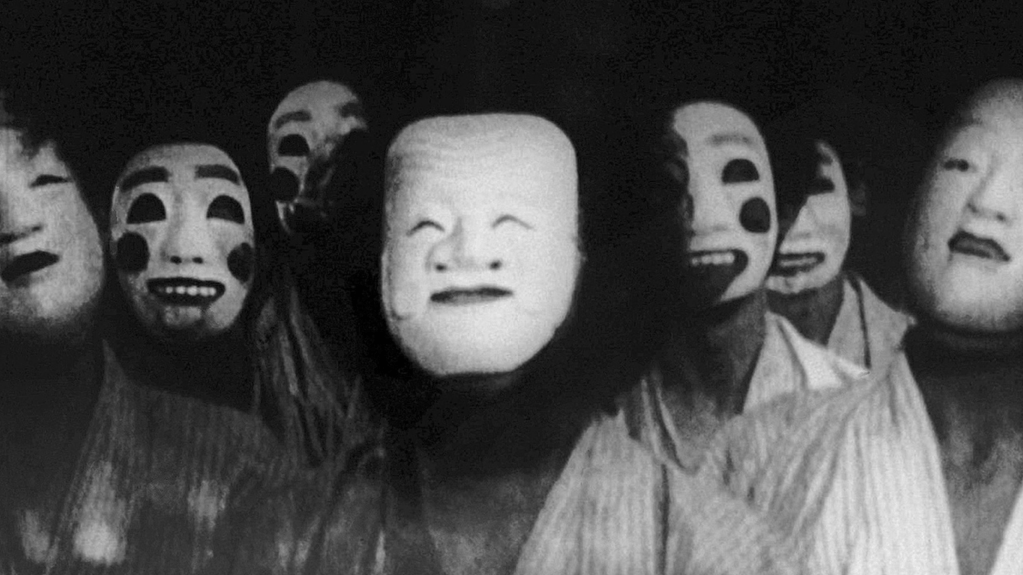
It’s almost Halloween as I write this and it seems fitting to think about what it is that makes some early silent films so creepy. Yes, the era is perhaps best known for light-hearted comedy, but some cinema from that time is quite unsettling, even films that weren’t meant to be frightening. They are an imitation of life just off enough to be unnerving in particular for the contemporary viewer, especially one watching prints quite deteriorated from the pristine originals, or shown at the wrong speed, but A Page of Madness must have had to have caused at least a few nightmares even when it was first released. Beyond the silence, I think it is the grainy, strobing, scratchy images, dark shadows, and the macabre knowledge that everyone involved in the film, or saw it when it first came out, is almost certainly dead, that makes these films, in word—uncanny.
Among the first to discuss the term was German psychiatrist, Ernst Jentsch in 1906. He described it as a certain kind of unease or a lack of orientation. Later, Freud in his seminal essay, The Uncanny (1919), mentioned, among other things, waxwork dolls, automata, doubles, ghosts, mirrors, the home and its secrets, and madness as uncanny, but he could’ve have easily have discussed cinema which was emerging as a major art form.
By the 1910s and 20s motion pictures were no longer a novelty with feature-length films from many countries becoming commonplace, including Birth of a Nation (USA, 1915), J’accuse (France, 1919), and The Cabinet of Dr. Caligari (Germany, 1920). Along with growing film industries were developing film movements such as Italian Futurism, Russian Montage, and French Impressionism.
A Page of Madness owes a lot to German Expressionism and is reminiscent stylistically of Nosferatu (1922), The Last Laugh (1924),and Metropolis (1927) with its quick cuts and optical effects.The avante-garde horror film was the product of a Japanese literary group known as Shinkankakuha (new perceptions) and is based on a short story by Nobel Prize-winner Yasunari Kawabata and directed by Teinosuke Kinugasa who is perhaps better known for his Academy Award-winning historical drama The Gates of Hell (1953).
Kawabata and Kinugasa’s collaboration was thought lost for 45 years until it was rediscovered by Kinugasa in rice cans in his storehouse, minus roughly a quarter of the film. A Page of Madness was subsequently rereleased with a new score by Minoru Muroaka. The missing celluloid certainly adds to the mystery of the film as does the lack of intertitles. Japanese silent cinema had the tradition of the benshi, live professional narrators who would explain films to theater audiences. Without a benshi, intertitles, and with a large fraction of the film lost, A Page of Madness can be hard to follow. Although a score was later added, it’s difficult to know how much of the chilling effect of the film is accidental as a result of what is missing; at times it seems as if the makers deliberately made use of the limitations of the medium. It is perhaps best then to view it more for the experience than for the story.
The non-linear narrative, such as it is, seems to concern an ex-sailor’s (Masao Inoue) remorse at being so long at sea that he caused his wife (Yoshie Nakagawa) to slip into madness and attempt to kill herself and their daughter (Ayaka Iijima). In secret, the ex-sailor works as a janitor at the psychiatric hospital where his wife has been committed.
It’s hard to tell what’s real and what everything means. The film begins with a modern dancer. Next is the wife dancing wildly in her room/cell to music presumably only she can hear, before descending into teeth-baring almost animal-like insanity while her husband can only watch. A thunderstorm rages outside, or does it? Nakagawa deserves immense praise for her sympathetic portrayal of mental illness as does Muroaka for his chilling, constant and unrelenting score which is a much sound effects as it is music. Inoue as well deserves a lot of credit as the husband struggling with his own turmoil. The violent weather also seems to recall his time at sea as the film flashes back time to the wife’s comital joining other patients, including one who appears to be literally barking mad. A Page of Madness is scene after scene of disturbing images. Without giving away too much away, there’s a part that Freud would have had a field day with—it takes the familiar and makes it strange.
If your idea of silent film are the well-known antics of Charlie Chaplin, Buster Keaton and Harold Lloyd, set them aside for a moment and experience this eccentric masterpiece. It’s hard to believe A Page of Madness was nearly lost, but then roughly 90 % of all silent films have vanished. It was a fragile medium and there was little serious regard for preservation, so the remaining frames of film flicker back to us in light and shadow as rare ghosts from another time.
How to cite: Dutch, Jeremiah. “A Page of Madness and the Cinema of the Uncanny.” Cha: An Asian Literary Journal, 20 Oct. 2024, chajournal.blog/2024/10/20/page-of-madness.



As an American who has called Japan home for over 25 years, Jeremiah Dutch’s writing crosses both cultures. He’s written about such diverse topics as horror films and climbing Mt. Fuji. While still an undergraduate, he wrote for The Haverhill (Massachusetts) Gazette and The Portsmouth (New Hampshire) Herald. In 1997, he graduated from the University of New Hampshire and moved to Japan to teach English the following year. In 2007 he earned a MS.Ed in Education from Temple University and for over seventeen years taught at the post-secondary level while continuing to write academic articles, fiction, and non-fiction. He currently teaches at Rikkyo University. In 2022, his short piece, Zen Failure in Kyoto won an Honourable Mention in the Seventh Annual Writers in Kyoto Competition. This was excerpted and adapted from his then novel-in-progress, Gaijin House. Another adapted excerpt was published this year under the name “Transported Souls in the Motel of Regret” in the anthology Mono no Aware: Stories on the Fleeting Nature of Beauty. These days he calls Yokohama home and lives there with his wife and two daughters. When not writing, teaching, or spending time with his family, he enjoys reading, exercising, and following baseball. Some more information about Jeremiah and his writing can be found on his website and Instagram. [All contributions by Jeremiah Dutch.]
 Cha
Cha 