
📁 RETURN TO FIRST IMPRESSIONS
📁 RETURN TO CHA REVIEW OF BOOKS AND FILMS
Click HERE to read all entries in Cha on All We Imagine as Light.
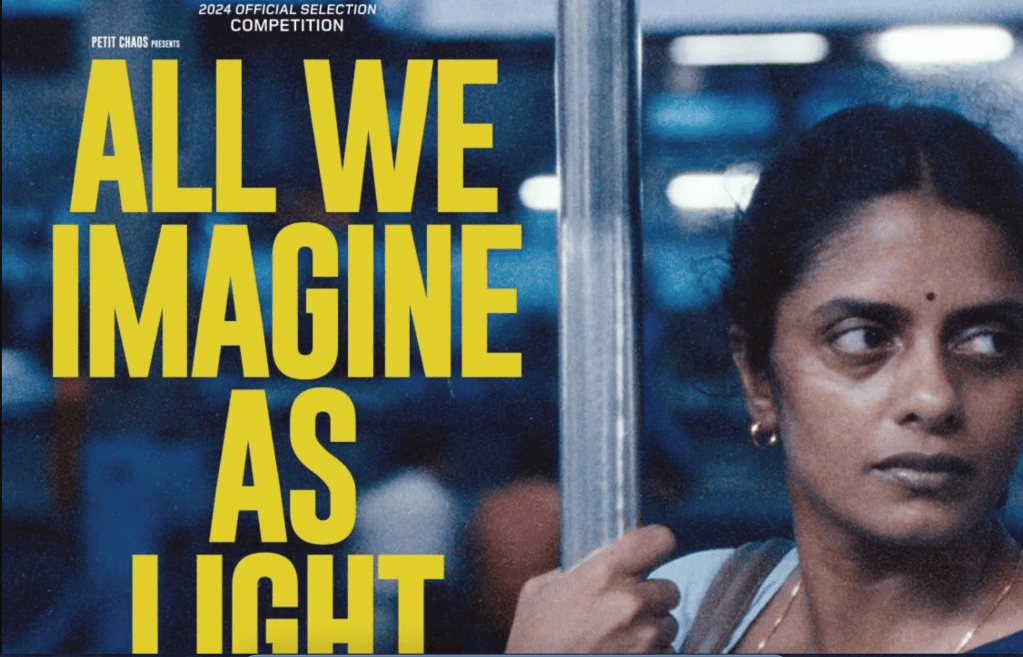
Payal Kapadia (director), All We Imagine as Light, 2024. 118 min.

Payal Kapadia’s debut film, A Night of Knowing Nothing (2021), was a documentary that followed the protests at the Film and Television Institute of India, told through one student’s love letters to another. Kapadia’s reliance on voice-over narration in the autofictional film is more than just an artistic decision—it offers the students, who are currently being charged with unlawful assembly, criminal intimidation and rioting (including Kapadia herself), some deniability. She masterfully blends the personal with the political by wrapping her protest in gauzy poetry. Winner of a Grand Prix at Cannes this year, Kapadia’s fiction debut All We Imagine as Light (2024) had its North American premiere at the Toronto International Film Festival, where her soft yet powerful register is reprised to tell the story of two nurses working in India’s largest city.
The film opens with a gloomy morning in Mumbai as Kapadia invites us to contemplate: is this a city of dreams or illusions? The 46 million migrant workers that prop up the spectre know that it is neither. A kinetic sequence of street vendors setting up shop during rush hour is overlaid with meditative voices reflecting in Gujarati, Malayalam, Bhojpuri, Marathi, Hindi. Every village has a person that lives in Mumbai…In Mumbai there is work and money, why would anyone want to move back?… You better get used to impermanence. As the streets merge into train tracks, we are introduced to our protagonists: the older, hardened Prabha (Kani Kusruti) and the younger, free-spirited Anu (Divya Prabha) who both migrated from Kerala and now work together at a hospital.
The two nurses offer each other comfort and familiarity in an otherwise alienating metropolis. In quiet kinship, they head to and from work together, disrupted by a mysterious package addressed to Prabha that follows them into their apartment. “It looks so… international,” says a wide-eyed Anu. The package reveals a shiny rice cooker, beaming bright in the small, dim room—a gift from Prabha’s estranged husband, who moved to Germany and left her behind.
Both the roommates allow their longing to disrupt the dreary and demanding routine of the hospital. As Prabha mourns the past and what was lost, Anu fantasiaes about the future and all that she has to gain. Surreptitiously, she steals kisses from Shiaz (Hridhu Haroon), her Muslim boyfriend, as they plot together to find some time alone and collapse the distance that remains between them.
The hospital, like the city, is its own ecosystem that is immune from none of its stratifications. Gossip erupts over Anu’s affair, conflict breaks out with stubborn patients, romances spark with doctors and unlikely friendships blossom. Sometimes, it feels like a game of Telephone: the nurses who speak to each other in Malayalam speak to the doctors in Hindi, who speak to the patients in English, casting a subtle hierarchy over the film for those who know to notice. Who gets to ride the urban tide of progress and who is washed ashore?
Parvaty (Chhaya Kadam)—a cook at the same hospital—for one, is cast away. She is a widow who faces eviction from her chawl (a tenement built for the workers of the now defunct mill where her husband worked) at the hands of developers. Vivified by her recent disempowerment, Parvaty seeks refuge in her friendships and politics. At a rally, she finds herself surrounded by people who share her struggle— those who built a city that decided it no longer has any space for them. The camera pans to images of Bhagat Singh, B. R. Ambedkar and Savitribai Phule (leading revolutionaries in the anti-caste movement) on the wall, and then the workers who cry and pump their fists in unison.
In a mischievous act of private protest, Parvaty casts a rock at the new high-rise in her neighbourhood when no one is looking. “They build towers so tall, thinking, hoping that one day they can replace God”, she remarks, mirroring Arundhati Roy’s scathing remarks about Antilla, residence to India’s richest man. This is no inert vignette of metropolitan misery, it is a plea for hope and change.
In the second half of All We Imagine as Light, the tinny gleam of the rice cooker splinters into an abundant and diaphanous light as the three women journey to the seaside village of Ratnagiri, Parvaty’s home, as she is done feeling like an outsider. In contrast to ravenous Mumbai, the beach is a sanctuary of peace and quiet. Kapadia and her creative conspirator, Ranbir Das, enhance the textures of these two distinct terrains which lends an impressionistic quality to the film. No scene in Mumbai is without the “natural” sounds of the city—impatient honking, incessant chatter, the crinkle of plastic—towards which one is forced to develop an immunity, just like the locals. Ultra-blue tarp heralds in every monsoon, casting a perennial shadow and fluorescence over Mumbai, whose shelter Prabha and other pedestrians scurry under.
If blue tarp is the skin of the city, then the red laterite rocks through which Anu and Shiaz frolic are Ratnagiri’s. Here, the artificial glow of Mumbai fades into a soft, delicate blush. A visual heave, and then a sigh of relief. As they unwind, Prabha and Anu happen upon the answers to their own longing. And then… a renewal of hope, an escape from tired fate, the proverbial light at the end of the tunnel.
Payal Kapadia believes in this light, keeping her political allegiances alive in her humanistic portrait of love, longing and friendship. Her integrity makes her a distinct voice in Indian cinema, that is now hostile to the sharp and critical social realism it once fostered. Despite its international acclaim, A Night of Knowing Nothing never came out in India. But the Grand Prix at Cannesis a sound too loud to ignore, and the industry and the government is being forced to celebrate the same revolutionary spirit it unflinchingly persecutes.
How to cite: Namah. “Elegy on Love and Migration: Payal Kapadia’s All We Imagine as Light.” Cha: An Asian Literary Journal, 15 Oct. 2024, chajournal.blog/2024/10/15/all-we-imagine.



Namah lives in Toronto and her writing is deeply influenced by the city. She wants to talk to you about film, fashion and freud.
 Cha
Cha 