
📁 RETURN TO FIRST IMPRESSIONS
📁 RETURN TO CHA REVIEW OF BOOKS AND FILMS
Click HERE to read all entries in Cha on Half Sound, Half Philosophy.
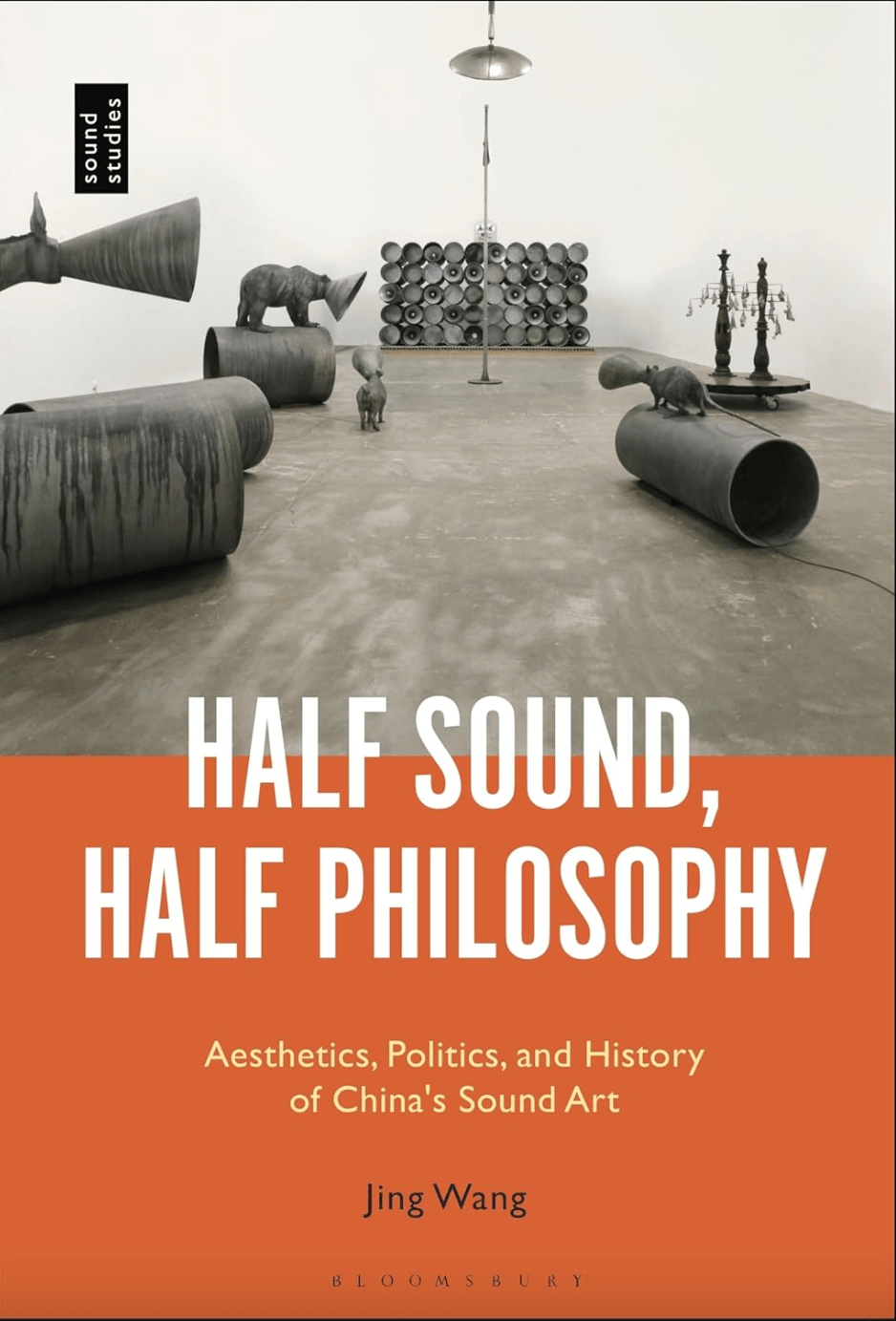
Jing Wang, Half Sound, Half Philosophy: Aesthetics, Politics of China’s Sound Art, Bloomsbury Academic, 2021. 232 pgs.

Half Sound, Half Philosophy: Aesthetics, Politics of China’s Sound Art is an interesting in-depth look at the world of sound as art in China. Music is considered to be ordered sound, while noise is disordered sound. “Sound as art” falls somewhere in the middle. Sound can be both “orderly” and “disorderly” but both deliberately and randomly used in the artistic sense by the hands or ears of artists.
Sound as well as music has a prominent place in the world of art practice.
The first chapter of the book investigates sound through the Chinese philosophy of qi 氣. It is the most theoretical chapter and can be read “first or last” according to the author. The second and third chapters are historical accounts of the use of sound in contemporary Chinese art and in electronic experimental music. The remaining chapters are thematic analyses of China’s contemporary sound art practice through notions informed by qi philosophy.
Chapter 1, which is challenging to summarise concisely in just a few words, re-contextualises sound to that of qi, which emphasises “correlationality, resonance, process, and transformation”. Literally meaning vapour, air, or breath, the word qi is often translated as vital energy, vital force, material energy, or simply “energy”; related to sound, it can be seen in three dimensions—sound produced by qi, sound as a manifestation of qi and acoustic technology as a facilitator of qi. The philosophy of qi suggests that “myriad things that are constantly resonating, condensing, disintegrating” and reflecting and resonating with the seasons, constantly changing form.
For me, Chapter 2, “A Brief History of Sound in Chinas Contemporary Art”, a detailed look the development of China’s contemporary art from the mid-1980s to the 2000s, is the most interesting chapter of the book. The point is made that “video evolves out of the electromagnetic and hence video art bears a closer relation to audio art than to film and photography”; this is true, as sound has to be emitted from some device or some mouth…so there are elements of the visual are important for the sound to successfully work as an art piece as the following artworks show, some of which I have personally seen.
Take Zhang Peili for example, one of China’s sound art pioneers. His 1991 video titled “Water: Standard Version from the Cihai Dictionary” (which is in Hong Kong’s M+ Museum), concerns a standard broadcasting voice that is heard out of its usual context of a national news report. The video features well-known CCTV anchor Xing Zhibin, sitting at her desk reading words from the dictionary entry for the character of water, in an expressionless manner. The video presents viewers with a strange scene: an authority figure reading out words that are true, but devoid of meaning. It directly comments on the ever-present TV and the existence of state-controlled media.
In Xu Zhen’s “Shouting” (1998), which is also in the M+ Museum’s collection, Xu suddenly shouts on the busy Huaihui Road in Shanghai, prompting pedestrians to turn around, startled. Xu originally intended to focus on the shouting itself, but the passersby became the subject of the work, shifting the framework of the performance from his action to the reaction of the onlookers. In the words of Wu Meichun and Qiu Zhijie, who are quoted in the book, “at the expense of being regarded as shameless, the artist captures a fragile moment in the collective unconsciousness”. The work “walks a line between guerrilla social intervention and an expression of existential anxiety”.[1]
Another work in the M+ Museum’s collection is Wang Wei’s “1/30th of a Second Underwater” (the title of the work is taken from the camera’s shutter speed). This is a photographic and sound installation: eight colour transparencies inserted on the ground depict a person underwater. Contorted faces and hands are pressed against the glass, and bubbles appear, as if the person is running out of air, trying desperately to escape. Each transparency was placed in an illuminated light-box, set on a platform in a darkened corridor constructed for the piece. Sound playing in the corridor gave the impression of voices emerging from underwater. The narrow corridor and the enlarged faces heightened the sense of claustrophobia and unease. Sounding out will not save you. Originally the installation was positioned near the entrance of a gallery so visitors were forced to walk over the images, stepping directly onto the face of the person struggling to breathe. In its Hong Kong showing, you can still walk across it, but it is optional, not necessary, so it loses some of its force as a statement.
In the 1950s and 1960s, political propaganda “music”, political speech and news reports were played through loudspeakers or on home radios. Radios were the most common medium for home listening during this time. Shao Yi’s installation Broadcast (2008) put audio clips of field recordings of private conversations and conference speeches inside 60 recycled radios collected from villagers in Zhejiang province.
Shao’s work reminds me of He Xiangyu’s “Dedicated to her: Loudspeaker” (2011, not mentioned in the book), which I have seen in the M+ Museum. A loudspeaker broadcasts on repeat an extract from Mao Zedong’s official proclamation of the founding of the Peoples Republic of China in 1949: “Comrades, the Peoples Republic of China is established! The device’s design is similar to the one used in the ceremony, a reminder of the historical moment, yet it is placed in the gallery with no announcer in sight. We have to fill the gap between past and present with our imagination.
Then there is a work by Geng Jianyi, “Tremble with Fear” (1989/2012), in which unsettling background noise minor interruptions become a strong interruption when people approach the artwork. Jiang Zhuyun’s “Sound of Temperature” (2005) takes the thermodynamics of a quivering body and oscillating speakers to produce sound: a contact microphone is attached to his naked body, and the vibration of his quivering body is transmuted to audible sound.
But there were also artworks were produced in intentionally avoided emitting audible sound in the external space, except for the friction sound of devices in operation. This reminds me of the Samson Young piece that is not listed in the book, which is a great oversight. Young’s “Muted Situation #22: Muted Tchaikovsky’s 5th”, as part of his “Muted” series, is a work where the music is “removed” and a surprising amount of previously unnoticed sounds can be heard in this performance. We hear keys clacking, sheets of music rustling, and bows sweeping tonelessly over strings. You could say it was “uncovering the unheard”. Young won the inaugural Sigg Prize in 2020 for his “Muted” series.
The chapter entitled “In Praise of Strange Sounds of the Shamanistic” is inspired by the shamanistic references and mysticism in contemporary new music practice, sound art, and experimental music. Drawing from China’s own shamanic cultural past, one musician, Tan Dun, is known for his fusion of ancient Chinese cultural elements with classical music, contemporary avant-garde music and popular music. He refers to his childhood memory of growing up in a rural Hunan village full of shamanic folk culture. His works incorporate indigenous music/sounds in his contemporary works. I have been fortunate to see Tan Dun at least three times in Hong Kong.
Sound/audio-visual works also show the complex connections between landscape and humanity in our post-industrial and increasingly virtual world. Bitcoin Mining and Field Recordings of Ethnic Minorities (2018) by Liu Chuang showcases how “nano-politics of the nation-state and the global capitalist economy shape the nervous system, the body gestures, the attention mode, sensual perceptions, and psychological and political desires”. The work, which is currently on view in the Shanshui: Echoes and Signals Special Exhibition at the M+ Museum, is a three-channel video connects hydraulic projects and bitcoin mines in southwest China. Drone footage of bitcoin mines, filmed footage of workers, and archival footage is woven together with references to Andrei Tarkovsky’s film, Solaris (1971), and Steven Spielberg’s Close Encounters of the Third Kind (1977) to create a “poetic sub-textual narrative of the other”. This footage and its voiceover narrative trace the lines of power, and the technologies that have displaced people and conquered territories and raise challenging questions about the geopolitical, economic and cultural impact of technology on peoples and societies across the globe.
To sum up, this is an interesting and comprehensive compendium of sound art in contemporary China, and it is hard to do justice to the many artists mentioned on this book’s pages who have contributed to sound art in a review like this. The discussion of qi as having an impact on Chinese artists is interesting and seems thorough, but I don’t always feel that the connection between the concept of qi and specific individual artworks is made clear enough in the author’s analysis. The book could also have done with more thorough proofreading to remove some glaring typos.
[1] In Chinese Art since 1970 The Sigg Collection (Thames Hudson), edited by Pi Li.
How to cite: Eagleton, Jennifer. “The World of Sound as Art in China: Jing Wang’s Half Sound, Half Philosophy.” Cha: An Asian Literary Journal, 14 Oct. 2024, chajournal.blog/2024/10/14/half-sound.


Jennifer Eagleton, a Hong Kong resident since October 1997, is a close observer of Hong Kong society and politics. Jennifer has written for Hong Kong Free Press, Mekong Review, and Education about Asia. Her first book is Discursive Change in Hong Kong (Rowman & Littlefield, 2022) and she is currently writing another book on Hong Kong political discourse for Palgrave MacMillan. Her poetry has appeared in Voice & Verse Poetry Magazine, People, Pandemic & ####### (Verve Poetry Press, 2020), and Making Space: A Collection of Writing and Art (Cart Noodles Press, 2023). A past president of the Hong Kong Women in Publishing Society, Jennifer teaches and researches part-time at a number of universities in Hong Kong. [All contributions by Jennifer Eagleton.]
 Cha
Cha 