
📁 RETURN TO FIRST IMPRESSIONS
📁 RETURN TO CHA REVIEW OF BOOKS AND FILMS
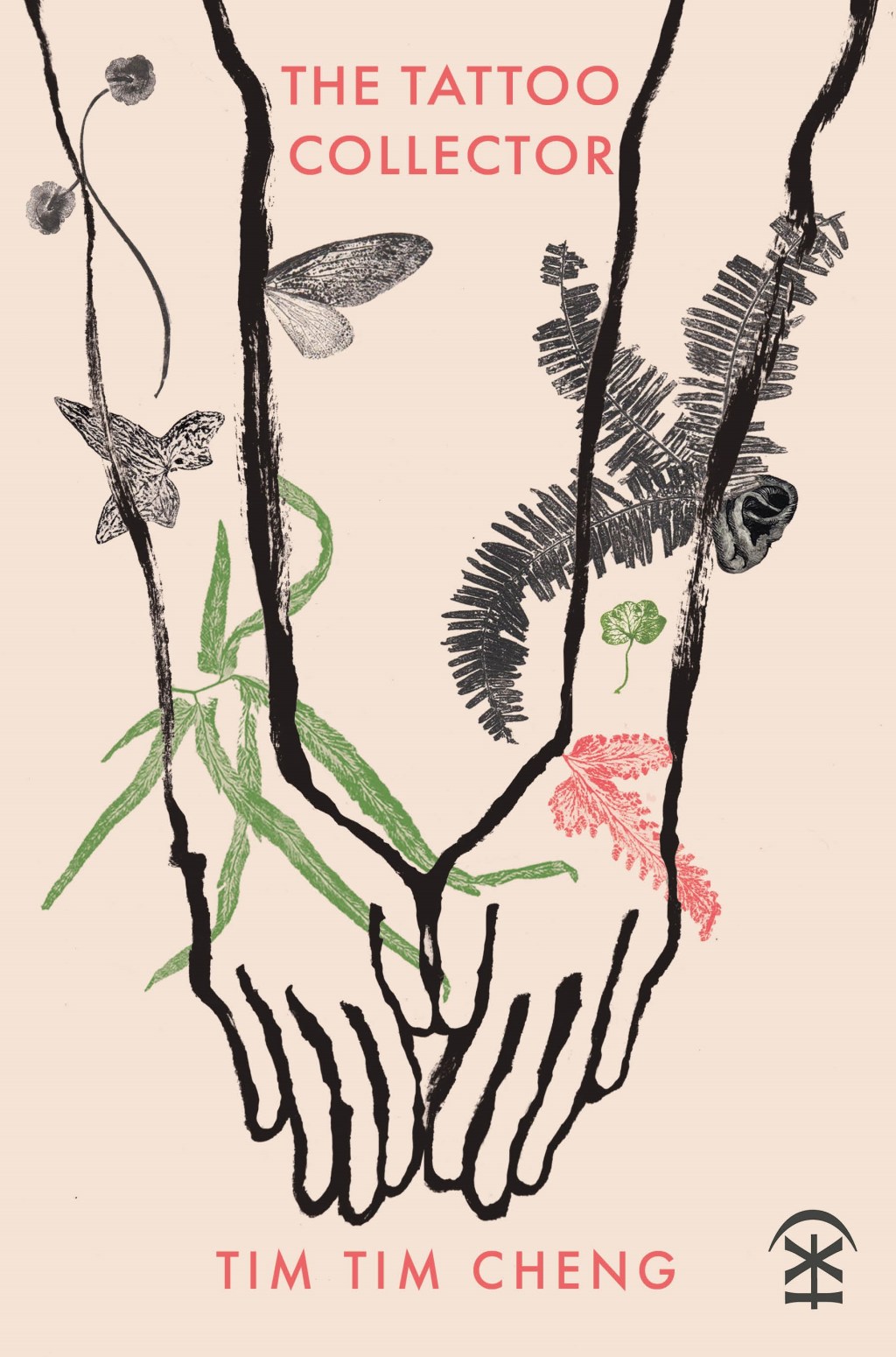
Tim Tim Cheng, The Tattoo Collector, Nine Arches Press, 2024. 72 pp.

In case you hadn’t known that the British ruled Hong Kong until 1997 or needed sudden clarification on the purported duration of “One country, two systems”, a stock paragraph has headed every piece of foreign reportage on Hong Kong from the last five years. Rooted in the history glossed over by these stock paragraphs, the Hong Kong poet Tim Tim Cheng works in English to implicitly and explicitly challenge the myths and languages we use to describe Hong Kong. A year after her pamphlet Tapping at Glass and the co-edited volume Where Else: An International Hong Kong Poetry Anthology (both Verve, 2023), Cheng’s debut full-length collection, The Tattoo Collector, undoes these overburdened narratives to ink other, scintillating, histories onto her homeland’s skin.
Cheng’s instinct for scaffolding initially reveals itself in The Tattoo Collector’s tripartite sectioning. Following her opening joust in “Questions for the Police at Royal Infirmary”—“If you were in the interrogation room, could you tell my great granny lied / Are you kind when no one watches”—Cheng’s three sections each take an epigraph, quoting from Mei-mei Berssenbrugge, Etel Adnan, and 曹疏影Cao Shuying. From these epigraphs, we might identify each section’s main theme (in the order of their appearance) as empathy, history, and rebellion, even though Cheng’s poems interlock across section frames in time, place, question, and form. The total effect of such an amalgam evinces a climate of loss and confusion, even collapse. In “Master Narratives”, at the beginning of The Tattoo Collector, Cheng writes: “Why do I still believe—like a stranger— / that being understood could save us?” Yet out of this structured entropy, Cheng fashions a clear poetic narrative of becoming, summoning order and rigour from her poetic intermingling of the post-“2019: HKSAR” spacetime: “saving me / from this world’s unmasking”.
A collection of mostly short, formally experimental lyrics, narrated by a multidimensional “I”, The Tattoo Collector reads autobiographically in light of Cheng’s recent move from Hong Kong to the UK. Punctuationless at the Royal Infirmary Hospital in Edinburgh at night, Cheng asks the officer: “Why am I looking at you without disgust / Is it because this country is so new to me.” Another poem in The Tattoo Collector’s first section—on empathy—takes place in the “Surgeons’ Hall Museum” in Edinburgh. Cheng transposes the inherited Chinese female trauma of “a foot snapped, bound heel-shaped / Fissured into rot” to a colonial European stage of pathology, patriarchy, and possession, even in death:
You desire some biography
Some reads bandaged, aged six
You are like those who desired her jiggly gait
Named that lotus feet
You name a woman by her suffering
A woman names you her suffering
Which you inherit without knowing
Without her knowing.
But Cheng situates the pain of this possessive “unmasking” much, much earlier, earlier than even bound feet. “Long before” the Dutch and the Japanese, “we had always sharpened our teeth, / lining, webbing our limbs / with sugarcane juice and soot,” she alliterates in “The Tattooist”, a poem whose first-person narrator speaks as an Indonesian woman during World War II. Cheng’s love for tattoos is another autobiographical pin in The Tattoo Collector, whether they’re historical in “those brief, horizontal lines / charcoal-inked on Ötzi’s body…”, or contemporary in “the coming of black outlines, / which safeguard every lost charm”. Across the spatiotemporal spectrum of lived experiences, The Tattoo Collector narrates a sonic, rhythmic chain of historical dispossession and magical resistance: for Cheng, tattoos appear as a structural motif of auspiciousness or healing, like crystals or amulets. From “The Tattooist”:
To bear fate on our skins, our skins,
our bearing, housing our souls—
a graphite starburst on my shoulder
sheltered me from evils
And in “Skin. Me”, which superimposes the verbal imperative of “[to] skin” over its innocuous nominalism, Cheng infuses tattoos with transformative, active power, as though skin were a canvas that spurred tattoos into radical being: “Here a snake that hisses at / its eternal reflection was someone’s / chest. Laurel leaves anchor a boat / between faded nipples.” Skin, “cracking with / lines of a leather couch”, is a porous membrane that separates the outer from the inner, the tangible from the imagined, the official from the grassroots. If oriented towards care and self-protection—“thinking of an infant’s playdough fist / tight around a mother’s finger, / insulated by a big wish”—then a collection of tattoos can only be a talisman; Cheng’s brilliance in The Tattoo Collector lies in animating the metaphorical potential in so seemingly permanent yet permeable an act.
In the vein of Nicole Wong’s metaphorical “terroir”, let us transpose the art of tattooage to that of translation. Tattoos translate at the border between flesh and air, transforming shifting images into the intransigent language of bodily permanence, “the different strengths between / bold clouds searing across my ribs”. Tattoos negotiate the tensions latent in the dualities of source language and target language, outer and inner, and other metaphorical binaries: “Some say the clouds and eagles hurt the same / but this skin hears one at a time.” This skin bargains slowly, with “a patience so wild / it bit half-dried cement.” So we get, in “Master Narratives”:
I translate my flesh into empires, possessed
by the thing that also reads as 東西 eastwest.
From the centre of the marginalised diaspora, The Tattoo Collector tattoos the skin of the Anglophone writing industry with Cheng’s native Cantonese. Multiple poems braid linguistic and formal experimentation into a single vector of subversion. “Rudimentary Cantonese” in the empathy section, mimicking a toddler’s acquisition of Cantonese, divides briefly into three columns, punning and translating between them. In “瑞龍樓 Shui Lung House”, in the history section, Cheng arranges Chinese idioms like 春聯, couplets traditionally hung on the sides of doorways for prosperity and peace. Juxtaposed against the poem’s English text—“Edges are knifelike in street lights / Something slithers by my wrist…”—Cheng’s Chinese content ironises 春聯’s moods of celebration across dual narratives of time.
One poetics, multiple linguistic systems: Cheng’s aesthetics of invention draw new possibilities of organisation and creation to the fore, fearless and necessary where its contexts stagnate. But it’s not that this collection is necessarily intended for a linguistically double- (or triple-)facing audience, like Hong Kong’s. Glosses, italics, and endnotes guide a non-Sinophone reader through Cheng’s verbal tattoos, in a fascinating exercise of the frontiers of understanding. As Choy-Ping Ní Chléirigh-Ng writes on “infusing Cantonese with meaning or ‘reduc[ing]’ it to sound”: “Do we always have to understand everything?” The space of non-understanding that Cheng opens for non-Sinophone readers is equally one of possibility and interpretation, an invigorating process of repoeticising acquired assumptions.
And Cheng’s chosen poetic forms re-articulate the Anglophone canon of poetry. “How Memory Works”, subtitled “on the sudden closure of Apple Daily, the biggest pro-democracy press in Hong Kong” and first published in Tapping on Glass, is especially striking for its structural resemblance to Wallace Stevens’s “Thirteen Ways of Looking at a Blackbird”. Like Stevens’s poem, Cheng’s sequence of tercets spins from the natural—“I would love to believe the sky / is apologising but it never does. / We rain on its behalf”—to the metaphysical, of “absence” and the internet: “Refresh—404 not found.” Cheng’s elliptical narration rests on a political moment—one of “ghosts polic[ing] too”—figuring the newspaper as Stevens’s blackbird; that is to say, the poem could as well be entitled “Ten Ways of Policing the Past”.
Perhaps over-disseminated historical narratives also constitute a (national) canonisation of the past. Cheng’s treatment of Winston Churchill’s speech in “Emergency Regulations Ordinance (1922–)” confounds Churchill’s top-down, London-centric narrative of the 1922 Hong Kong’s Seamen’s Strike with a grassroots, local narrative of 2019, italicised and bracketed as though visually tattooed upon Churchill’s colonial voice: “[when the baton hit her head] [T]he staff of many firms and some Government servants, such as office messengers, have come out. [i can’t sleep]”
Cheng’s intricate retranslations of state violence, neocolonisation, and generational trauma recall Don Mee Choi’s sublime memory work in DMZ Colony (Wave, 2020), where in US-occupied South Korea, prisoners’ whole bodies were blue “from savage beatings. She thought she was the only blue one, but the woman next to her was also blue!” It thrills and chills me to read these brilliant poets in tandem with each other, both working to siphon imperialism and misogyny out of their insidious inherited historical narratives and present-day contexts. See Cheng’s “Blue Fires”, where strategic repetition accumulates into a confrontation with “the memory my body rejects /
It is hotter than what is visible. Therefore, blue
Derek Jarman says before you turn blind, the world turns blue
Blue is drumming in my arms
…
I am about to touch the fire inside me
And find the fire you touched
Cheng’s force of presence evokes, too, Jay Bernard’s Surge (Chatto and Windus, 2019), which explores the archival silences and racial, institutional, psychic, and physical violence surrounding the 1981 New Cross Fire, in which thirteen young Black people died, to be met with a sickening societal disinterest. Like Surge, The Tattoo Collector does not stoop to one-track narratives of right and wrong, shame and guilt, “the witness and witnessed”. In the aftershock of mass social trauma, Cheng nuances the “concentric” repercussions of a search for justice and memory while moored in the diaspora, “homesick” while “sick of home”.
And this is how the repercussions ripple out: from history, “The Sand I Stand on Is Not My Own—”
… but a congregation
of distances.
… I still take it, nothing strategic,
the way dead things settle in sediments.
—and rebellion, “Hidden Agenda”—
Then I,
…
then I make I an anti-elegy,
then I make—
—to the salted twist of an ending in “Bad Tattoo Poem”:
No one could tame me—
black me out—I gnarl.
“Black me out—I gnarl. I gnarl!” Cheng’s energy, calibrated through the growing collective “we” of The Tattoo Collector’s third section, is contagion. She manages to metabolise a concern for the social body alongside the metaphorical furore of translating across and upon physical and linguistic bodies, layering distinct bodily modes in a single collection of less than eighty pages. Whippy, spry, this is one of my favourite lines from The Tattoo Collector: “I keep saying Jubilee as Jollibee, / meal deals preferred to monarchy.”
As we rework what it means to originate and move forth from Hong Kong, Cheng’s refractive voice offers a kaleidoscopic lexicon of loss and belonging that we can each choose to adopt, adapt, or reject. From Cheng’s inscriptions in The Tattoo Collector—permanent on paper, permanent in mind—what we glean is not her yearning for salvation, but a stunning articulation of the individual conviction necessary to rewrite our own histories, retranslate our own languages. To understand ourselves is to save ourselves.
How to cite: Suen, Michelle. “Blue Fires Burning in Tim Tim Cheng’s The Tattoo Collector.” Cha: An Asian Literary Journal, 2 Oct. 2024, chajournal.blog/2024/10/02/tattoo-collector.


Michelle Suen is from Hong Kong and lives in Dublin, Ireland. She is studying English literature and history at Trinity College Dublin and is an assistant editor of fiction for Asymptote. [All contributions by Michelle Suen.]
 Cha
Cha 