
📁 RETURN TO FIRST IMPRESSIONS
📁 RETURN TO CHA REVIEW OF BOOKS AND FILMS
Kangyu Garam (director), Lucky, Apartment, 2024. 96 min.

This review may contain spoilers.
What would hate look and feel like if it took on a sensory form?
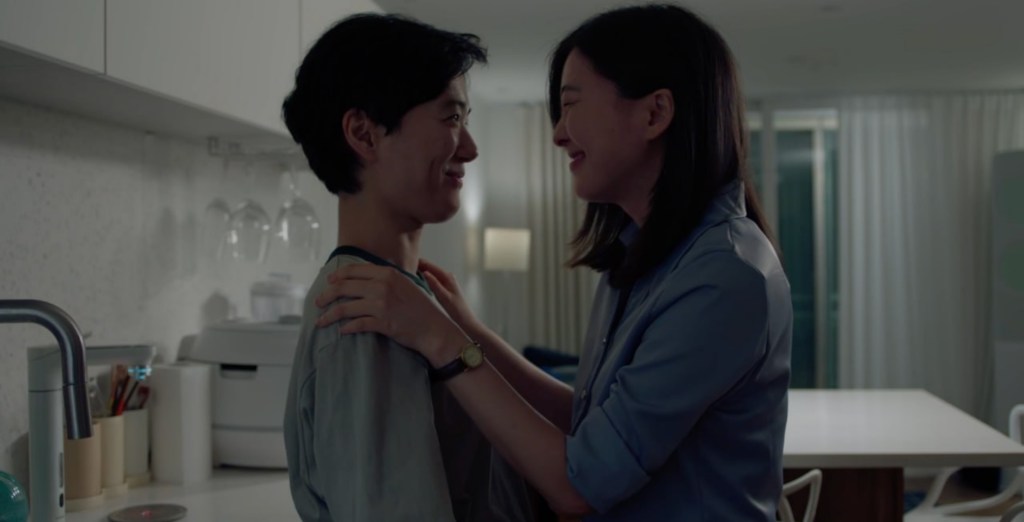
South Korean documentary filmmaker Kangyu Garam makes her feature debut with Lucky, Apartment. Using olfactory encounters as a metaphor, Kangyu follows a lesbian couple and addresses themes of queer ageing against the backdrop of heteronormative middle-class desires, which overshadow the everyday struggles of queer individuals, particularly among the young and precarious, living in Seoul.
Sun-woo and Hee-seo are a lesbian couple in their early thirties. They live in a small apartment on the outskirts of Seoul, which they bought on a high-interest mortgage. Their relationship is strained after nine years together. As they reconsider their future together, Sun-woo begins to detect a foul odour coming from the unit below. The stench grows stronger daily. Sun-woo desperately seeks help from tenants, the building management, the police, and Hee-seo, only to be constantly rebuked. The tenant representative pressures Sun-woo to remain silent so as not to jeopardise property values in the building. Sun-woo’s obsession with the smell parallels Carol White’s fixation on toxic fumes in Todd Haynes’s Safe (1995), where much like Sun-woo, Carol drives away those around her. If Todd Haynes used sensory experiences to depict the horrors of the domestic heteronormative middle-class pretence, the smell in Lucky, Apartment is a reminder that the everyday struggle for queer subjects remains entirely invisible, despite the apparent presence of an unbearable odour.
It is revealed that the tenant below, an elderly woman known as “the flowerpot lady”, has died, and her decomposing body has then been left unattended. Sun-woo is haunted by disturbing images in recurring nightmares, such as flashbacks of the old woman rummaging through a dumpster, or a worm being eaten alive by ants. In her search for the deceased woman’s family, Sun-woo uncovers connections between her own life and the old woman.
Imagining a future as an ageing queer couple is challenging in a society where homophobia is widespread, with a backlash against efforts to legalise queer rights, including same-sex marriage. While a recent landmark Supreme Court ruling in South Korea has recognised equal healthcare rights for same-sex couples, immediate dangers such as workplace discrimination and eviction remain unchecked.
In this context, the stench symbolises various things: Sun-woo’s growing anxiety as a lesbian, whose struggle in a complex matrix of sexual orientation, gender, and class is invisible to those around her. It also represents the neighbours’ eventual recognition of the deceased woman, who was an invisible queer woman herself. The tenants’ homophobia spreads like a pesky odour, forcing Sun-woo and Hee-seo to consider selling and leaving their apartment. Just as Sun-woo attempts, in vain, to mask the stench with scented candles, everything continues to spiral out of control. Hee-seo, who tried to advance in her career while remaining closeted, realises that her boss has been unfairly assigning all the work to her while promoting male employees. Tenants grow suspicious of Sun-woo and Hee-seo, spreading homophobic rumours about them.
The film’s first half unfolds like a mystery thriller surrounding the old woman’s death, while the latter half transitions to a narrative of care and tenderness. As Sun-woo and Hee-seo later discover that the deceased woman, Sin-im, was a lesbian, who had a same-sex partner, Jeong-nam, they begin to see themselves and their future in Sin-im and Jeong-nam’s lives. Because same-sex partners are not recognised as immediate family, Sin-im’s body cannot be claimed by Jeong-nam. Sun-woo and Hee-seo create a small makeshift grave for Sin-im on a hill behind their apartment, burying photos and keepsakes to honour and preserve the memory of Sin-im and Jeong-nam in a sacred space known only to them.
Cinematically, the contrast between light and shadow, fear and tenderness in the first and latter halves of the film is, although obvious, still striking, with soft sunlight shining on wildflowers, the makeshift grave, and the protagonists toward the end. The film is the strongest when it patiently explores the anxieties surrounding the smell—which is hard to visualise—encroaching what is supposed to be the safest place: the apartment. However, just like the stench that represents the rampant homophobia seeping through our daily lives, home can also be vulnerable to the encroachment of homophobia, especially for those like Sun-woo and Hee-seo. Ultimately, they muster the courage to disrupt their neighbours’ domestic bliss, while honouring forgotten and invisible lesbians like Sin-im. In the South Korean film industry, where frank and unapologetic onscreen portrayals of middle-class hypocrisy and queer ageing are few and far between, Kangyu Garam’s Lucky, Apartment sets a promising example of weaving together fear, hate, care, and tenderness at the heart of everyday queer lives.

How to cite: Yoon, Soo Ryon. “A Queer Shape of Smell: Kangyu Garam’s Lucky, Apartment.” Cha: An Asian Literary Journal, 22 Aug. 2024, chajournal.blog/2024/08/22/lucky-apartment/.



Soo Ryon Yoon is a National Research Foundation academic research professor at the Institute for East Asian Studies, Sungkonghoe University, Seoul. She has published her research on racial politics of contemporary Korean performance in a number of venues including positions: asia critique, Performance Research, GPS: Global Performance Studies, and Inter-Asia Cultural Studies. She was previously an assistant professor in Cultural Studies at Lingnan University and a CEAS postdoctoral associate at Yale University. She was deeply immersed in Hong Kong popular culture as a teenager by way of Wong Kar-wai’s films. [All contributions by Soo Ryon Yoon.]
 Cha
Cha 