
📁 RETURN TO FIRST IMPRESSIONS
📁 RETURN TO CHA REVIEW OF BOOKS AND FILMS
Pang Laikwan, One and All: The Logic of Chinese Sovereignty, Stanford University Press, 2024. 276 pgs.

As I finish writing this review, we are a few days away from Hawaiʻi’s Lā Hoʻi Hoʻi Ea, or Sovereignty Restoration Day. First celebrated on 31 July 1843, the holiday commemorates the time Queen Victoria sent Admiral Richard Thomas to restore the sovereignty of the Hawaiian Kingdom, the independence was of which recognised by France and the United Kingdom later the same year, becoming the first non-Western nation-state to be thus recognised. In ‘ōlelo Hawaiʻi (Hawaiian language), “ea” means not only “sovereignty” but also “life”, “breath”, which “make[s] land primary over government, while not dismissing the importance of autonomous governing structures to a people’s health and well-being”.[1] Despite more than a century of illegal occupation and colonisation by the United States, the celebration of the Sovereignty Restoration Day continues to take place in 2024. As I looked at the Hawaiian flag risen at Thomas Square, I lost track of the last time when I actually rose for and saluted the People’s Republic of China (PRC) flag, wondering: why would I feel more genuinely festive and inspired by Hawaiian peoples’ national holiday than my own?

Large Hawaiian Flag flies on mauka side of Thomas Square

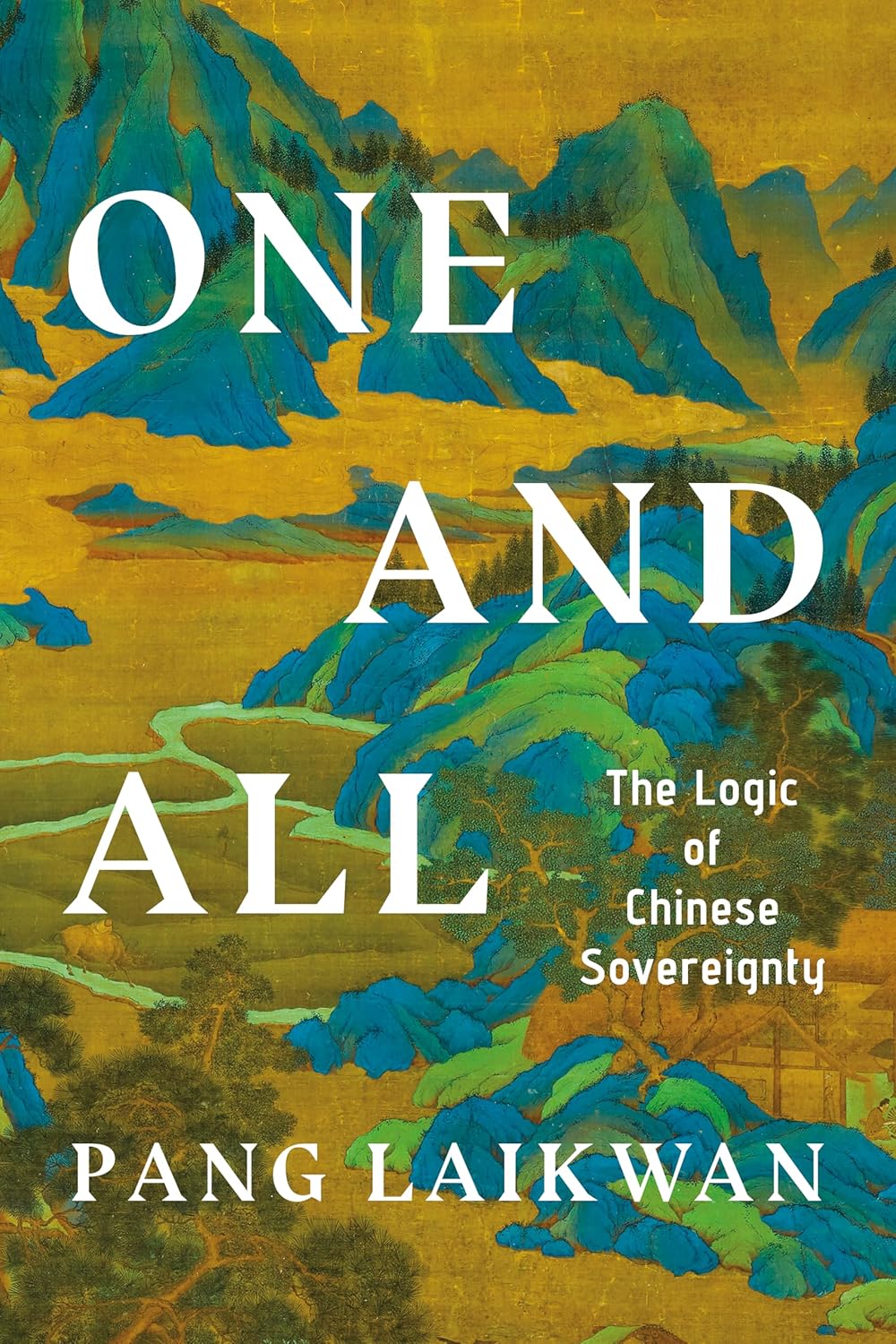
The blue-and-green mountains layer themselves into a loose “Z” shape, with the towering cliff at the top, stretched to the middle ground with flat hills, trailing off to the bottom into huge rocks. Dark green pines grow by the mountains, filling in gaps to catch the wind. In contrast with the metallically bright mountains, the background is a more tender, faded, and plain yellow, grounding the viewer back to the earth. Looking closer, a residential complex blends in between the trees and rocks at the bottom-right corner, where a small human figure resides. On the left, the green melodic curved lines surround the farmland, serving as muddy paths for cattle to take. Caught by the mountains’ grandness and the meticulous depiction of human activities, I was fully enchanted. Only after a short second, did I notice the white letters in the foreground, placed by the mountains.
The book cover of Pang Laikwan’s One and All: The Logic of Chinese Sovereignty can hardly be ignored. The signature, “dazzling” blue-green (qinglü 青绿) style of this landscape painting is known for its reference to the immortal realm and fantastical places. For the cover of a book about Chinese sovereignty, the glowing land looks very different from the two-dimensional, top-down map of China the state uses to claim “sovereignty and territorial integrity” (主權和领土完整) in territorial disputes such as the South China Sea. Cropped from Xiao Chen’s “Valley and Mountains, after Zhao Boju” dates back to the Qing dynasty,[2] and the original painting by Zhao is no longer available. Instead of an image that claims originality and authenticity, Xiao’s painting highlights the reproduction of artistic traditions, and perhaps, of more dynamic circulation of political ideologies in history. At the same time, the mundane agricultural and manufacture activities depicted also speak to the concrete, popular, communal experience of sovereignty that goes beyond territorial jurisdiction. Together, Xiao’s landscape painting exceeds a mere symbolic representation of Chinese sovereignty.
Whether intentional or not, Pang’s thoughtful cover design embodies the main themes and methods of the book. Unsatisfied with merely an authoritarian reading of state sovereignty, Pang foregrounds the often-abstract entity of the “People”, who “will preserve against all odds [and] [deny] any outside power to rule the people” (xii). By focusing on the domestic dimension of state sovereignty, Pang asks, how does the plurality of Chinese people constitute the unity and coherence of the state? How is the state received and reproduced by the people? Aligning with her central philosophical exploration of dynamics between “many” and “one”, this book answers these questions by invoking the current PRC state’s primarily utilitarian sovereigntism—where sovereignty is regarded as a supreme political doctrine—and the ways in which people align with, respond to, and resist state sovereignty. Relatedly, the utilitarian sovereignty enables a level of adaptability and flexibility in the face of different challenges: from ancient, modern, socialist, to contemporary China—a historical approach that denaturalises the current PRC state historiography of a coherent and unified “China”. Instead, looking into cultural representations of sovereignty and their discontents, Pang also highlights concrete moments of de/reterritorialisation from the ground up and present sovereignty as a “state-people-territory-history imagination” with analysis of various genre, including literature, painting, and digital culture (22).
A widely recognised and referred concept now, zhuquan (主权) was first translated and reintroduced to China from Japan in the nineteenth century to articulate modern sovereignty of the nation state. Acknowledging the Westphalian roots of China’s modern sovereignty, as different from the monarchical sovereignty notion of datong (大统) or fatong (法统), in Part One, Pang traces a genealogy of governance and political legitimacy that is “indigenous” to China, as well as Chinese people’s ongoing debates, creativity and potential flourished after encountering the European Other. This section begins with Chapter One’s discussion of the Confucianist and Legalist roots of Tian (天), a core concept loosely translated as the “heavenly order” that legitimises the rulers’ governance in ancient China with divine power. Intellectuals in late Qing and the Republic Era were pressed by the need to modernise, and Chapter Two focuses on the introduction of racialism, a European ideology adapted to create indivisibility against foreign enemies and multiracialism by both the Kuomintang (KMT) and the Chinese Communist Party (CCP). Chapter Three foregrounds the modern PRC’s claim on continual revolution as the foundational and necessary process to restore order for state-building, especially in Socialist China.
Presenting the many forms and development of political legitimacy in China, Part One’s theoretical exegesis does not aim to make an ontological claim of what Chinese sovereignty is or is not. Rather, an awareness of dialectical dynamic persists. The divine and cosmic order of Tian, for example, is understood as “simultaneously unfathomable and easily observed” while both protecting and requesting submission from the people (35). Similarly, as revolutions are intertwined with correcting the cosmic order and achieving statism, the Chinese (revolutionary) subjects are also rendered dialectical: “being both aggressive and amicable facilitates the PRC’s governance to meander between struggles and peace, confrontation and reconciliation, as demanded by the situation”. (96) Later in Chapter Four of Part Two, Pang goes on to discuss how socialist landscape painting embodies “such dialectics between aesthetic universalism and territorial materiality”. (145) Nothing is definite or definitive. It is not surprising to pick up Pang’s frequent usage of “dialectical” in her presentation of these foundational Chinese political concepts, given that dialectical materialism, despite being overshadowed by pragmatism after marketisation, remains the official ideology of the Party State. Pang’s recognition of its significance, however, also explains the consistent vitality and adaptability of China’s state ideology and the recent revival of dialectical materialism by Xi.
Consistent with Pang’s emphasis on dialectics is her caution with possible conflation, an active move against Western oversimplification (along with essentialisation) of Chinese political thought. While she makes basic distinctions between “state” and “nation”, “sovereignty” and “government”, Pang’s sensitivity towards the Chinese language also brings the reader to moments of translation whose afterlife reflects the de-radicalisation of political concepts in the Republic Era. Modelled after Soviet Union’s national minorities system, to distinguish itself from KMT’s Han-centred assimilation, the CCP promised ethnic minorities the right to self-determination. Choosing a unified state over a federation, at CCP’s Sixth Plenary Session of the Sixth Central Committee in 1938, the Party official shifted from self-determination to (zijue 自决) to self-government (zizhi 自治), where national independence of ethnic minority groups are no longer permitted (75). While self-government is often recognised as a manifestation and a critical step for self-determination in the context of Indigenous politics, taking us back to distinction between “jue”(决) and “zhi”(治), Pang points out a more drastic shift from political right to administrative right. The simple change of one character has long lasting effects, enabling the Chinese state to perpetuate settler-colonial violence in the frontier of Tibet and East Turkestan (Xinjiang) while predicting unending resistance and movements of independence from these regions.
Part Two of the book opens up with a similar intervention of “minquan” (民權), a key concept that is part of “Three Principles of the People” (Sanmin zhuyi 三民主義) proposed by Sun Yat-Sen. Challenging the common translation of “minquan” as “democracy”, Pang interprets “quan” as “sovereignty” rather than “power” base on Sun’s own deliberation of minquan to be “the successor of shenquan 神權 (divine sovereignty) and junquan 君權 (monarchic sovereignty).” (113) As a result, Pang offers “popular sovereignty” as the more appropriate translation of “minquan”, concerned more with progressive mass politics rather than a particular political system. Part Two thus unfolds as popular sovereignty is pursued, imagined, and represented. With Sun’s writing on minquan as the ideological starting point, Chapter Four discusses intellectuals’ renditions of genuine popular sovereignty and critiques of impotent political subjects in Republic literature as the Chinese People were expected to become modern citizens. Chapter Five analyses territorial sovereignty which is represented by an integration of Chinese traditional genre of landscape painting (Shanshui 山水, directly translated as “mountains and waters”)and the modern ideology of socialist realism after PRC’s establishment. Pang goes on to discuss economic sovereignty and the economic subject of “garlic chives” that are harvested and sacrificed for the nation’s wealth in the neo-liberal, post-Socialist era.
“Sovereignty” is undoubtedly the golden thread of One and All, in which Pang traces its glimmer, endurance, and bifurcation, weaving together a logical narrative of China’s political legitimacy. Seemingly wrapped together, China’s body is etched with subtle red marks left by tight golden threads. While some applause the threads’ strength, others mourn the wounds. By the end of the book, even with Chinese youth’s “lying flat” resistance against the state capitalistic logic of productivity, the atomic and submissive subject “harvested” for China’s economic sovereignty paints a gloomy picture. Is this result inevitable? The passion, determination, sacrifice inspired by this political ideology—were those all for nothing? If we can easily criticised the contemporary Chinese state, what about those political actors and intellectuals that believe in genuine sovereignty? Or has sovereignty always been a scam?
While China’s current sovereigntism is logical, it is not inevitable. The chaotic but open early Republic era, for example, was the experimental grounds for a Chinese federation where local governments could “self-rule” and perhaps later could coexist (68). Before long, caught between national unity and international collaboration, or more simply, culture and class politics, in the post-independence era when China led the anti-colonial Global South, its decision was historically contingent:
China’s sovereign structure could have been a radically different one if the Maoist ideology had been able to develop into some fruition, where international collaboration was not based on sovereign interests but common political values, where respect for racial differences reconciled with the socialist ideal of equality. (76)
Pang similarly grant this contingency, and more so, agency to state-led cultural production of the landscape paintings:
If these new socialist artworks could be more profoundly materialist—liberating our senses to experience the world anew—they might be able to further open up our sensibility to nature that traditional shanshui has already professed and encourage us to reflect on our sovereign desire to control the environment. (157)
With these “could have been” moments, Pang challenges linear historiography of the modern Chinese state. At the same time, she seems to be implying that genuine federalism, Maoism, and materialism still possess political potency for radical alternative modes of sovereignty if they have been followed through.
Pang’s comment on cultivating sensibility to nature through Socialist national paintings specifically suggests a different relationship with land, which has been reduced into “land-scape” by the aesthetic genre. This reflection reminds one of indigenous notions of sovereignty, which often emphasises “protect[ing] the land and the relationships to it…” and is “incompatible with…territorial control for the purpose of exploiting the land as a resource” compared with the Westphalian notion of sovereignty, which China is widely understood to have adopted.[3] As Pang is aware of notions of indigenous sovereignty and community sovereignty, I wish she had spent more time analysing the role of land plays in articulating Chinese sovereignty—in literature, poetry, songs; at the grassroots level, from an urban planner’s view; as resource, commodity, or genuine home…What does it mean when China is a land that grows “garlic chives” instead of sustenance food? Following Pang’s critique of the missing materialism in landscape paintings, I also wonder how the transforming materiality of China’s land has articulated its sovereigntism differently. In what ways are Chinese people materially removed from land as they were absent in the landscape paintings? What becomes of the national landscape now, given that China is more and more defined by infrastructure constructions? Other than painting “more profoundly materialist” landscapes, what other ways can we inspire true love for the land, and genuine sovereignty that remain faithful to anti-colonialism and anti-imperialism?[4]
An attempt to answer the last question also suggests that perhaps logic alone cannot fully capture the sense of contingency and genuine moments of radical politics described by Pang. As mentioned, Pang’s frequent usage of “simultaneous”, “also”, and “both…and…” embodies a generous grammar that deconstructs false dichotomy that is necessary. These grammatical intricacies and necessary clarifications correspond to Pang’s intention to delineate a logic of Chinese sovereignty—not just ideologies, discourses, representations—but logical rhetoric fortified by ongoing creative cultural representations. However, this rhetoric is compelling to the People not only because they are logical and smart, but also because they possess affective forces. Pang herself states that “revolution often provides some ‘authentic’ moments of sovereignty, when the participants encounter an intense experience of presence, connection, and solidarity”. (102) I would like to believe that such intense experience happens more frequent than we think, even in the static and conservative consolidation of state sovereignty. While not explicitly pointed out, Pang’s decision to have Part Two dedicated to cultural representations speaks to the affective component of perpetuating political doctrines. From disappointment in Chinese people’s unpreparedness for modernity, a sense of awe when viewing the sublime mountains and rivers on the painting, to humour and self-ridicule from the “garlic chives” through internet memes, these aesthetic texts not only represent but also produce a sovereigntism that is articulated by spontaneous feelings, senses, emotions, and desires. We are inspired to notice these moments of genuine experience of sovereignty in order to imagine and mobilise changes.
Pang’s One and All is undoubtedly a well-executed book and fruitful read for its rigorous engagement with Chinese political theory and outstanding trans-disciplinary, multi-media analysis. Though focusing on one main concept and a particular context—sovereigntism in China—Pang’s book has global implications. As suggested in her conclusion, other nations are invested in increasingly restrictive (and racist) immigration control and obsession with national security, as sovereignty possessing masculine, suffocating, unnegotiable power. Pang not only traces China’s state violence—both domestic and abroad—to a longer intellectual, political history, but also points out the similarities shared among other world powers, despite their position as “China’s rival”. This is perhaps the moment when Pang loses faith in state sovereignty, after all. In the conclusion, and several other places throughout the book, she yearns for the global commons, especially as we face planetary challenges that requires collaboration rather than competition among countries. While the reference often comes rather abruptly and not properly expanded, Pang does open up the important conversation to reconsider sovereignty beyond the nation-state level. As Pang provides us the historical, and at times radical, earth China’s state sovereignty is rooted in, the challenge to imagine genuine sovereignty for the grassroots, the people, communities has just begun.
[1] Noelani, Goodyear-Kaʻōpua, Ikaika Hussey, and Erin Kahunawaikaʻala Wright, eds. A Nation Rising: Hawaiian Movements for Life, Land, and Sovereignty, Narrating Native Histories, (Durham: Duke University Press, 2014), 3.
[2] Princeton University Art Museum, “Valley and Mountains, after Zhao Boju (擬趙千里荷鄉清夏),” n.d., https://artmuseum.princeton.edu/collections/objects/22783
[3] Harald Bauder and Rebecca Mueller, “Westphalian vs. Indigenous Sovereignty: Challenging Colonial Territorial Governance,” Geopolitics 0, no. 0 (May 5, 2021): 1–18. https://doi.org/10.1080/14650045.2021.1920577.
[4] The expression “genuine sovereignty” and other usage of “genuine” in this review is inspired by the notion of “genuine security” by International Women’s Network Against Militarism, which challenges the militarised notion of “national security.” I was also told by an organiser that, during a Lā Hoʻi Hoʻi Ea celebration in Hawaiʻi a few years ago, “genuine sovereignty, genuine security” was seen on an event flyer.
How to cite: Su, Kaiqing. “Quest for Genuineness: Pang Laikwan’s One and All.” Cha: An Asian Literary Journal, 30 Jul. 2024, chajournal.blog/2024/07/30/one-and-all.


Kaiqing Su (she/her/她) was born and raised in Guangzhou, China. Currently, she is a doctoral student studying in the Political Science department at the University of Hawaiʻi at Mānoa. Her research focuses on the ways infrastructure development transforms human-environment relationality by attuning to the materiality of the more-than-human with a focus on China’s presence in Pacific Island countries. She is generally interested in critical cartography, politics of translation, historiography, and decolonisation. Residing in occupied Hawaiʻi for three years now, she is also active in local labor union organising and demilitarisation movements.
 Cha
Cha 